
Welcome back. I’d like to jump right in: today, I’m talking about anxiety, and sharing the strategies I employed to overcome it.
Yes, I’m speaking in the past tense. This will already bother some of you.
Permit me a brief rant, for the sake of framing the proper perspective with which to consume the advice that is soon to follow.
In our current social climate, in our current climate of social discourse, we talk about problems as being lifelong companions that we have to “manage a relationship with.”
What I hear less and less often is talk of actually solving problems.
Well, let me qualify that: I quite often see wildly hyperbolic click bait headlines on YouTube thumbnails along the lines of
“Try this for 15 minutes and you’ll never struggle with procrastination again.”
But when you watch videos like that, you usually find a generalized strategy filled with caveats and disclaimers: no one is really promising you the moon.
What they seem to be promising, actually, is a robust new social identity as someone “living with X.” For example,
I read a book about fixing my handwriting, and it leads you to believe that you need to be writing out the letter J for an hour a day if you want to cultivate self love (no, I am not joking). The author, at one point, casually mentions that she’s been working on the letter Y for 20 years.
Why this raising of the hurdle, rather than lowering it? Isn’t that what help with a problem is supposed to mean? Not when you’re being sold advice by people who are trying to make a career out of marketing their content. They’re looking for subscribers, followers, and students. In other words, lifelong customers.
What the pharmaceutical industry has done to illness is exactly what the content industry, the “attention economy” has done to confusion and indecision: made it into something more profitable to “manage” than to solve.
I’ve dug up a larger topic than either of us want to exhaustively explore right now, but I think you see what I’m getting at here:
Problems do have solutions. Anyone who tells you otherwise is selling renewable purchases.
As I go on to discuss a three layered approach for combating anxiety, then, always hold a clear destination in view: we’re not heading into the labyrinth of “working on yourself.”
This is continuing education: you have workable skills, but they’re limited. Better skills make you less limited, and expand the scope of your days and years.
The methods I’m about to impart, then, might require intensive focus and a large amount of time at first, if the problem is acute, but should reach a state of occasional maintenance once you’ve righted the ship.

Layer One:
Learn to see anxiety as your (error prone) friend.
Anxiety is something you have. It is not an event happening to you. You are not a victim of it. We evolved the capacity to feel anxiety so that we could manage risks. If we couldn’t feel pain, we wouldn’t know to withdraw our hand from the stove, and yet our skin would still burn. In exactly the same way, the person who feels no fear or anxiety is no less at risk just because he or she doesn’t perceive it.
In this way, anxiety is here to save your life the same way the pain receptors in your skin are here to save your hand.
So, anxiety is your friend in the same way that pain is your friend. But, as I mentioned earlier, our friend is prone to error.
According to Randolph M. Nesse, in a 2022 article for Evolutionary Psychiatry: Current Perspectives on Evolution and Mental Health, natural selection makes valuable features essentially impossible to “debug.” With all of our heritable traits, we cannot stop, wipe the slate clean, and begin again. We can do nothing to refine features and eliminate bugs. Natural selection is bound up with maximum gene transmission: all our traits are vying for renewal. Heritable traits don’t improve in response to environmental factors to which they are totally blind.
Your body thinks your life is in danger when really you’re just uncomfortable at a cocktail party with the friend group of your new girlfriend, or you’re late for work, or you can’t find your headphones and the Uber is leaving soon, or your apartment is cluttered, or your finances are a mess.
In all of these examples, anxiety would be maladaptive or simply pointless.
I am no stranger to feeling anxious. I know what it feels like to have nerves that won’t settle, a sense of safety and belonging that never arrives, and a need to fill the empty space with words, steering a moment rather than letting it be.
If this is something you struggle with on any kind of ongoing basis, meaning if you’re prone to suddenly having a freeze response, shortness of breath, elevated heart rate, jumpiness, and feeling unsafe, and you know that there is no real threat to you,
Then do what I did: tighten all the loose screws. Go through your life from top to bottom, and
Deepen what is shallow,
Strengthen what it weak,
Organize what is cluttered,
Systematize what is random,
Take inventory of what is uncounted.
Start with the big three: food, sleep, exercise. I’ve said plenty about all three of these, but here’s the bare bones minimum version of my advice, which I follow:
Sleep for 7.5-8 hours a night.
Walk as often as you can, ideally 30 min a day.
Eat single ingredient foods 80% of the time.
Until you can learn to respect your body, you don’t deserve to be free from its constant warnings. You need to heed its warnings and alter course. That’s step one.
Step two is to spend a few minutes cleaning and decluttering every day. Listen to podcasts or music while washing and putting away dishes, throwing away paper, filing paperwork, folding laundry, cleaning desks and sinks and mirrors.
Now your body is less angry, and your mind is less angry because your home environment is orderly, and conducive to thought.
Now that you’re handling these things, explore other areas of your life that need to be resolved into a system.
Every week, do a brain dump into a doc or a sheet of paper of everything currently unresolved in your life. I promise you, they all matter. Identify them, make plans for dealing with them, and put those plans on a time table.
A good rule of thumb: try to do one thing every day that you have resistance toward doing. The resistance is what’s stopping you, but not overcoming resistance is causing the anxiety, which cannot be overcome. The cause must be removed. Every time, no exceptions.
Over the next several months, your anxiety will go down. You’re getting your life together. It should feel good, and it does.
That’s the first layer. Walk around the perimeter of your life and reinforce the borders. As it says in the Tao Te Ching, “the man who knows how to live…has no place for death to enter.” Do you leave openings for disaster in your life? That might be why you have anxiety. Set those aright and watch the bad feelings diminish.
Essentially, you feel anxious because you feel threatened by something you don’t feel strong enough to confront. You need more confidence. Confidence makes you inclined to confront your troubles, rather than run from them or play dead.
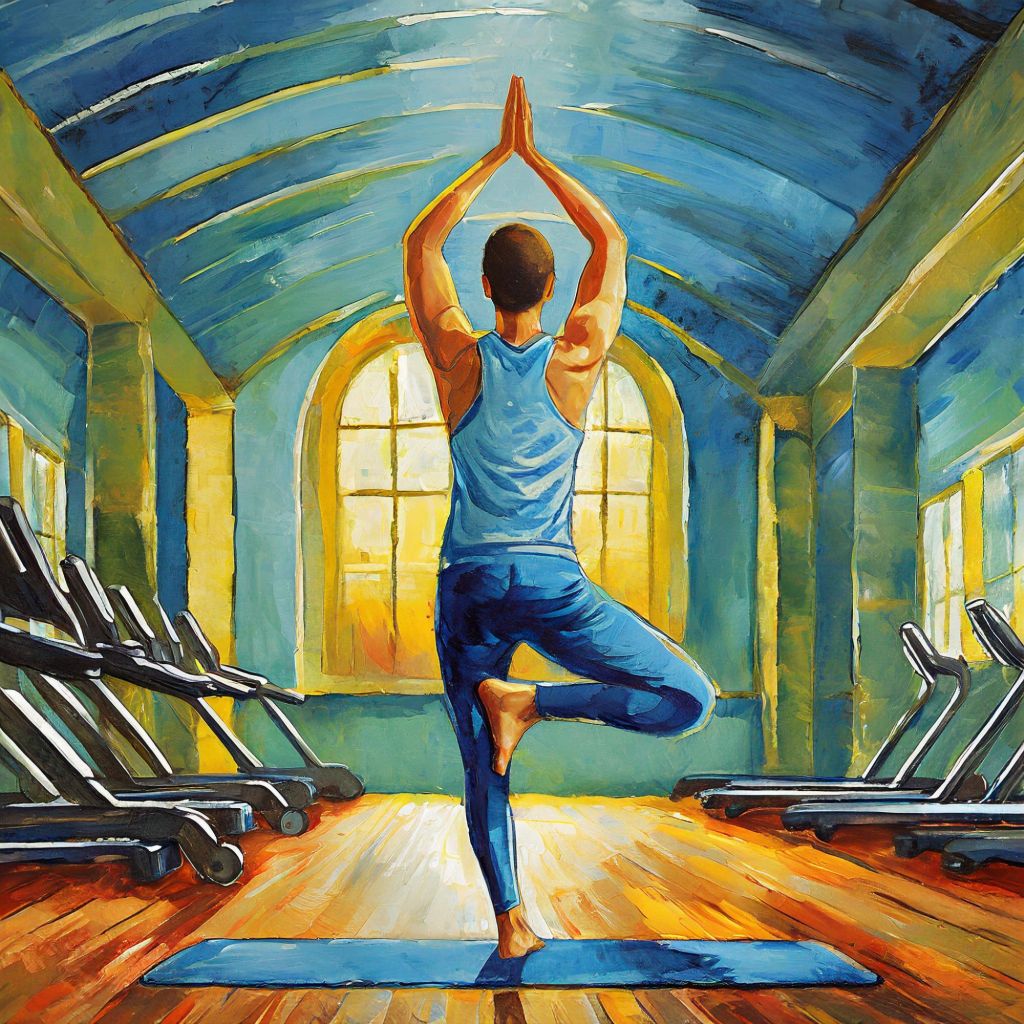
Now we go to the second layer, which is more targeted at the level of your body.
Breathwork, stretching, vigorous exercise, and exposure to heat and cold.
Strenuous exercise like calisthenics or weightlifting helps the body to break down excess stress hormones, increases the production of endorphins, increases energy and alertness, and has been proven to significantly reduce anxiety if made into a regular practice.
Stretching reduces muscle tension, increases blood circulation, increases serotonin levels, and helps with lymphatic drainage. It improves sleep quality.
Long deep breathing reverses the state of fight or flight response, lowers the heart rate, lowers blood pressure, reduces lactic acid, balances oxygen and carbon dioxide levels in the blood, improves the immune system, and improves mood and general well-being.
Taking a cold shower for just 2-3 minutes can improve circulation, lower perceived stress, raise immunity, diminish depression symptoms, help with muscle soreness, and improve alertness.
Sitting in a sauna for 30 minutes lowers cortisol levels in the blood (the stress hormone) by as much as 40%, insulates the brain from stress-induced harm (by promoting BDNF levels), has an immediate antidepressant effect, and increases endorphins (just like weight lifting).
How frequently should you do these activities?
You can and should stretch daily. Five minutes after waking, five minutes before bed. You can do more, and more is better, but five and five is fine.
Ditto for deep breathing. A modest daily practice beats inconsistent marathons.
You can take a sauna and a cold shower seven days a week as well.
Weight lifting is different. I did 6 days a week for about a year, began regressing, and gradually scaled back to one session every five to seven days. I made a lot more progress that way, because my recovery capacity had a chance to build back up. Now I’m back to three days per week. Start slow and find what works for you.
My routines with all of these have varied over the years, but these activities, especially having all of them in your life on a weekly basis, are life changing. They will utterly transform what it feels like to live in your body. The brief feelings of discomfort that come with all these activities is a small price to pay for the feeling of being able to handle whatever comes my way.

Lastly, and this is our third layer, I want you to tackle anxiety by broadening your behavioral repertoire. You freeze up for two reasons, which are closely related but not identical: you don’t know if you can handle what’s coming, and/or you don’t know what to do.
To put it in perspective, I do everything in the first two layers, and that doesn’t mean that I magically know what to do all the time.
Weight lifting and decluttering and eating simple food does not endow me with the knowledge of how to fix a tuning issue with the bridge of one of my guitars.
What they endow me with is the predisposition for action, rather than avoidance. I’m more inclined to Google something, call the manufacturer, search for a YouTube walk through, or simply jump into motion in the assumption that the next steps, the proper solutions, will reveal themselves simply by engaging with the problem (they quite often do).
So, your homework is twofold:
Start by making lists.
Create a numbered list up to 25. Write a pertinent “what can I do about X” question at the top. Populate the list.
Examples:
What can I do when a conversation seems to be stalling out?
What can I do when I feel off track?
What can I do when I can’t think straight?
By the time you get to 25 legitimate answers, you should be excited to try them all out. Instead of feeling like you’re out of ideas, frozen in place, you now have 25 ways to choose your own adventure.
The second part is simpler:
Ask yourself, when you feel anxious: what would a perfectly normal person do right now? Notice how you immediately had an answer? The mistake everyone makes, aside from not asking the question to begin with, is assuming the answer that comes to mind couldn’t possibly be good enough. While someone else, including your own future self, might have better answer, this is the answer you have to work with now.
So, work with it.
Prove to yourself that you can summon from within yourself something that is good enough.
You can do this. You can decide on a way forward, implement it, and put the current scenario behind you.
To summarize before closing, I’ve put forth a three pronged approach, each building off the other.
Firstly, we need overall stability and health. Fix your sleep, fix your diet, and get moving every day. Attack clutter on a daily basis. Then attack “clutter” everywhere in your life. It always takes a lot of work at first, and eventually very little at all to maintain it.
Secondly, we dive deeper into your ability to manage anxiety at the physical level. Weight lifting, cold showers, hot saunas, stretching, and breathing deeply. You need at least two of these on a routine basis. Frankly, you need lifting and stretching no matter what. The other three are for people who really enjoy being nice to themselves.
Thirdly, now that you have the capacity, the self credibility, and tenacity, attack your inability to take action, and concurrent tendency to freeze, are the local level: specific to the problem at hand. While you’re at home, feeling calm and collected, brainstorm 25 ways to deal with a specific problem. When you’re in the moment, simply ask yourself “what would the person who knows what to do be doing right now?” Lo and behold, you do know.
Put all of this into practice, and it is very hard to feel like a victim anymore. When you know you have your life together, and you feel physically strong and healthy, and know how to break through the fog of inaction, it is very difficult to feel anxious. When it arises, you know it is a signal originating within yourself, not a disaster happening to you.
Thank for you reading, talk to you soon.
-Jas

 Make Beautiful Choices