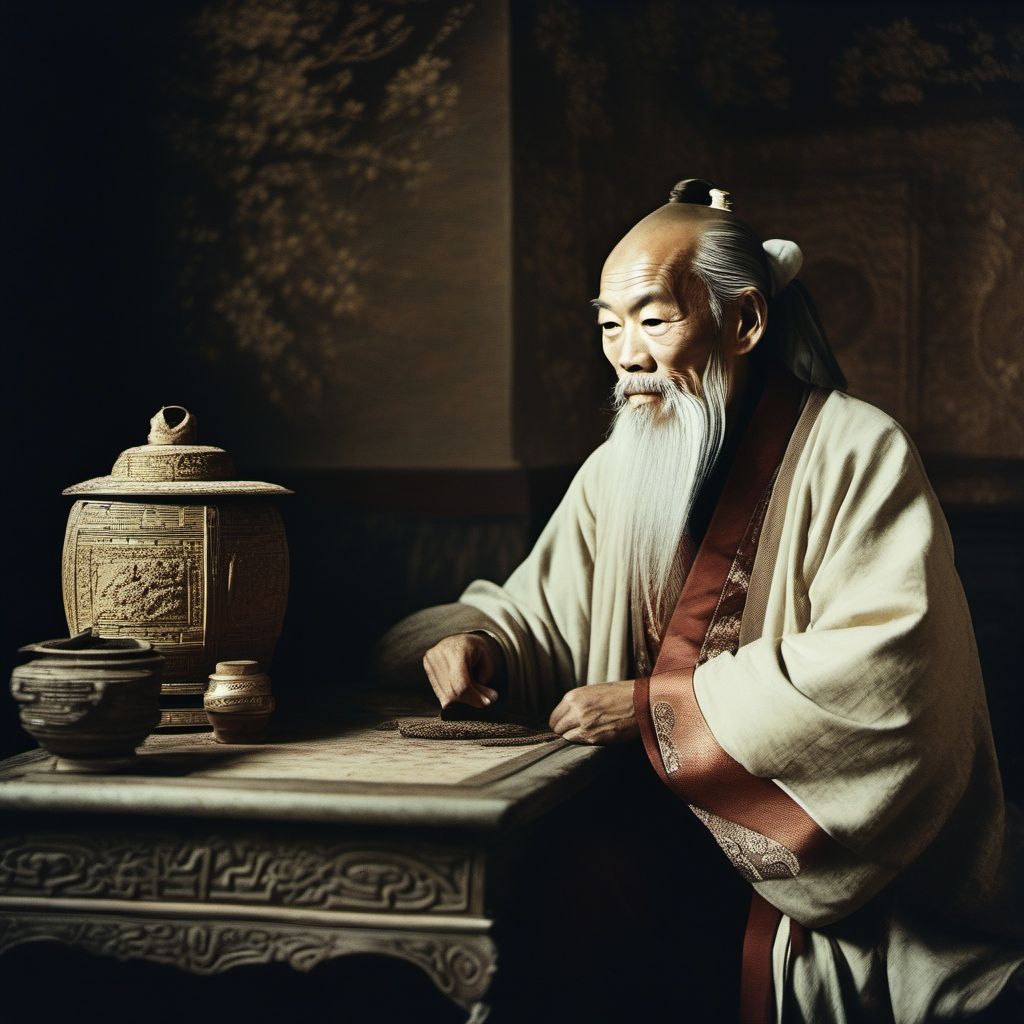
“Eastern philosophy.” Oh, boy. Here we go.
In keeping with my perennial theme of weeding out non serious people by referencing books like The History of the Peloponnesian War, or using terms like Episodic Future Thinking, today’s topic is similarly weighty, if not vastly weightier:
The Tao Te Ching.
Right away, I’ve confused some of you. Yes, the “Ts” are both pronounced “D.” No, I don’t make the rules here. No, you cannot speak to a manager.
The Tao Te Ching is the foundational text of Taosim, attributed to Lao Tzu, a man who lived in ancient China roughly 2,500 years ago, supposedly a contemporary of Confucius, who, legend has it, declared that Lao Tzu was “a dragon.” I will grant the presumption that Confucius was speaking figuratively.
I was introduced to this text, oddly enough, during my freshman year of high school. We did Chinese history, of all things, during our first semester. The only thing I remember from the course, however, was reading and becoming instantly enamored with the Tao Te Ching.
It was wise. It was cryptic. It was insightful. It was laconic. It seemed to be animated by an effortless mastery of life and all it’s governing and competing forces, seen and unseen: whoever it was who wrote this ancient text clearly got it – the ability to define, with the appropriate subtlety, the scope of what can and cannot be said, what can and cannot be known, and the best way to convey both without inviting a two dimensional reading.
Many years later, in 2022, I came back to this book with more than a casual interest: I set myself the goal of memorizing it, which I achieved in 162 days. For several months after that, I would repeat the entire text, out loud or silently, every day.
Sometimes I did this in one sitting, like a ritual to start the day. Other times I would do it in batches, grouping the 81 chapters into 3 groups of 27. Sometimes I would use a random number generator to prompt me to do the chapters out of order.
Why did I do this?
One word comes to mind: wisdom.
I knew that wisdom was in the text, in literally every stanza, and I also knew that I was unwise. I knew I was unwise, and I also knew that something rash had to be done to disabuse me of my lingering arrogance, immaturity, selfishness, willful blindness, moral weakness, and my willingness to disappear when holding the line was inconvenient.
I had to straighten out my life, and become someone solid and sincere all the way to the core. And, I knew that hammering in these exact words, until they could be recited verbatim without glancing at the text, would set me on that path.
So, I memorized one chapter every two days, learning 81 chapters in 162 days. Then I set about making sure I had all of it rock solid, backwards and forwards.
I have better things to do than spend all day complimenting myself, but I do feel grateful to my previous self for conceiving and executing that plan. It changed my life for the better, and set in motion many of the changes that have brought me to where I am now, which is a place in which I’m happy to be.
What I’d like to do today, then, is take some lines from the text and elaborate upon them. Why? Because wisdom is what we are after in life. Having it makes everything better, but lacking it makes everything worse. In many ways, your life is only as good as you are wise.
No situation is so bad that it cannot be redeemed by wisdom, and no situation is so good that it cannot be brought to ruin by ignorance. I have seen both take place, by my own hand, and so I know what I say when I speak this way.
In many ways, this entire project being undertaken here could be reduced to the following goal: to make wisdom more attractive. Let’s see how we do today.
In light of the above “mission statement,” let’s start with Lao Tzu’s first protracted description of a wise sage, which constitutes the entirety of chapter fifteen.
The ancient masters were subtle, mysterious, profound, responsive.
The depth of their knowledge is unfathomable.
Because it is unfathomable, we can only describe their appearance.
Watchful, like men crossing a winter stream.
Alert, like men aware of danger.
Courteous, like visiting guests.
Yielding, like ice about to melt.
Simple, like uncarved blocks of wood.
Hollow, like caves.
Opaque, like muddy pools.
Who can wait quietly while the mud settles?
Who can remain still until the moment of action?
Observers of the Tao do not seek fulfillment.
Not seeking fulfillment, they are not swayed by the desire for change.
When I say there is a lot here to think about, I say it as someone who repeated, and dwelled upon, and summoned up those words on a daily basis for probably over 365 consecutive days.
He is telling you exactly how a wise person behaves, and appears to a “normal” person like you or me.
Let’s go through it one line at a time, which is how I memorized it in the first place.
The ancient masters were subtle, mysterious, profound, responsive.
Note the way he intentionally places the image of the wisest of us in an undefined point in time – “ancient.” This is no accident. It is effective to think of the ideal as something abstracted from our daily life, suspended in a “somewhere out there.” So, he makes it clear that these were real people, but that their time has long since come and gone.
This is not trivial. Were he to frame the ancient masters as angels, it would only reify the idea of an afterlife. That is not the project here. An exceptional human is a viable role model that we can be moved to emulate, while supernatural beings represent an unattainable level of perfection: we can only submit to them in our inferiority.
Subtle, mysterious, profound, responsive.
The meaning of the first three adjectives is expanded considerably by the fourth. “Responsive” suggests that the subtlety, mysteriousness, and profundity is all a measured response to events unfolding in the present. The ancient masters are not withdrawn into an unseen world to which we have no access: they see the same world we do, are party to the same events, conversations, and relationships.
Again, they are not from an afterworld, nor have they sought refuge in one. They have mastered the real world. Our world.
The depth of their knowledge is unfathomable.
Because it is unfathomable, we can only describe their appearance.
To someone who has never eaten an apple, your knowledge of apples is unfathomable: no words can possibly impart direct experience, and the understanding that springs therefrom. What we can do, however, is look at the way people who have a specific form of knowledge seem to behave differently from those who lack it. Before disease could be defined, for example, an unhealthy person could be observed.
Watchful, like men crossing a winter stream.
Alert, like men aware of danger.
Watchful and alert. Treat this like an elaboration of the previous “responsive.” The sense of high stakes is important: treating everything like it matters. Nothing is casual – there is a difference between right and wrong, because there is a difference between safety and danger. There is a difference between crossing a winter stream and falling into it, the latter being potentially life threatening.
I take this to mean that all actions are undertaken with the awareness that mistakes have consequences, and that no consequences are trivial.
Courteous, like visiting guests.
Yielding, like ice about to melt.
The similes are so informative here. Let’s break them down to a level that is almost pedantic.
A visiting guest is not necessarily a friend or neighbor or relative, but an outsider who has temporarily come into the private space of someone else. Etiquette is how trustworthiness is communicated, and there is no place for overfamiliarity. When the encounter is over, each will return to his or her own life, of which neither other person is a part.
Why laboriously spell this out? Because it is the easiest thing in the world to forget that other people are sovereign over their own lives, and every encounter we have with other people is like momentarily becoming a guest in their presence.
A wise sage is someone who observes rules of etiquette and behaves courteously, because it brings out the best in his host. It reminds us all of the distance between us, making us more conscious of how we present ourselves.
Seeing others as outsiders to our lives automatically puts us in the role of representatives or ambassadors.
“Ice about to melt” is one of those many unforgettable lines that fill the text. About to melt – not melted! Not a pushover, not formless and in a state of unquestioning acquiescence, but about to melt. Solid, but not rigid. An ice cube resting on a surface that can be easily moved when force is applied.
Resistance only invites greater force. To yield is to make the continued application of force unnecessary. However, yielding does not equate to “capitulating.” Think of the difference between considering a request and granting it. To reference the previous line, a guest is not a slave! And yet a guest is not a master either. To walk this line at all times is to have self respect and the appropriate level of consideration for others simultaneously.

Simple, like uncarved blocks of wood.
An uncarved block is the inverse of the unmelted ice. An uncarved block has not yet acquired a shape that will both determine and limit its future use. It is a symbol intended to convey unrealized potential, and the flexibility to steer that potential toward the appropriate ends. The knowledge of the appropriate end to which one should direct his or her potential is only available to someone who is totally present to what is happening in the moment. The ability to become what one must in the face of reality’s demands is to be simple, but by no means simpleminded.
Hollow, like caves.
Opaque, like muddy pools.
I take these lines to mean that a wise sage is not harboring some private inner world, but is an empty vessel into which the reality of each moment can effortlessly flow.
Fair enough, you say. But why also “opaque?” Because you cannot peer into the mind of a sage. In this case, outer behaviors are not windows into something deeper. They are what they are. The sage’s behavior does reveal something: the subtlety of the situation at hand. It reveals nothing, however, about the sage’s “motivations.” The sage’s motivations are to live in reality: reality is the determinant of activity, not “motivations.” Thus the sage appears opaque.
Who can wait quietly while the mud settles?
Who can remain still until the moment of action?
These questions are immediately answered by the concluding lines,
Observers of the Tao do not seek fulfillment.
Not seeking fulfillment, they are not swayed by the desire for change.
Meaning that people do what they ought not to do, which is to act prematurely and incorrectly, because they are swayed by the desire for change. If you can accept the situation for what it is, you can do what must be done. If you cannot do this, then your actions will be driven by a self centered search for fulfillment.
Observers of the Tao, which simply means people who live correctly, do not seek fulfillment. Why not? Perhaps they are already fulfilled. They understand their own needs, and are capable of fulfilling them without imposing on others, or in ways that conflict with other pressing matters.
I want to close by elaborating on this.
When you know you are strong, your strength is available to help others.
When you are unsure of your strength, you want to prove it by defeating others.
Fulfillment, self confidence, accomplishment, the private cultivation of virtue – these allow you to remain still until the moment of action. Again, why? Because your worth is not at stake in each and every situation. Your worth has been built up, and power can now be expended and expressed toward worthy ends that become self evident to opened eyes with nothing behind them.
Imagine how you might conduct yourself if you were not swayed by the desire for change. Imagine what you might do, and, equally important, what you would have the power to cease doing, if you were freed from the pursuit of self fulfillment.
How do I free myself from this, you ask?
Start by contemplating the gap between your qualities and the sagely qualities described above. This is what I did, what I still do. You close the gap by staring at it, acknowledging it, and aiming for what you can glimpse on the other side of it.
Daily, hourly, one moment at a time.
Thank you for reading. Talk to you soon.
-Jas

 Make Beautiful Choices