Well, it’s confession time.
From time to time, and sometimes on a daily basis, I like to indulge in something the kids today colloquially refer to as “nerding out”
(If you found that verbage to be “tortured,” just know I also like to indulge in “torture”).
I recently finished reading the 4th of 4 books I’d picked out some time ago, all on the subject of turn of the century Paris and Vienna.
Specifically, I read Jannick and Toulmin’s Wittgenstein’s Vienna, Carl E. Schorske’s Fin de Siecle Vienna: Politics and Culture, Roger Shattuck’s The Banquet Years, and Roger Herbert’s Impressionism: Art, Leisure, and Parisian Society.
They were filled with profound insights about history, art, music, theater, human psychology, politics, and European culture in a broad sense.
The period of history documented by the 4 texts, each from markedly different angles and academic disciplines, was the transition into modernity as we know it.
From the hegemonic rule of the aristocracy to the cultural pluralism of the ascending bourgeoisie.
From a culture of ever increasing embellishment and ornamentation, to the point of obscuring the facts of a news story or even the functional purpose of a household object, to a sweeping movement in Spartan minimalism and curt, modern essentialism.
Whereas meaning was once concentrated in history, religious scripture, mythology and parables, it was suddenly available right here, right now: in depictions of street performers, in nubile ballet dancers being prepared for their auditions by their hunched, working class mothers, in the blank faces of people adapting to rapid urbanization, and in the rising black and gray smoke of trains and factories commingling with clouds in otherwise blue skies above verdant rural landscapes – similar in appearance but divergent in import.
Whereas art once strove to uphold an aspirational picture of humanity, it now began to critique, to relish the nonsensical, the absurd, the irreverent, and even the boring.
These were the ways in which the world was changing from, say, 1850-1915. The florid half-truths of Romanticism were drawing to a close, and stark geometry of modernism was setting in.
For those of us who have, in recent years, begun to ponder, often vexedly, how we got here, how our world came to be what it now so undeniably is, I recommend all of these texts: I wanted answers, and I found them.
What constitutes the bulk and the remainder of this article, then, are some of the major insights gleaned from each of these texts. These are all pieces of a puzzle foisted on me by my own inborn interests and unique path through life: they may mean something similar or totally different to you, and that’s part of what makes them worth sharing.
The Banquet Years
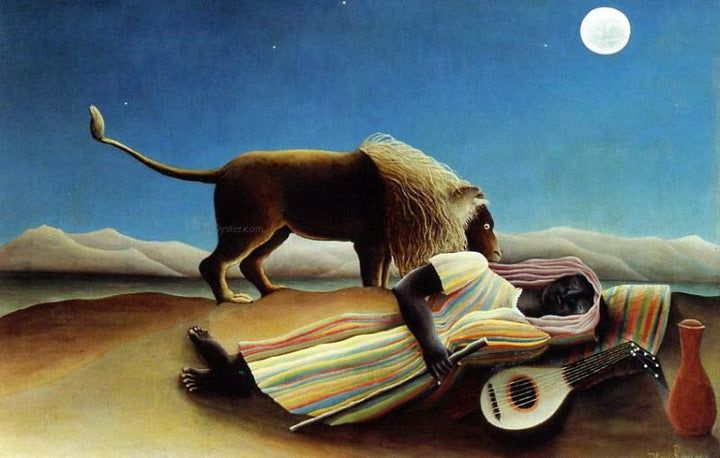
Roger Shattuck’s masterful text chronicles the origins of the French avant garde movement through the lens of four major figures: Henri Rousseau (a painter), Erik Satie (a composer), Alfred Jarry (a writer), and Guillaume Apollinaire (poet, playwright, and impresario to the Avant Garde). The four are each given a two part treatment – first, a biography, and second, a rigorous analysis of their work and their contribution to the overall cultural climate.
When I think about this book, what comes to mind?
The death of novelist Victor Hugo in 1885 left a kind of vacuum of power in the vanguard of French culture. The prevailing sense, at the time, could be summed up with the question “now what?” The last titan of the Romantic Era had died, and the movement, or movements that would eventually follow it had not yet materialized.
The Banquet Years chronicle a time where the arts were in a state of arrest – like a wildly creative and also rambunctious child waiting in daycare between the end of the school day and the arrival of his mother. The innovations of the four artists explored by Shattuck are innovations born of directionlessness:
Erik Satie constructed a photo album, so to speak, of short, baffling works for piano that sat in singular moods rather than undergo development. He was neither as emotive as Ravel or as fantastical as Debussy but was, rather, best described as quaint. At times melancholic, enigmatic, poignant, and even sinister, the pieces nonetheless go nowhere. Satie’s unique triumph is that he is unafraid of the boredom that pervades his music: he doesn’t reach for greatness, but is content where he is. Before Satie, you were at least expected to pretend to be reaching for the stars, even if you had none within you to guide you on.
Similarly, Henri Rousseau’s paintings show a flattened, cartoonish, and also slightly alien world. Beautiful, bewitching, mysterious, but also hard to take seriously, he doesn’t dive deeply into the moment like Degas nor does he totally withdraw into the imagination like Dali – as a visionary, he is lazy. As an iterating craftsman, however, he is industrious. Shattuck describes him as having found his mature style early on, preferring to perfect it rather than subject it to evolution. Again, as with Satie, the theme of arrest, stillness, and rumination.
In what ways did these observations contribute to my own intellectual and artistic growth?
Reading The Banquet Years introduced me to a number of important ideas.
There are many ways to develop, or even to refuse to develop, an idea. Development can be shown from a thousand feet or in an extreme closeup. You can simply get better at the things you like to do and do well, and that’s ok: you do not have to be driven by ideas of or pretensions to greatness. The idea of being free to play with and toy with a concept should always be available: it has to be acceptable to be momentarily aimless. The keyword being momentarily: briefly, and sporadically. Like the subjects of the Banquet Years, you may find yourself at not a deadend but a red light, and in those moments you should know how to daydream, lest you go mad.
Impressionism: Art, Leisure and Parisian Society
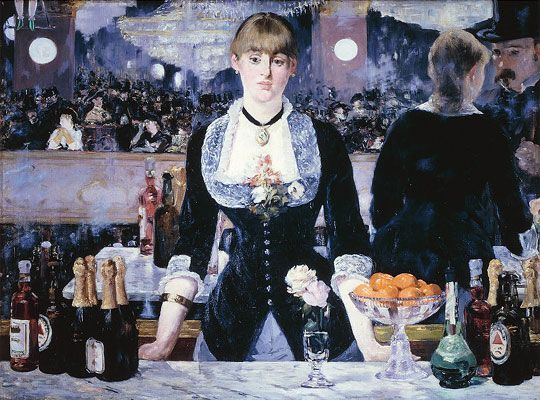
Yale Professor Robert L Herbert taught this material for thirty years before writing this book, and thus delivers us the distillation of a lifetime of scholarship and teaching experience. It shows on every page. Rather than progress chronologically from the 1860s to the mid 1880s, the book is organized by different domains of life: the racetrack, the opera, the ballet, boating, seaside resorts, and so on.
Between 1850 and 1880, Paris underwent extensive structural changes that can best be described as the process of urbanization: it went from a medieval city to a modern city. The population tripled in a 30 year period, not from a “baby boom,” but from adults relocating. This had vast implications for every social and economic strata of society.
Herbert shows us how these changes were rendered on the canvases of, essentially, the big 4: Claude Monet, Pierre-August Renoir, Edouard Manet, and Edgar Degas (with only occasional mention of Morisot, Corot, and Caillebotte).
What are the big ideas and life lessons that I drew from this book?
Firstly, an entirely newfound appreciation for the craft of painting. These days, one could hardly be faulted for failing to think about the simple fact that, before photography, the painting was the primary visual record of the world. Everything is constructed by hand: the shapes, the colors, and sense of shadow, depth, proportion, perspective: it is all manufactured by the skill of the painter. Therefore, when looking at the work of a master, every aspect of a painting represents a decision that reveals something important about the painter himself, the presumed audience of the painting, and the actual objects or events depicted on the canvas.
Herbert does a great job of showing how the various socioeconomic conditions of the painters show up in their depictions of their subjects.
Renoir is fond of showing us smooth, glowing, almost cherubic faces exuding pacific tranquility. Herbert notes that Renoir is incapable of irony: he renders people as though they were actually angels, and he was arriving at last in heaven.
Monet also wants us to see a beautiful and beautified world: he idealized the new vision of Paris and its suburbs put forth by Haussman’s renovations, and uses the calculated geometry with which his world was being reorganized as the basis for his own compositions: a subtle endorsement of the changes sweeping the country.
Both Renoir and Monet were what you would call struggling artists, and they looked up at the Parisian leisure class with aspiring eyes, almost devoid of critique.
Manet and Degas, however, were both well to do and thus had not only greater access to but very different perspectives on Parisian society. There is more psychological depth, almost as a rule, with the two of them when compared to Monet and Renoir: we see real people, with their resentments, perversions, vices, pretenses, and also their elegance, sophistication, and worldliness. They are insiders, so to speak, and they are eager to tell us “how it is.”
Simply compare Renoir to Degas in their rendering of the ballet: beautiful aristocratic women leaning over the balconies on the one hand, and rich, fat, balding men waiting in the wings to receive the dancers backstage, on the other. In a nutshell, that is the difference.
What was I left to ponder?
Urbanization caused quick and drastic changes to the way people lived their lives: rather than living amongst the same 200 people for your entire life, everyone knowing you and you knowing everyone, urbanization created world where you passed by 200 brand new complete strangers every single day.
As a result, people learned to wall themselves off. Others became flaneurs: sophisticated observers of urban life. Those with the means to do so would escape the din of city life in weekend trips to quaint villages that were now seen as places for a “getaway.” You paid a premium to float about in momentary solitude “in nature” – the same nature from which cities provided safety and respite now become the quiet idyllic settings in which people recharged.
But the refreshing calm of nature, for the well to do Parisian, was a complete illusion: to actually live in the environs they merely patronized for a weekend would require a flinty ruggedness totally beyond their reach. Rapid economic growth had suddenly allowed people to rent the experience of nature on their own terms, and everyone responded to this. People who had hitherto lived as fishermen for generations suddenly found themselves taking the wealthy on little boating excursions, teaching swimming lessons, or renting out paddle boats, and buying their fish from markets.
The world was becoming the playground for the bourgeoisie, and they wanted to escape into an illusion of their own making, rather than to rule the world before them.
One cannot help but notice the link between the saturation of crowds, the larger than life expansion of the cities, and the emerging sense of alienation that follows as a direct result. A beautiful, sanitized, orderly, yet uncannily unfamiliar world lacking in warmth, in which you are never truly at home, and off of which you can never take your eyes: this is the phenomenon that was first seen by the Impressionists, but has been with us ever since. Through their artwork, we can imagine what it must have been like to experience urbanization and modernity for the first time.
Wittgenstein’s Vienna
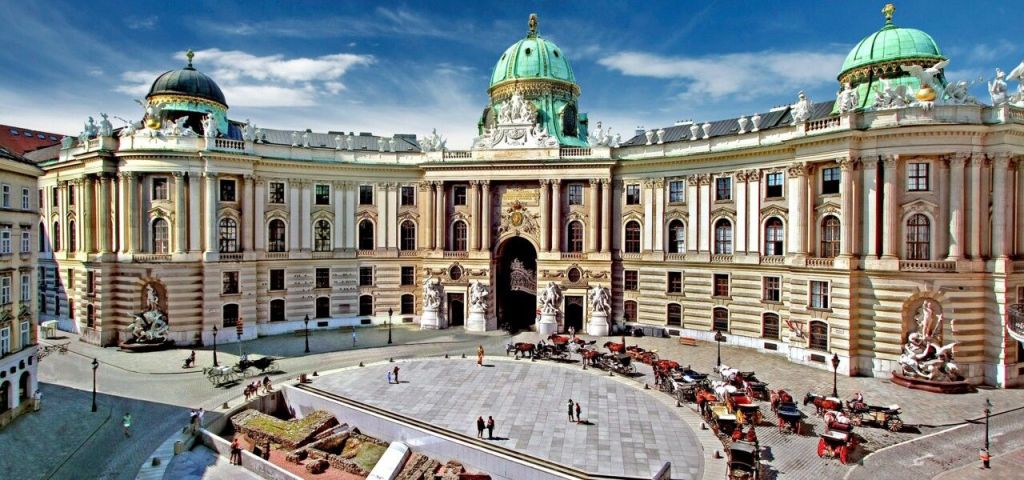
Authors Allan Janik and Stephen Toulmin tackle an extremely narrow subject: the cultural milieu that produced Ludwig Wittgenstein, author of the famous and famously difficult Tractatus Logico-Philosophicus (treatise on the philosophy of logic). The Tractatus has material that is both rigorously logical and seemingly mystical – while this has baffled many, Janik and Toulmin demystify Wittgenstein by situating him personally and intellectually within both the Vienna of his day, and a lineage of thinkers outside the domain of logic altogether that nonetheless account for Wittgenstein in ways logicians simply cannot.
Essentially, Viennese society in the mid to late 19th century was uniquely capable of producing great artists and intellectuals because of its restraints: most houses lacked any method of heating, and so the intellectual class practically lived in cafes during the day, all day every day. The result of this was a level of contact, communication, and collaboration between people of all different disciplines that would have been impossible even in the most open minded of universities.
Influential physicists, composers, psychologists, musicians, painters, architects, and political theorists didn’t just travel in the same circles, but could literally be found in the same salons and soirees. Wittgenstein’s family home was the site of many of these gatherings, and he was steeped in a world of a caliber most of us only dream of and almost none of us could actually contend with.
At that time, much of society was drifting into a malaise born of over saturation. The most popular genre of writing at the time, the feuilleton (a section of a European newspaper or magazine that contains light literature, fiction, criticism, and other entertaining material), had become a window into a sort of collective psychosis slowly gripping Habsburg Vienna in the midst of the dissolution of the Austro-Hungarian empire. Flowery and expressive language became a way of concealing and embellishing the facts of the matter, as if in service of a widespread sense of denial about the state and fate of society. While the feuilleton was the most prominent vehicle of this phenomenon, it could be seen everywhere: even basic household objects were made with such excessive ornamentation and their purpose was obscured.
This was the intellectual climate into which Wittgenstein was born, where the greatest minds of the day were concerned with a project, in each other their respective disciplines, that looked a lot like the advent of Zen Buddhism: stripping away everything but the absolute bare essentials, and militantly defending the line between substance and embellishment.
This insistence on simplicity, clarity, and minimalism, and its concomitant insistence on the admission of limiting principles could be seen in architecture, mechanics, legal philosophy, and also ethics, and this is where Wittgenstein comes in.
The authors place Wittgenstein as the culmination of a line of ethical thought spanning the works of Kant, Schopenhauer, Kierkegaard, and, tangentially, Leo Tolstoy: where do ethical principles come from? Do they come from religious doctrine? Do they come from logic? Are they deduced from observation of nature? Is an ethical life found in community? In the church? Deep in the soul of an individual?
Wittgenstein answered these questions by way or negation: by insisting on silence in all areas about which one cannot possibly speak clearly. The Tractatus Logico-Philosophicus is his attempt to delineate with merciless precision the realm of what can be said from the realm of the ethical, which is entirely ineffable.
It has to be treated as ineffable to insulate it from performative language games, or sophistry. And for this reason, it is seen by some as a text about logic and, by others, as a text about ethics. In fact, it is both: he proceeds to what he believes can actually be said clearly, and we are left to infer that whatever falls outside its scope can be deemed, in terms of truth seeking, to be utterly incoherent.
Just as Zen Buddhism rejects all of the culture, pageantry, and mythology of Mahayana Buddhism to preserve the essential core of meditation, and denies the practitioner any and all satellite features (it is a bicycle, not an SUV), Wittgenstein essentially redraws the boundaries of language in a way that only permits that which makes perfect sense. The rest deserves only silence.
Fin de Siecle Vienna: Politics and Culture
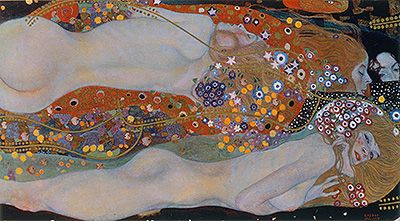
Whereas Roger Shattuck frames the French avant garde as a period of experimentation born of playful, if alcoholism-fueled irreverence, and given license by the aloofness and conservatism of the deeper reservoir of French culture that knew it wasn’t going anywhere, Carl Schorske’s rendering of the Viennese avant garde is the exact opposite: a society on the brink an apocalyptic collapse at the hands of forces they themselves set in motion and yet could not contain, their art and music like screams into the void that fell on deaf ears until long after it was too late.
If that sounds hyperbolic, remind yourself what became of a disaffected Viennese painter who unfortunately discovered a gift for oratory, a bottomless pit of hatred and megalomania, and an impressive appetite for amphetamines.
The main thrust of Schorske’s book is the illumination of a kind of backfiring magic trick: enlightenment liberalism fills a void left by the fallen Austro-Hungarian monarchy, and bourgeoisie is in ascendance as the aristocracy fades. And yet, even as society is hopefully looking to a golden age of upward mobility, rationalism, and secularism, the forces that dethroned an oppressive hegemony are yet unable to unite the forces it freed: now that power has passed from the aristocracy to the bourgeoisie, everyone wants their share, and more. Nobody can agree on where society should go, and nobody has a mandate to rule.
High minded principles are unable to resolve ethnic, religious, and nationalistic divisions, and so those who feel most superior in their philosophy must watch the world they were promised slip from their grasp before their eyes.
In this context, the world received the artistry of Gustav Klimt, where his female subjects represent every possible form of relationship between a rational society and the emotional, irrational dimension it simultaneously depends on and struggles to “domesticate.”
In this context, Sigmund Freud reduces the societal to the psychological: an individual can resolve within him or herself the forces that are out of control at the collective level through psychoanalysis.
In this context, Arnold Schönberg contains the chaos of the world in a musical system called Twelve Tone Serialism, where each note has to be used once before any can be repeated, where soaring emotions and spiraling anxiety are hit with the cold shower of academic rigor.
Schorske’s collection of essays are some of the most sobering I can recall: there are times when the arts, even at their peak, are more like hospice care than a true intervention. In times of instability, society does not rise to the aspirations of its intellectual elites but falls to the level of its tribal conflicts, and the arts are merely a beautiful passenger to this sinking ship, serenading all the way down.
How to conclude?
What I hope to convey here through this four part book report is the way a series of books can expand one’s knowledge in expected and unexpected ways. I had specific ideas of what I might learn from all four books, and my hopes were fulfilled. They were also greatly exceeded, both to my delight and dismay. I saw for myself how much sheer information is necessary to produce a book worth reading, a book that can actually be called a work of scholarship. Rather than satisfy my curiosity, my entree in the subject by way of these 4 volumes only increased it. Now my interest feels serious, even urgent, and it cannot be denied. This is like having a dog: both a joy and a responsibility.
Like all my newsletters, I feel as though there is far more that was demanded of the subject than I was able to deliver, but, as always,
Thank you for reading, and talk to you soon.
-Jas

 Make Beautiful Choices