
Welcome back. Today, I want to talk about the intersection of positivity and realism.
I want a model of reality that I find credible, yet also provides me with some buoyancy in the face of life’s entropic forces.
What I don’t want to do is commit suicide unto the faculty of reason, which is how Albert Camus described faith.
Allow me to elaborate: I refuse to take refuge in something I know I don’t believe, just because it sounds reassuring. I can’t pretend to be convinced when I’m not, and, if I did, the internal conflict that would ensue would be far worse than living with the honest admission of uncertainty.
If you can get on board with that, or at least take that for a test drive from now until the end of my article, I think we can have an interesting discussion.
Before proceeding, another word of clarification: the reason pretending to believe what you do not is worse than whatever alternative honesty would bring as a consequence is that pretense is unhealthy.
Begin building on a foundation of falsehood, and, with every passing day, the sense of emptiness and meaninglessness only grows in intensity. When the time comes to assert what you actually believe, to stand up for your principles, there will be no weight behind it. You will have no credibility with yourself, and what should ring true only rings hollow.
So, we can’t cling to what we don’t truly believe, and, instead, we have to admit to our true beliefs.
One of those true beliefs, one true statement I can make now, however, is that beliefs drive behavior, and I therefore want the beliefs that will drive the right behavior. I want a good life, meaning that I want to live in such a way that I can look in the mirror and see a good person.
My fundamental beliefs about life, the world, and my place in it are what determine my actions, good or bad.
This is obvious: my beliefs about the weather govern how I dress myself.
If I want positive outcomes, then, I need positive beliefs that facilitate them.
So, if dishonest positivity is not an option, but some positivity is required, then neither is cynicism an option. Cynicism could be here defined as the belief that all positivity is dishonest and therefore not to be engaged in.
I gave a good overview of Negativity Bias in a previous newsletter, which I encourage you to read, but I’ll summarize here by saying that our biases make it hard for us to adopt a positive mental attitude: negative information is seen as more important, more true, and more sophisticated.
If faith is the suicide of reason, as Camus said, then I say cynicism is death at the hands of reason: an airtight explanation that nonetheless makes life impossible.
A brave and daring person, then, should insist that life’s horizons be kept bright without giving any insult to the faculty of reason in the process. Win win or no deal.
This brings us back to what I said at the outset: I want to talk about the intersection of positivity and realism. The most believable and the most uplifting, simultaneously.
I encountered an excellent prospective model for such a belief system in chapter 39 of the Tao Te Ching, which I will now reprint in its entirety, and proceed to analyze.

These things from ancient times arise frome one:
The sky is whole and clear.
The earth is whole and firm.
The spirit is whole and strong.
The valley is whole and full.
The ten thousand things are whole and alive.
Kings and lords are whole, and the country is upright.
All these are in virtue of wholeness.
The clarity of the sky prevents its falling.
The firmness of the earth prevents its splitting.
The strength of the spirit prevents its being used up.
The fullness of the valley prevents its running dry.
The growth of the ten thousand things prevents their dying out.
The leadership of kings and lords prevents the downfall of the country.
Therefore the humble is the root of the noble.
The low is the foundation of the high.
Princes and lords consider themselves “orphaned,” “widowed,” and “worthless.”
Do they not depend on being humble?
Too much success is not an advantage.
Do not tinkle like jade
Or clatter like stone chimes.
Before going through it in more detail, let me just tell you, in broad terms, what it is I believe you’ve just read: a presentation of a harmoniously interconnected world.
A world that is healthy, thriving, morally upright, and responsibly governed, where those who occupy the highest positions are humble because they are enlightened: they understand the inextricable link between what is above and what is below.
Here’s where we get to do a bit of what salesmen call “objection handling.”
It’s clear enough that the world isn’t perfect, or, at least, that kings and lords do not appear to “depend on being humble.”
It’s clear to anyone with eyes that there are plenty of problems at the level of governance, and that it is far from “whole,” as the text appears to state.
Here’s where I come to another important point about what it means to find the intersection of positivity and realism:
You have to be capable of stating and advocating for your ideal in the face of less-than-ideal circumstances.
I am certain that Lao Tzu did not believe all rulers everywhere to be whole and upright – he criticizes bad rulers frequently in other chapters.
What is being presented here, then, is the ideal that may never be realized, but toward which the real can always be nudged.
The key to being both honest and optimistic is to be in possession of a clear ideal: the 39th chapter of the Tao Te Ching presents one perfectly. Scanning all of creation from top to bottom, and praising it for its wholeness, its cohesion, its dutiful integrity. Everything performing its part perfectly because it is perfectly intact.
What is the benefit of accepting the image of the world put forth here?
I’ll answer with another question: If you saw the world and everything in it as whole and good, how would that influence your behavior?
A good world doesn’t need to be changed, only taken care of. A good person doesn’t need to be changed, only cared for.
Good people don’t always do what I want them to do,
Good people make mistakes,
Good people can stall out in their development,
Good people can get angry and say things they don’t mean,
And still be good people.
Similarly, the world contains death, disease, malevolence, tragedy, ruin, and baffling wastefulness,
And none of this constitutes proof that the world is broken in any way. These things are real, and the world contains them.
The notion that the world could and therefore should exclude things that are undesirable is to misunderstand what the world is: the world is the arena of cause and effect, the gallery of what is real. Presence in the world is conditioned only by the presence of prerequisite conditions: if it has been caused, then it is.
Whence comes the notion of incompleteness, then? The world as I have described it is perfectly sensible, perfectly complete, and perfectly good: all causes are entitled to their corresponding effects. That is fairness, that is wholeness.
People are who they are because they are elements of a world governed by actions, not by moral judgments.
Rather than decry the world or humanity for its ugliness, then,
And here is the leap into wisdom,
Recognize what is perfectly complete and fair in its ugliness.
The existence of something, the incontrovertible fact that you have experienced something is proof only that the world admits this, too, through its gates.
Where is the fault, the brake, the lie?
You should by now see what I have done:
I began by granting that the description of a whole and upright world was merely an abstract ideal,
Only to go on to prove that it is no mere ideal, but the actual state of affairs. You would have done the same, were you in my shoes.
There is nothing wrong with the world,
Nothing wrong with humanity,
And nothing wrong with you.

Believing something to be wrong turns you into a kind of impotent god, equipped on the one hand with superior knowledge (you know how everything should be) and lacking any ability to bend anything to your will on the other.
To believe that something is wrong with the world, humanity, and yourself is to hold a belief that leads different people down different avenues,
But never done the avenue of knowledge, never to enlightenment.
If you think a thing to be incomplete, you leave it to go in search of what might complete it, all the while neglecting it. Were you to operate under the assumption that all the puzzle pieces had been put back in the box, however, you would simply set about putting it together straight away, as no necessary thing is missing.
By knowing the world to be complete, you are free to engage it completely.
The disparities of the world do not prove the world to be broken.
Let us look again at the chapter:
Therefore the humble is the root of the noble.
The low is the foundation of the high.
Princes and lords consider themselves “orphaned,” “widowed,” and “worthless.”
Do they not depend on being humble?
What does this mean, the low is the foundation of the high?
Nothing can be raised up unless there is something else above which it is raised. That is what being raised means in the first place.
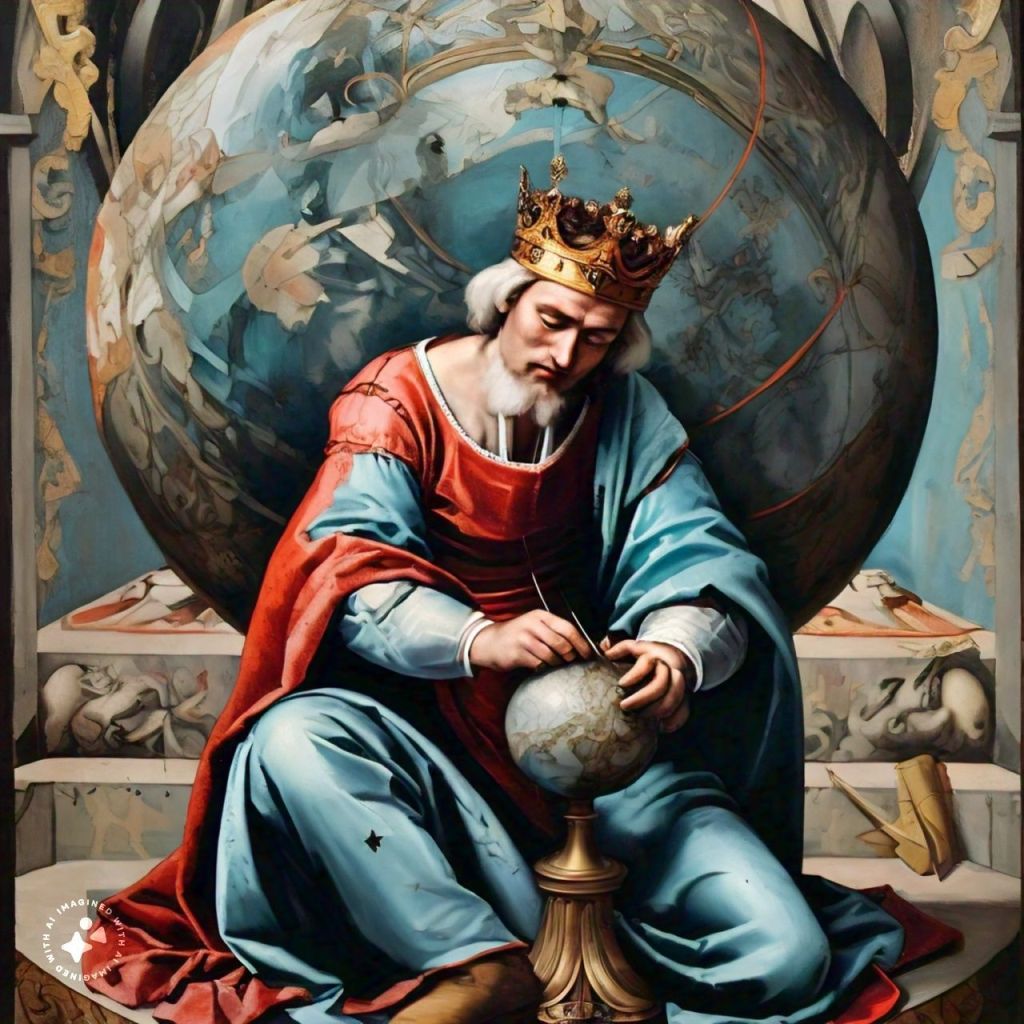
To have contempt for what is beneath you is like the treetops having contempt for their own trunks and roots, contempt for the soil on which it stands. The earth gave you something to stand on, gave you something over which to aggrandize yourself.
I can only say I am literate because others are illiterate. If I’m tall it’s because I’m taller than others, and their relative shortness is the basis of my status as tall: they gave it to me by creating the disparity.
This is the inextricable link between what is above and what is below. Great people only have value because of the mediocrity of others. Their greatness is owed less to their own accomplishments than to the relative lack of accomplishment of others.
This is why Princes and Lords “depend on being humble” – they are rulers because they are not subjects, the same way that night is not night as much as it is “not day.” One’s entire identity, everything you might claim for yourself, is created, even as a concept that can occupy your mind, by the reality of a disparity between one state and its opposite.
We have now revealed the meaning of the opaque closing lines, then:
“Too much success is not an advantage.
Do not tinkle like jade
Or clatter like stone chimes.”
Too much success is what you have when you forget that you only have success in contrast to those who are less successful, including your previous self. I cannot spurn the thought of myself as a helpless infant, because the level of change between my infantile state and my present state constitutes the sole basis for my sense of pride in how far I’ve come.
Headaches handed the billions to Advil.
Therefore do not posture and peacock, do not boast and tinkle and clatter: you only insult that which made you, which gave you everything you have.
How does any of this solve real problems for real people?
Ludwig Wittgenstein wrote that “the solution of the problem of life is seen as the vanishing of the problem” (Tractatus Logico-Philosophicus, 6.521).
The disappearance of the problem, not the appearance of the solution.
The Tao Te Ching is not a book that offers solutions as much as it accelerates the dissolution of problems. It offers a series of common sense perspectives that, when put together, taken deeply to heart, and applied assiduously, remove self created suffering from your life.
To be able to look around at the world, at humanity, at yourself, and see that all is as it should be – including the unceasing demands for attention placed upon you by all three – is to be at peace.
To think of the world, humanity, and yourself as broken, incomplete, and morally flawed is to live in misery: your best efforts amount to little more than putting lipstick on a pig.
When all is as it should be, nothing need be added, but the sense of moral condemnation is automatically subtracted. You live in a household that must be continually set in order. Things drift into disorder of their own accord – simply attend to disorder as and when you encounter it.
No, it does not minimize the scale of any problem to state it so plainly. What it intentionally minimizes is the self aggrandizing sense of drama that people are, evidently, eager to tack on to the problem. The drama frames the problem as exceptional: I tell you now, it is the rule.
To see the world as it is to be the exception can only mean that the alternative model for the world you hold in your imagination is, to you, the rule. The thing to which the present aberration must eventually yield.
“The humble is the root of the noble.” What is humility, but the ability to relinquish your private reality and submit to what is literally right in front of your face? Surely, this facilitates frequent and thorough attention far better than holding onto a fantasy into which you retreat in ways and at times that are not fully within your control, and are certainly detrimental.
The humility to relinquish one’s fantasies for the sake of reality. Fair enough, but, in what way is this “the root of the noble?” Because, and here I’ll be a bit cute if you don’t mind, the road to attainment is paved with engagement. Let the fantasy world wither so that the long neglected garden of the real might now flourish. The more you abandon self aggrandizing fantasy for the sake of humble toil, the more you take on the quality of nobility: skilled, accomplished, influential. Someone of substance and consequence.
To earn the respect and cooperation of others, perhaps even their admiration and deference, takes time and effort. “Therefore the humble is the root of the noble.”
It is the person who tries to circumvent this process that eagerly declares himself a success, “clattering like stone chimes.” Eager to announce and gloat in his superiority over the humble, he is a plucked flower without roots, destined only to wither. This is the fundamental distinction between fantasy and reality: the presence or absence of these humble and prosaic foundations.
See the world before you as the right one, the real one, the better one, and do what it requires of you: this is the path to nobility.
And that, I believe, is as honest as it is encouraging.
Thank you for reading. Talk to you soon.
-Jas









 Make Beautiful Choices