How To Drop The Persona And Become A Person: my interpretation of the Tao Te Ching

I’d like to begin by telling you a bit of my origin story.

When I decided to memorize the Tao Te Ching, I knew it wouldn’t be easy. It wouldn’t be easy because memorizing roughly 5000 words isn’t the kind of thing you just wake up one day and accomplish before going to bed.

It was going to take time, and the time had to be spent strategically.

I figured, these are short chapters. None of them are longer than 1 page. I can do 1 chapter every other day. That’s 162 days to memorize 81 chapters.

But, it will be a cumulative process. Learning chapter 2 is my opportunity to practice chapter 1. Learning chapter 3 is my chance to review both 1 and 2, and so on.

Would you like to know how I memorized the chapters? I would put the text in front of me, read a line out loud, avert my eyes from the page, and say the words I’d just read, 10 times.

I’m sure you can guess what I did next: repeated the process one line at a time, cumulatively, so that by the time I got to the last line, I was saying the entire chapter from memory in one sitting.

You know what’s remarkable about this approach? The efficiency. I didn’t time myself, but I would bet you anything it took no more than 15 minutes to learn an entire chapter in this way.

And then less than 1 minute to review.

As time went by, my brain became more and more accustomed to the process and to the material. I started to notice the patterns of how ideas were organized, developed, and repeated with variation. I began to understand the mind of Lao Tzu, and the mind of Gia Fu Feng, who translated his ideas into English.

I would review and solidify the material on the bus, at the gym, during walks, or at the beginning and end of the day, like a kind of meditation. I would see the way certain events, or thoughts in my mind, were almost answered by specific lines in the text.

I was living and breathing the Tao Te Ching every day, and it became the undercurrent of thought persisting throughout the continuous changes of daily activity.

I would navigate a busy street in Chinatown, and think, “yield and overcome.” Someone would be rude to me and I would think, “accept being unimportant,” or “he who takes upon himself the humiliation of the people is fit to rule them.” I would feel angry at someone and suddenly think “he who is self righteous is not respected.”

And so on. The words of Lao Tzu became like a toolkit into which I could reach at the moment of frustration, the moment my egotism, my vanity, my arrogance, my pettiness, my invented feelings of victimhood, my cruelty, or my vindictive sadism reared its ugly, insistent head, like a panting dog with halitosis.

I hammered in the words of the great sage with daily, hourly repetition, until the temple of wisdom could stand firm against the buffeting storm of my folly.

I am telling you now, there was much folly to be undone. I would read or recall the chapters and would quite often be moved to tears – by finally coming to grips with the extent of my error. Errors of perception, errors of effort, errors of abandonment.

But these were tears of relief, not sadness. The relief of finally seeing the self inflicted pain come to an end. To receive, into arms finally opened by fate and its deftly dealt blows, the knowledge of how to live and what to do.

With all of that in view, I would like to walk you through chapter 4, and share what I believe to be its true meaning, or, to say it better, the meaning that feels most meaningful to me.

I’ll reprint it first, and then comment. Are you with me?
Chapter 4

The Tao is an empty vessel; it is used, but never filled.
Oh, unfathomable source of ten thousand things!
Blunt the sharpness,
Untangle the knot,
Soften the glare,
Merge with dust.
Oh, hidden deep but ever present!
I do not know from whence it comes.
It is the forefather of the emperors.

If you really want to see those words through my eyes, you can memorize them right now using the method I described above.

1  line at a time, 10 times each, cumulatively. What will you begin to see in yourself and the world, for the very first time, if you give these words and ideas the keys to every room of your mind?

Let’s find out.

The Tao is an empty vessel; it is used, but never filled.

The language of the Tao Te Ching is poetic, and appeals to our intuition. I wouldn’t call it illogical, but nonlogical: it overcomes the demand for systematic consistency with the agility of metaphor, and by enlisting our imaginations.

Only you can explain this to yourself, the same way I had to wrap my mind around it all by myself.

The way of the world, the Tao, is the way of instantaneous invention, use, and abandonment of method. It is used but never filled. It never hardens into sediment.

The vessel is always empty: whatever it is that is needed now, the entirety of the vessel, the entirety of The Way, is available to receive it.

What is filling your vessel now? What is it that can’t enter because of what was never poured out from the past?

Lessons of today pour in, but they find a full glass, and water spills.

This messy absentmindedness is not the way. The way is the use without filling. Take the shape of this moment, but lose it instantly to take the shape of the moment that is already arising.

You think of yourself as something – a lawyer, a musician, a peacemaker, a liberal, a loving sister – what will you do when the moment calls for something that falls outside of the definitions you permit yourself?

I only need to be a guitarist when a guitar is in my hands. When the page is before me, a writer. When I go to bed with my lady, a lover. And so on. People want to be friends with a musician, a writer, a lover, a cook, an administrator, only if that person knows how to set all those things aside and be a friend when the friend is before them.

To have depth is to have a deep vessel that is nonetheless emptied at a moment’s notice, leaving only the deeply reverberating echoes of everything you’ve become at the behest of untold moments.

A word of warning – nothing you claim to be can ever excuse the refusal to become what is demanded of you now. “The Tao…is never filled.”
Oh, unfathomable source of ten thousand things!

The Sage does not claim to know what he does not know, what cannot be known. He does not know the secret origins of the universe, or how the world came to be as it is. He only knows that it is the way that it is. But do you know that much? The Sage does not necessarily have more information than you: in many cases you can be certain that you know more.

And, maybe this is the problem. When I think I know, my vessel is full – when I act, I empty it. Now the mysterious world goes to work with my offering of action, bringing forth an elaboration of itself as an answer. I discover that what I knew, even if completely correct, is always dwarfed by what I don’t.

No matter what I do,
or learn,
or say,
or think,
the flow of reality,
from one moment to the next,
the unfathomable source of ten thousand things,
keeps producing,
endlessly inventive,
never tiring.

I can only keep up by emptying my vessel over and over and over.
Blunt the sharpness,
Untangle the knot,
Soften the glare,
Merge with dust.

Why do we take it too far, you and I? Why do we dig in our heels, and harden into something unyielding and oppositional, judgmental, harsh, and punishing, or, on the other hand, into something evasive, flippant, dismissive, minimizing, and superficial?

Because our vessels are full. The vessel gets full and stays full, and flexibility disappears. To empty the vessel, to drop the rigid ideas of identity that we form as necessary responses to each moment, is to blunt the sharpness, untangle the knot, soften the glare, and merge with dust.

Stay in an idea of self long enough and it becomes too sharp to handle, too tight to budge, too bright to confront directly, too high and mighty.

Said another way, the waves are crushing you because you refuse to flow with them – you refuse to bend when life demands bending. Life is the stronger force. Life will break you, quickly and effortlessly, if you resist.

The folly of man, of you and me both, is in thinking our oppositional hardness has any real power.

Merge with dust: reconcile yourself to that which you are so sure is beneath your dignity, by which you feel insulted, or what you can’t be bothered to engage with.

And by this I simply mean: do what needs to be done, and do not let your pride, or your vain attempts to conceal your inadequacies, stop you.
Oh, hidden deep but ever present!
I do not know from whence it comes.
It is the forefather of the emperors.

I don’t know about you, but I love that line: hidden deep but ever present.

Both right here and out of reach, at the same time, at all times. I have a way of expressing this that I hope you’ll enjoy. I think it’s quite poetic, if I do say so: stop looking for it, and start looking at it.

If I told you to go find it, you would never be sure. And you would never find it. Because searching from place to place cannot be the way we find what is ever present.

If it is hidden deeply, look deeply.

I would repeat this line to myself over and over, oh hidden deep but ever present, as I went about my day. At work, in transit, in rehearsal, everywhere. It is here now. The great and final secret is in the room now, here with you now, has never been anywhere else but here. It was here then just as it is here now. Hidden deep but ever present. Always available, never gone, never withheld, never taken off the table, never something that does not apply – it admits no exceptions, and this is the ultimate humility: every moment spent without it is a moment I fail to look at it.

What happens to the conversation when you won’t make eye contact? This is what happens to you and the Tao, you and the way, when you refuse to look. It is humbling to look – because you can only see it by emptying the vessel. Emptying the vessel always means self abnegation: who I am is already who I was, I must now make room for what I might become.

I know this means something special for you, something it could never mean for me. You have your own private treasure of wisdom all to yourself in these words.

Empty yourself that you might receive it.

Thank you for reading. Talk to you soon.

Jas

Looking for more?
My recent interview with Atlantic Bridge Podcast
Follow me on X
Take my FREE 5 Day Self Development Primer
What Is Self Evident Is the Door To The Subtle: decoding chapter 2 of the Tao Te Ching

What does it mean to understand the world? If I say I do, what is it that I’m really saying?

That the world as such is no longer a problem for me. Existence is not a problem, and life no longer requires justification.

I no longer require justification, because I am a constituent of a world that I see as being precisely what it should be.

Does this mean I see the world as perfect?

Yes and no.

The way most people use the word “perfect,” I would have to omit a great deal from my field of vision to affirm it thus.

I don’t see all, but I omit nothing that is within my power to see.

Therefore,

When I say the world is as it should be, demanding no justification, and that this quality of rightness necessarily extends to me as well,

My saying so is also my saying that I mean something very different from you when I say “perfect.”

The world is not incomplete, flawed, or in any way a deviation from the way it was intended to be.

Because there is no intent, no plan that ran aground in the process of implementation, no explanatory gap between conception and execution.

It is what it is supposed to be, because this is how it came out. A world can no more fail to be as it should be than a wave can fail to swell and crest and crash as it should have.

While this kind of language is maddening in its apparent rejection of the rigor of protracted arguments, the simple tautology is actually the correct statement: it should be this way because it is this way.

If that sounds like it fails and even refuses to explain anything, that’s because it does indeed fail and refuse.

The world does not require justification.

I’ll go a step further: all justifications are refusals to understand and accept.

All explanations are designed to paint some details as relevant and others as irrelevant: without an argument to win, or an agenda to pursue, all details are either totally relevant or totally irrelevant.

“The world is as it is” is step 1 of the project of knowing what it is that the world is: I refuse to accept any plot summary, but demand to read the original text without abridgement.

People use words like “obvious,” “self evident,” “of course,” and so on, as a way of acting as if they already understand, that the world that is here to be seen is somehow insufficient in its obviousness – and they are only interested in explanations, justifications, hypothetical alternatives, utopian futures, lost paradises of the past.

Anything, apparently, but the world as it is. Anything but the world before their eyes.

We can now discuss chapter 2 of the Tao Te Ching, written by Lao Tzu and translated into English by Gia Fu Feng.

Go more deeply into what is self-evident, and see that there is nowhere to go and nothing to do: the secret is under your nose now, never more close at hand than it is now, and no one stops you but you.

I will reprint the chapter in its entirety and then expound upon it 1 idea at a time. Let’s begin.

Chapter 2:

Under heaven all can see beauty as beauty only because there is ugliness.
All can know good as good only because there is evil.

Therefore having and not having arise together.
Difficult and easy complement each other.
Long and short contrast each other;
High and low rest upon each other;
Voice and sound harmonize each other;
Front and back follow one another.

Therefore the sage goes about doing nothing, teaching no-talking.
The ten thousand things rise and fall without cease,
Creating, yet not possessing,
Working, yet not taking credit.
Work is done, then forgotten.
Therefore it lasts forever.

Analysis

This chapter is essentially broken up into two sections. The first section defines the relationship between conjoined opposites, and expends 62 words to make 1 point as perfectly clear as possible. 8 pairs of opposites are given as a way of driving home the point that this concept touches everything that can be characterized in any way whatsoever – that is to say, absolutely everything.

The second section makes far less self evident points, but nonetheless cannot stand without the first section.

The subtle thing is always, by definition, hidden within the obvious thing: one who refuses to look at what is obvious, the busybody who says it is beneath his sophistication, will never see the subtle thing within.

This was the point being made in the introduction: if you cannot grant what is obvious, perhaps it is not obvious to you at all.

Under heaven all can see beauty as beauty only because there is ugliness.
All can know good as good only because there is evil.

Therefore having and not having arise together.
Difficult and easy complement each other.
Long and short contrast each other;
High and low rest upon each other;
Voice and sound harmonize each other;
Front and back follow one another.

It means what it sounds like it means: the one owes its existence to the existence of the other. The two arise together, and cannot arise one at a time. Non identical twins, you might say.

The collection of trees exists with or without our conceptual scaffolding around it, but the moment we begin to describe the forest, the opposing concepts are instantly created.

The sunny part above their canopy and the shady part below it. The relative height of them: a tree cannot be tall but it can be taller than.

In fact, a tree needn’t be named a tree at all, except to expediently distinguish between tree and not tree. If we don’t chop that oddly shaped gray thing for making fire and building huts, then we need one word for rock and one word for tree. One word for stone and another for lumber.

We have a word for day because we have both day and night.

We have words like virginity, puberty, and acquitted, because we understand that specific actions and processes irrevocably divide our lives into stages of before and after.

Perspective and position are what gives things their import, are what actually generate entire concepts like having and not having, difficult and easy.

Therefore the sage goes about doing nothing, teaching no-talking.

Why does a deep, rather than superficial understanding of this all too basic fact lead to doing nothing and not talking?

Because the end to the futile flailing that we call reactivity comes about by giving up, at least partially, this perspectival relativism that is at the heart of all value judgments.

If something is worse than something else, it requires justification. If it just is, it doesn’t.

Consider, then, a new set of conjoined opposites: judging and accepting.

There is a time for judgment, and a time for acceptance. We are presented with decisions, and this is when we judge. Once the decision is made, we have to work with whatever was chosen, and judgment makes this impossible.

Comparison between the thing we chose and the alternatives, real or imaginary, that we didn’t choose, confuses us. It makes us think we are back there at that fork in the road, when in fact we are already a fair ways down one of the two paths.

If my meaning is unclear, here is illustrative example: imagine waking up one day, 50 years into your marriage, and exclaiming, alas, my wife is old! She is old because you’ve been married to her for 50 years, and she is now 50 years older than the younger woman with whom you fell in love and asked to marry you.

Way back when you made your decision, she was young. Younger by 50 years, anyway. Therefore young and old arise together. You cannot marry a young woman without one day waking up next to a much older one. If you have chosen wisely, and fate is kind, then both situations were created simultaneously: growing old together is a sign of a successful relationship.

If you start on the path of education, of study, of reading and writing, you will grow in erudition, but you will also create philistines. The higher you climb up the mountain of knowledge, the smaller and more distant and unrelatable will be all those who didn’t join you on your journey. The path of study therefore creates both the knowledgeable and the ignorant.

The same can be said of anything: wealth, experience, skills of a particular sort. You cannot have more of anything without increasing the discrepancy between yourself and others.

Only a fool spends years studying esoteric knowledge only to be astonished at the relative ignorance of others. No Olympic weightlifter is truly shocked that someone else can’t make that weight budge an inch.

The sage goes about…teaching no-talking. What is there to say? What is there to point at in astonishment: all pursuits create more of the thing we were trying to minimize in ourselves. A day spent alert and active guarantees deep sleep.

The sage does not react because he sees everything, all subjective experiences and relative qualities, all concepts that only exist perspectivally, as being created by the processes of living themselves. Therefore what is there to comment on, and to whom? It is all feigned ignorance for the sage.

The ten thousand things rise and fall without cease,
Creating, yet not possessing,
Working, yet not taking credit.
Work is done, then forgotten.
Therefore it lasts forever.

Without cease. We do have to make decisions are the path we take in life, but the vast majority of our lives spent walking the path. A decision is made in a moment, but our lives are made by our ability to abide by those decisions.

Being the employer or employee, being the writer or the instructor, the husband, the mother, the neighbor, the keeper of the household: these are about actions, not decisions.

The demand for action is unceasing, and there is no room for standing back as if to say look at me, look at my accomplishments. Because the next moment and its attending demand for action is already here, and you only miss the chance before you now by stopping to evaluate what you’ve just done.

This is why work is done and then forgotten. Forgetting is what clears the workspace for the assignment that is only now arriving.

You may be better or worse than some, you may be sharper or duller in your aptitude, comparatively lucky or unlucky.

The open-eyed observation that rightly informs action is not aided by comparison to others.

We make comparisons when we are offered a choice. Therefore, it is lunacy to engage in comparison when no choice is on the table, and greater lunacy still when there never was nor ever could be such a choice.

This is why the world, and our selves, require no justification: they were not selected out of any number of available alternatives. If you can show me that you paid a premium for the world and were promised more than you were delivered, by all means tell me more. But the onus is on you.

The sage, the wise person, is busy creating, busy working, with no need to hold onto or receive praise for the results. The only result that matters is the resultant opportunity to continue working, to continue living.

Thank you for reading. Talk to you soon.

-Jas

How To Inoculate Yourself Against Ideology

Today I’d like to start by expanding on a theme that came up in last week’s discussion of Faust: you don’t possess capital T truth as much as you divest yourself of expedient lies.

For context, Socrates used to refer to a little voice within himself (dæmon in Greek) that would object when he was about to say something dishonest, facile, or otherwise playing to emotion but lacking in rational substance. We call Socrates wise, and he was, because he obeyed this voice consistently.

What always struck me as the most notable quality of Socrates is the lack of an intuitive sense of rightness: the best he got was an absence of wrongness. No green lights, but either red lights or no lights at all, so to speak.

There is a parallel to this in Michelangelo’s statement that he removed everything that was not David, or Thomas Edison saying that he didn’t fail 10,000 times but rather found 10,000 ways that didn’t work.

The right way is there, and no matter how much marble you remove or methods you have to discard along the way, the one right way just happens to be the one that doesn’t feel wrong.

What you don’t do is invent it. You don’t invent it because you can’t invent its rightness, its efficacy, or its perfect proportionality: that feeling of yes, this is it (the actual lightbulb turning on) is discovered, not created. If it were created, you could have created a “wrong way” that worked, because you would have created a thing that also possessed the feature of “working.”

We all know this is not what happens: why else would it take Edison 10,000 iterations, or Socrates a few moments of reflection, or Michelangelo however many blows of the chisel: we cannot make untrue things true.

What I’ve just done is laid the groundwork to discuss the first chapter of the Tao Te Ching. The book of the way.

I look at the Tao Te Ching as the most effective means by which people can disabuse themselves of wrongheaded ideas, and, specifically, inoculate themselves against ideology. To stop reducing the world and everything in it to dogmas, doctrines, memes, avatars, slogans, and statistics, and start actually seeing the world as the world.

The world is already here, but unlike Michelangelo’s David, it is not latently present in rock and awaiting its liberation by our hands.

Unlike Edison’s lightbulb, we don’t need to go through 10,000 ways that don’t work before we can find the one real world.

It is actually something closer to Socrates: he didn’t say things he knew to be untrue, and we must stop believing in things that we know to be make believe.

The world is what you have left, what you always already have, when you stop ignoring it in favor of make believe.

This will all make a lot more sense after we’ve gone through the entirety of chapter 1 one idea at a time, which starts now.

The Tao that can be told is not the eternal Tao.
The name that can be named is not the eternal name.
The nameless is the beginning of heaven and Earth.
The named is the mother of the ten thousand things.
Ever desireless, one can see the mystery.
Ever desiring, one sees the manifestations.
These two spring from the same source but differ in name; this appears as darkness.
Darkness within darkness.
The gate to all mystery.

Analysis:

The Tao that can be told is not the eternal Tao.
The name that can be named is not the eternal name.

To just say the tired cliche once so we can move on: the Tao is beyond words.

What does it mean, then, to start a book with that statement?

There is already an invitation to think, and I can promise you that it goes farther than thinking about the ineffability of some great profound truth. That by itself, while it might feel grandiose or inspiring depending on your temperament, does nothing for you in practice.

What it asks you to consider is that what you are about to read is a book about the Tao. The book itself is not the Tao, the same way a book about apples isn’t an apple and can’t be eaten or planted or used to make pastries.

A book about apples, to someone who has eaten, or farmed, or baked with apples, however, would be quite interesting and valuable in its own way.

Words are words, and things are things. For words to really make sense, and not lead us astray, they must refer back to real things. They must illuminate them in some way, either through analysis, parable, or even something more poetic and abstract.

What words do not do is alter reality. Words are the map, but the world is the real unalterable thing we are trying to map with our words.

The nameless is the beginning of heaven and earth.
The named is the mother of the ten thousand things.

Here are two “terms of art” used throughout the text: “heaven and earth” refers to the greater backdrop of nature itself (mountains, the sky, oceans, the elements in general, the world in an inert sense), and “the ten thousand things” refers to the humdrum of activity, the bustling and coming and going of life, human society, the dynamic and demanding perpetual motion of the world.

The above lines are more here for clarification of terms and establishing, pardon me, a proprietary lexicon, rather than make a specific point.

If something is being said here, it is simply that language exists to help us navigate our world, and would be irrelevant and non-existent were we to be without the need to live and move about in it.

Again, words are not real in an absolute sense, but are perspectival in nature.

Ever desireless, one can see the mystery.
Ever desiring, one sees the manifestations.

To continue with the theme of perspectivalism, the world looks the way it looks because of the things you want from it. When you’re in the mall and you’re trying to find Zara the other signs only have the meaning of “not Zara.” When you need to find the bathroom the blue and white rectangular sign with the slacks or the dress is the only symbol you see – the rest vanishes.

If our perceptions reflect our motivations, our physiology, our abilities, our societies, our threats and fears, how much does our language reflect those perceptions?

Language describes reality in a way that advances a particular agenda: it is a function of the desires we are actively working to fulfill.

If our desires were as simple as someone trying to find Zara or the bathroom, our language would be that simple (and when that’s truly all that’s at stake, our language is indeed simple).

Consider that people’s agendas are often quite a bit more complex than this, however.

People conceal things from themselves and others, and advance a specific version of themselves through social conditioning,
manners,
self image,
aspirations,
regrets,
the intent to appear
sexually available or unavailable,
interested or uninterested,
in agreement or disagreement,
confused or comprehending,
cooperative or hostile.

What people see in front of their faces has every bit as much to do with what they have or haven’t learned from the past and where they believe they’ll be in the future. What people see before them and what they do and don’t want from it is conditioned by time constraints, mood, social standing, relative familiarity with whatever is around them, and the history of their relationships with whatever they’re interacting with.

This is but the quickest and crudest of hints at what people have going on beneath the surface.

A person is like Omega Centauri: a globular cluster of thousands upon thousands of stars that looks like a single, unified star to the naked eye.

If the appearance of the world varies based on our varying desires, then there are as many worlds as there are people in it.

Well, not as many worlds, but as many maps of the world. Maps tell you how to get from one place to another, but the world itself doesn’t tell you anything.

Change your desires, and the manifestations change. The map of the world changes.

Am I saying that there is such a thing as living entirely in the world, without any reference to the abstraction of a map (a picture of the world made of concepts)?

There may or may not be, but I can tell you that every description of such a life, every church or workshop or online course or YouTube channel or tweet or cult leader or infographic or alien artifact telling you how to achieve it and why would be nothing more than another map.

The Tao that can be told is not the eternal Tao. Whatever it is you’re saying, it is about the Tao, but does not in itself constitute the Tao.

These two spring from the same source but differ in name; this appears as darkness.
Darkness within darkness.
The gate to all mystery.

Lao Tzu is saying, to stick with my verbal device, that both the map and the terrain “come from the same source, but differ in name.” He then goes on to say that such a thing is confusing and mysterious. Well, I’ll say.

But we can neither claim a full understanding nor be content with our incomprehension: we must strain to grasp the just out of reach knowledge, and not “revel in ignorance as a maggot revels in pus” (thank you, Swami Venkatesananda, for that blinding gem of invective).

The terrain includes you, with your private map. It is a fact that you imagine the world as you do. Your imaginings may be illusions, but there is also the concrete fact that you operate under their sway. That you believe them is a concrete fact, that you act within the framework they create is a fact, and the consequences of those actions are also facts. How could it be otherwise? And so, the dream comes to life. The sleep walking man, whatever he sees in the dream, walks over to a real toilet or refrigerator or staircase or whatever.

And in this way, illusions are real. Both true and untrue, both ephemeral and concrete.

Unless you are willing to say that all illusions,
all delusions,
all forms of make believe,
all beliefs,
some noble and some nihilistic,
murderous and saintly,
are interchangeable solely because they share the quality of perspectival relativism,

then you must admit, at least provisionally,

that they have an unconditional reality to them in one respect: they are specific perspectives.

The line between the two, between mystery and manifestation, conditional and unconditional reality, objective and subjective, is therefore, at some level, not as distinct as we would have it.

These two spring from the same source, but differ in name: truth and illusion differ in name only.

He says it: this is the gate to all mystery, darkness within darkness. If you say you get it, you are lying. If you say you have no idea what he means, you aren’t even trying.

In conclusion, what do we do with the ideas we have just been occupying ourselves with? What is their value? I contend to you that their value is Socratic: they make the inner voice a bit louder and clearer when it seeks to stop us from capitulating to expedient falsehoods. We can temper our inescapable participation in perspectival relativism, in private illusions. In recognizing that illusion is the one universal currency we all traffic in, we can become a bit less bewitched by our own and a bit more interested in another’s.

Not for the sake of being persuaded, co-opted, intimidated or seduced, but for the sake of sanity. For the sake of avoiding a war between competing illusions, and for aiming at what is real and shared rather than what is private and illusory.

Society, civilization, culture – these are shared maps. Shared ways of organizing the world that factor in the realities we can’t escape and the illusions that comfort us in ways the bare terrain simply doesn’t (if you doubt this, show me one group of people who doesn’t participate in invented meaning).

The ever present danger that people pose to one another is the co-opting of public tools by private agendas.

We create something held together by abstractions, which is culture, so our personal impulses can be restrained and sublimated toward an idea of the greater good.

But because those abstractions are just that, abstractions, individuals can put pressure on them in all kinds of ways so that they change into a reflection of their own desires – not inherently a bad thing, but the devil’s in the details: we want more culture, more advancements in quality of life, higher standards of literacy, fitness, purposeful industriousness, research, and so on. What we don’t want, what no decent person wants, is for these collective word games to devolve into ideology.

Ideology is the brutish half wit cousin of culture, of thought. Culture makes life livable, makes life’s mysteries approachable from countless directions and thereby provides outlets and purpose to all temperaments and talents – ideology shrinks life into trite slogans and shuts off the noble impulse toward knowledge and self actualization that defines culture at its best.

Ideology shuts off thinking and drives base instincts toward exploitative ends, all while invoking principles, compassion, empathy, and tolerance. It only unites one group so that they might be mobilized against another.

It speaks the language of guilt, justice, resistance, restoration, oppression, victimhood – never of challenge, achievement, discipline, sacrifice, individual cultivation, skill, or wisdom. It parasitizes culture while animating us with the spirit of barbarism.

It can only be practiced collectively, never privately. Culture, in the sense that it is the opposite of ideology, is a system that creates personal enrichment through collective cooperation.

From one human to another: always be mindful of this difference.

The enduring value, for me, in my life, of remembering that the Tao that can be told is not the eternal Tao, and that mystery and manifestation spring from the same source, is humility. Humility. Stupid, doltish, boorish ideology is what awaits every slob who believes he is gorging himself on the truth, like a pig burying its face in a trough of slop.

Believing that you know, that you own the real and are here to spread it, to lease it at a premium, to bestow it upon the great unwashed masses, is the path over the edge of the cliff, admiring your elegant map all the way down.

A sage bows before reality, no matter how dimly or partially he sees it. And in so doing, saves himself and others from harm. From all the harm that could have been prevented with just a bit more wisdom and a bit less falsehood.

Thank you for reading, talk to you soon

Jas

I Read The Tragedy of Faust: Here’s What I Learned

Welcome back.

Earlier yesterday morning I finished reading one of the crowning achievements of western literature, The Tragedy of Faust, written by the German polymath Johan Wolfgang von Goethe between 1730 and 1790.

In today’s article, I’m going to give a brief overview of Goethe as a literary and cultural figure, provide a very general outline of the plot, summarize what the play has to say about the nature of good, evil, and redemption, and conclude with some reflections of my own.

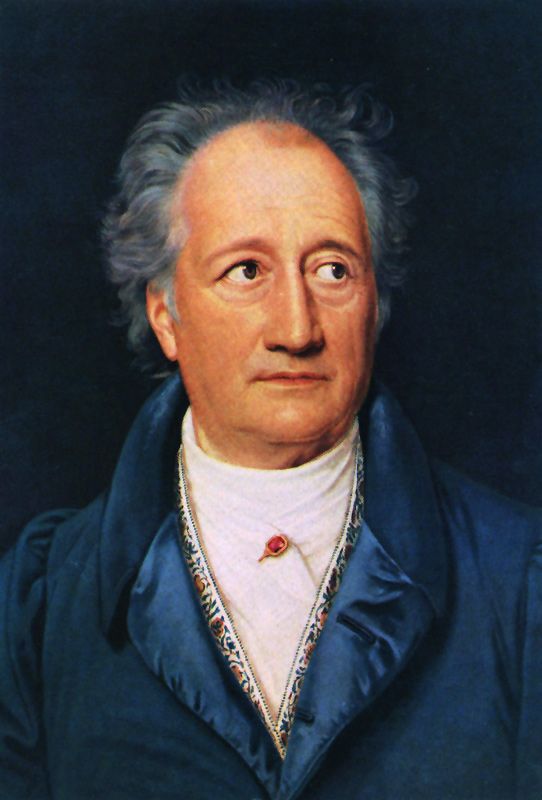
Goethe (pronounced, more or less, Gur-ta) was German novelist, playwright, poet, scientist, critic, statesman, and even theater director.

His career is, therefore, beyond synopsis and not reducible to a single work, or even a single genre of writing. In every area of intellectual life Goethe touched, he is considered a master, and, in some cases, unsurpassed.

His influence on the German language and on the trajectory of the western literary world is hard for an anglophone reader to comprehend or relate to.

Perhaps, if Shakespeare, Charles Darwin, and Mark Twain were combined into one person, this might approximate the stature of Johann Wolfgang von Goethe.

For these reasons, his tragic play Faust holds special significance. It is a life-spanning work, begun early in his life and concluded near its end.

Johann Wolfgang von Goethe

The protagonist, Heinrich Faust, is clearly a representation of Goethe in many ways: a doctor and a scholar, whose studies and achievements have led him to the pinnacle of the European model of enlightenment, has nothing left to conquer.

Alone in his study, his quest for knowledge has alienated him from the world: not only has he not found happiness, fulfillment, or love, but he can think of nowhere else to look. He is experiencing, in the words of the poet Wallace Stevens, “the barrenness of the fertile thing that can achieve no more.”

He has followed the enterprise of truth seeking, as he understands it, to a dead end.

Late into the night, he thinks to turn to occultism. He opens a book of runes and symbols, eventually deciding to summon the Earth Spirit.

Faust may be an impressive scholar, even an authority, but he is out of his depth when the Earth Spirit materializes: he jumps with fright and cowers from it, embarrassing himself and drawing the ire of the apparition who is taken aback and disappointed by Faust’s temerity. He departs, leaving the would-be wizard dejected.

This is Faust’s lowest point: he is in fact contemplating suicide, seeing that he can no more be satisfied with academic knowledge than he can stomach the path of occult knowledge. He has nothing left.

At the last moment, however, he is interrupted by his servant, Wagner. They briefly converse, and his despair is not so much assuaged as it is dissipated. They decide to take a stroll through the town, now that the sun has risen.

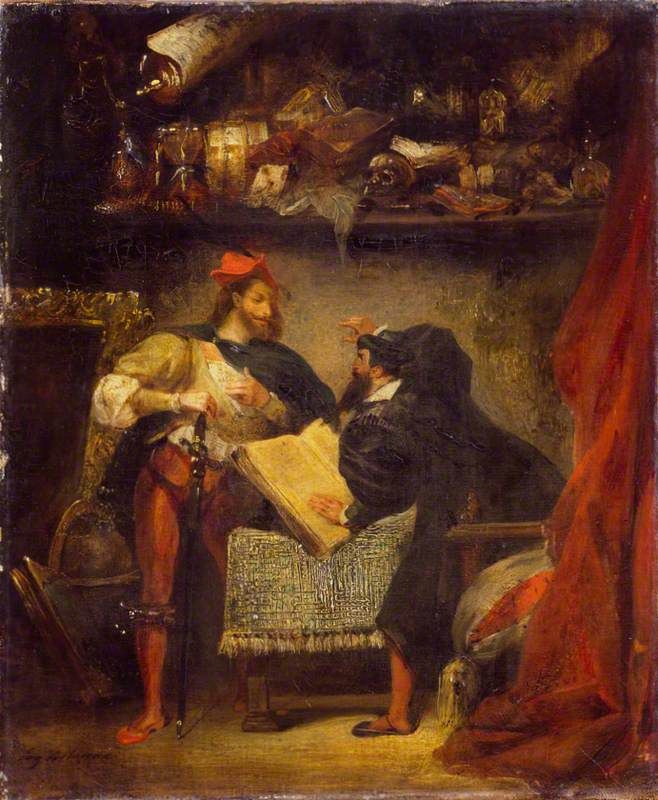
It is here that the real plot of the play begins: a black dog approaches them, follows them home, back to Faust’s study, and then reveals his true identity: Mephistopheles, the devil. Or, as he describes himself, “the spirit that negates.”

After some back and forth, the world-weary and disaffected Faust sees in Mephistopheles an opportunity, and strikes a bargain with him: grant my every desire, always at my beck and call, until the moment I say “abide moment, thou art so fair.”

Faust is going to exploit the supernatural powers of Mephistopheles in one final attempt to find that which has eluded him all this time: that magical something that will finally quell his desire for more. If Mephistopheles can satisfy Faust, Faust’s soul belongs to Mephistopheles for eternity: the archetypal Faustian bargain.

The adventures that follow are humorous, grotesque, macabre, and also heartbreaking. He encounters a simple but virtuous peasant woman, Gretchen, with whom he becomes infatuated. Enlisting the dark powers of Mephistopheles, he eventually creates the necessary conditions to seduce her, and they have sex.

Because Faust is searching for the be all and end all of experience itself, however, he is not and cannot be satisfied with this, and abandons her to pursue other strange and dark phenomena with his enabling companion.

When he misses Gretchen and decides to visit her again, however, he finds that she has gone mad, and is awaiting execution. We learn that her encounter with Faust has irreparably destroyed her family, her sanity, and her life.

The sleeping potion that Faust gave to Gretchen’s mother to ensure that she wouldn’t wake up while they were having sex proved fatal.

The man that learned of their illicit rendezvous and died in a duel with Faust in an attempt to defend her honor was her own brother, Valentine.

Gretchen became pregnant with Faust’s baby and, both abandoned by him and left without any family on his account, drowned the baby and went mad. For the crime of infanticide, she is to be put to death.

While Faust is overcome with grief by what has happened to Gretchen, he does not truly love her, and is not prepared to sacrifice anything for her. He cannot save her conscience, but he tries to get her to escape the jail with him (made possible by the help of Mephistopheles). But for Gretchen, it is all over: she cannot live with what has happened, what she has done, and with the total loss of her own innocence and virtue. She stays, and dies. Faust leaves, to continue his quest.

This concludes part 1 of the tragedy. Part 2, heavily abridged in the Walter Kaufmann translation I read, concerns Faust and Mephistopheles traveling through time and to distant regions of the world, interacting with mythological and historical figures.

The play concludes with Faust, now a very old man, with the tragedy of Gretchen far behind him, now engaged in an ambitious project of land development, essentially taking on the work of civilization itself: conquering nature for the sake of human flourishing.

One elderly couple stands in his way, refusing to give up their estate to make room for his designs. He enlists Mephistopheles’ help, but his demonic companion goes too far and burns down their vineyard, killing the old couple.

For the first time, Faust expresses remorse, and is soon thereafter visited by the spirits of Want, Care, Guilt, and Distress. Care alone can reach him, and she immediately takes his eyesight from him.

It is here that Faust undergoes a sudden change: unable to see the results of his actions, he begins to direct the actions of others, not to the fulfillment of his desires, but towards what he intuitively knows to be “right” in a higher sense.

Essentially, he directs the men at his disposal to work at the limits of their ability, even the limits of their safety, in the service of work that is both beneficial and never ending. In the knowledge that men would undertake this task, at his behest, he says at last, verweile doch, du bist so schön! Abide, thou art so fair.

Faust then dies, and, before he can be taken away to hell, the sky opens and the angels remove him to heaven, where his spirit is reunited with the heavenly spirit of Gretchen.

Faust dies a reformed, enlightened man who has attained the true meaning of human life, and has exercised his accumulated power to pass it along. In so doing, his soul is redeemed, and the devil is cheated of his due.

And so the play is concluded.

Analysis

What does Faust get wrong? How does his path lead him from error to enlightenment? In what way does his ultimate realization excuse or redeem his previous errors?

Let’s start with the first glaring error: Faust is mistaken about both the nature of truth seeking and meaning.

Faust sees truth as a thing you can acquire. A commodity or currency that he stockpiles through taking on and mastering various fields of study. This is an incorrect path to truth, and I will now explain why.

The idea of seeking truth, as we understand it, could be said to begin with Socrates. There were pre-Socratic philosophers in ancient Greece, but they did not give us methods, only specific ideas – some of them still inspire us today, most are antiquated, but none of them can be called a system of thinking.

What Socrates gave us was a method by which we could inoculate ourselves against falsehood. A method of probing into facile statements that served a kind of scalpel of logic: whatever is unclear, shallow, or contradictory is cut away by the process of inquiry.

For Socrates, truth is whatever remains after untruth has been carved away by inquiry: resistant to paraphrase, summary, or sloganeering, the truth is subtle and dignified. It is not a possession.

The purpose of pursuing truth, from a Socratic standpoint, is to purge oneself of falsehoods, to say and do nothing that you know, deep down, to be flimsy, expedient, or manipulative.

This is not what Faust has done. Faust has lived his life like a kind of academic imperialist – going from one field of study to another in the hope that his lust for conquest will one day be sated.

In other words, what he is really seeking is technical mastery. Expertise. It is fundamentally acquisitive: something is missing in his life, and he believes that once he reaches a certain threshold, or perhaps unlocks one specific secret, that he will finally be at peace.

Why is this the correct understanding of Faust? Because of the terms of his agreement with Mephistopheles. He is willing to pay the ultimate price, the eternal fate of his soul, in exchange for the one experience that will make him say “abide! Thou art so fair!”

It should be said that Faust is intellectually arrogant. He believes himself to be above his fellow man, and believes the world to be incapable of offering him anything up to his standards.

Mephistopheles frequently mocks him for this, and we see that away that the promise of instant and total wish fulfillment is instantly and totally corrupting for Faust: he becomes so infatuated with Gretchen that he begins bossing around Mephistopheles in a way that almost elicits sympathy from the reader.

This poor little devil, made to do the bidding of this petulant and impetuous man, who has lost all sense of proportion of over the prospect of, pardon me, getting laid, and who senselessly lavishes a modest peasant girl with entire treasure chests of gold and jewelry, on a scale that brings her more embarrassment, suspicion, and social alienation than delight.

And, why is Faust so obsessed with Gretchen to begin with? Because Gretchen is good, simple, and pure. She has substance, but is not learned or sophisticated. She has a simple way of life, working with her hands and caring for immediate family.

She has what he lacks: dutiful, honest work and human connection based on love and mutual interdependence. She has a real life and real relationships.

An already enlightened Faust would have met Gretchen recognized this. Would have committed himself to her and gone through the necessary steps of winning her over, and winning the approval of her family.

But Faust wants to have her, not commit himself to her. This is the entirety of the difference between Faust and Gretchen: she has commitments, he has conquests.

If we are to learn anything from what happens to Gretchen, from her sorrow and madness at having been reduced to a vehicle for sexual experience while being left to deal with the real consequences of that – her brother dying in an attempt to vindicate her honor, her mother dying from a sleeping potion, her pregnancy and subsequent act of infanticide, and all of this happening without Faust by her side – it is that the promise of effortless wish fulfillment leads to tragedy and disaster.

What is it that ultimately redeems Faust?

Let’s hear it in his own words:

This is the highest wisdom that I own,
The best that mankind ever knew:
Freedom and life are earned by those alone
Who conquer them each day anew.
Surrounded by such danger, each one thrives,
Childhood, manhood, and age lead active lives.
At such a throng I would fain stare,
With free men on free ground their freedom share.
Then, to the moment I might say:
Abide, you are so fair!
The traces of my earthly day
No aeons can impair.
As I presage a happiness so high,
I now enjoy the highest moment.

Let’s break down what this isn’t. He doesn’t find faith. He doesn’t commit himself to a woman. He doesn’t find meaning, necessarily, in charity or “selfless service” either.

What he finds is a categorical change in where meaning is sought, rather than in what. There is no longer any what at all, but a how. Not in acquisition, not in knowledge, not in experiences, not even in the nature of the rewards or consequences.

Redemption is found in the process of giving the moment one’s all, one’s total effort, with nothing held back. “Surrounded by such danger, each one thrives.” Real activity, with real stakes. Work that must be renewed daily. The opposite of accumulation, and, actually, the opposite of achievement in the way we think of it.

Faust comes to understand that no single experience or achievement or acquisition relieves the need for daily exertion toward worthy ends: his error, all along, was the belief that there is such a thing as satisfaction, cessation, or arrest.

Oddly enough, his final understanding is an echo of one of his musings early in the play:

It says: “In the beginning was the Word.”
Already I am stopped. It seems absurd.
The Word does not deserve the highest prize,
I must translate it otherwise
If I am well inspired and not blind.
It says: In the beginning was the Mind.
Ponder that first line, wait and see,
Lest you should write too hastily.
Is mind the all-creating source?
It ought to say: In the beginning there was Force.
Yet something warns me as I grasp the pen,
That my translation must be changed again.
The spirit helps me. Now it is exact.
I write: In the beginning was the Act.

Faust speaks these lines moments before the black dog reveals itself to be Mephistopheles, reinforcing the blasphemous nature of the statement. What Faust’s final speech makes clear is that his emphasis on action was right all along, but not the spirit in which it was undertaken.

The deluded Faust of this early monologue dreams of the power to hold dominion over his world, but the enlightened Faust sees that only in the performance of the action is redemption to be found.

This realization stands outside of any commentary on what one should do, and toward what ends. It leaves the question of ends off the table altogether. And, it must be so: Faust has gone to the ends of the earth, backwards and forwards through time, in search of what, and has found nothing. Nothing real, nothing final.

What he finds is not quite the act, in the sense of cause and effect, in the sense of agency and mastery, but action itself: primal, atemporal, total, immersive, vigorous.

It can be said that this understanding is redemptive because it leaves no room for the corruption of one’s motives, because there is no motive. There is no reward. The total immersion in the action itself is the reward:

Freedom and life are earned by those alone
Who conquer them each day anew.

Thank you for reading, talk to you soon.

-Jas


PS – I explore ideas like this because it brings my life into alignment with my ideals. My inner picture of who I am and how I want to live in the world.

I share my thoughts publicly because I want to encourage others to do the same: to make the necessary changes that will bring the outer into harmony with the inner. This is happiness, self respect, and purpose.

To that end, I also create short form content on X/Twitter dealing with psychology of self development, and I’ve recently created a free 5 day educational email course on the same topic, “Self Development Cheat Codes.”

It goes over the 5 biggest mistakes people make when they decide they want to get their lives together, and I provide 15 specific frameworks to guide people along their journey. If you’d like to have more of a concrete method at your disposal, get the free materials here.

Thanks again.

The Weak Have Desires, The Strong Have Purpose

Welcome back.

Today, we start with a quote from anthropologist Ralph Linton, taken from his text The Study of Man. I’ll reproduce the quote first and provide analysis after:

This tendency toward the unnecessary and in some cases even injurious elaboration of culture is one of the most significant phenomena of human life. It proves that the development of culture has become an end in itself. Man may be a rational being, but he is certainly not a utilitarian one. The constant revision and expansion of his social heredity is a result of some inner drive, not of necessity. …it seems possible that the human capacity for being bored, rather than man’s social or cultural needs lies at the root of man’s cultural advance. (p.184-5, Ralph Linton, The Study of Man)

Read the first sentence again: this tendency toward the unnecessary and in some cases even injurious elaboration of culture is one of the most significant phenomena of human life.

“Injurious elaboration of culture.”

Let me paraphrase: the same way that a moth is hardwired to use a light source to orient itself in flight, and cannot distinguish between the moon and a candle, and thus cannot avoid burning itself…

…it seems possible that humans are hardwired to revise and expand upon their inherited social systems, and cannot distinguish between what works just fine and what could be better. Thus, we can’t quite steer clear from “injurious elaborations of culture.

To paraphrase again: boredom leads people to do things that are unwise, on both a personal and societal scale.

What is wisdom? The capacity to differentiate between what is truly beneficial and what is merely tempting. What is necessary and edifying and what is unnecessary and injurious.

Philosophy (the love of wisdom) is the enterprise of installing better software in our malleable minds – updates that can tell the moon from a candle, an opportunity from a trap, selfishness from self respect.

And this is why I focus as much as I do on the Tao Te Ching: it seems dead set on communicating the necessity of knowing when to stop. How to become someone who instinctively knows where the limits are before they are exceeded.

It immerses you in the attitude of a wise person, and, if you stay in it long enough, internalizing and practicing it diligently, you become wise too. Doing less of what is unnecessary, the requisite attention, energy, and will to do what is necessary is available more often and in greater supply.

Today, I want to dissect chapter 3. You’ll see why in a moment. It contains some truly puzzling phrases that demand interpretation but yield correspondingly deep insights.

Chapter 3

Not exalting the gifted prevents quarreling.
Not collecting treasures prevents stealing.
Not seeing desirable things prevents confusion of the heart.

The wise therefore rule by emptying hearts and stuffing bellies,
By weakening ambitions and strengthening bones.
If people lack knowledge and desire,
Then intellectuals will not try to interfere.
If nothing is done, then all will be well.

When I was engaged in the work of memorizing the text, I began to take a special liking to the stanzas that seemed almost intentionally objectionable in the way they were worded.

People should lack knowledge? That is a good thing? We should do nothing? We should ignore the problems of the world? We should give up on our hopes and dreams and just eat to our hearts’ content?

It sure sounds like that’s what’s being said.

I can assure you, however, that Lao Tzu went to the appropriate lengths to divert shallow, reactive minds. These seemingly ridiculous statements that occasionally surface in the text are here, I believe, to attract those who are sincerely curious and willing to do the necessary heavy lifting, so to speak, to get at the truth, while putting off those unwilling to exercise their minds.

So, let’s begin. Let’s actually think, and grow from the labor of doing so, rather than simply consume the same trite drivel in new verbiage over and over again, atrophying from the lack of effort.

Not exalting the gifted prevents quarreling.

Let’s make sense of this by going back to the absolute basics. What do we want a society to be? Harmoniously integrated. We grant without question that there is a distribution of virtue: some are obviously better than others. Some are taller, stronger, faster, healthier, smarter, and even nobler than others: only the worst people deny this. What, then, is the best thing to do with the best of us?

If the goal is cohesion, integration, a society functioning as one organism, assigning the appropriate duties and resources to each component part, then exaltation does nothing to achieve this goal.

Exaltation actually separates the gifted from the rest, and puts a spotlight not on their achievements but on them. To exalt means to lift above the others. Why? So it can be seen and admired by all. Does that sound healthy and appropriate to you? To encourage people to think of some as above them, and themselves as necessarily inferior?

Is it socially responsible to encourage some people to feel superior and others inferior?  Is it socially responsible to turn attention and praise into a currency with value, to be sought, traded, and expended for personal benefit?

Obviously not. We’re invited to consider how this path leads to division (quarreling), rather than cohesion.

What do I think we should do instead? Fair question, and I will answer it later, but not now. Now, we get clear about what does not and cannot possibly work. That’s always step 1.

Not collecting treasures prevents stealing.

It might not be obvious that exalting the gifted causes quarreling, but it should be obvious that stockpiling resources attracts desperate and unscrupulous people seeking resources.

What’s less obvious, though? That having to have (collecting treasures) isn’t that different from having to praise (exalting the gifted). If the best thing to do with the gifted is not to exalt them, then the best thing to do with treasures is not to collect them, and for the same reason.

Not seeing desirable things prevents confusion of the heart.

One more negation before we get into solutions, prescriptions made in the affirmative.

Where does confusion of the heart come from? From gazing upon something lovely and longing for it. Imagining you need it, feeling pained by your lack of it. Feeling that whatever you do have must not be good enough, if you feel this desire and longing in the face of what you do not possess.

This is confusion: not knowing where to go, being unsure of where you are, unsure of what you perceive. Possessed by fantasy, imagining yourself enhanced by the acquisition of more, and being increasingly lured into an imagined world. It should go without saying that living in imagination, in longing, in fantasy, does not make for coherent and sensible actions in the real world.

The wise therefore rule by emptying hearts and stuffing bellies,
By weakening ambitions and strengthening bones.

Paraphrase: the wise rule by putting energy into what is real, and ignoring what is not real.

What is wise is to invest your energy in what you have (stuffing bellies and strengthening bones), rather than chasing after and longing for what you don’t.

Before you entertain ideas of what’s missing in your life, experience what it feels like to be truly well nourished and strong. Learn to combine a rigorous exercise regimen with an appropriately robust diet. Learn how to sleep properly. How to drink water diligently and consistently, how to maintain mobility and flexibility and balance.

Instead of becoming enamored with the value in others and in objects, see value in yourself. Not in an egotistical way, which is actually seeking the approval of others and therefore valuing their opinions over your own, but in a responsible way. Extract all the gold from your own mine before envying another’s.

Said as directly as possible: draw all the strength, stability, health, capacity, confidence, and even beauty out of the resource that is your own body before you give a single thought to what you would demand of the world.

If people lack knowledge and desire,
Then intellectuals will not try to interfere.
If nothing is done, then all will be well.

People always have a hard time with these three lines, and it’s not hard to see why.

As is always the case with Lao Tzu, use the part that does make sense to decide the part that doesn’t: this never fails.

Let’s agree that interference is bad. In this context, it almost certainly means misguided, unhelpful, and possibly harmful and exploitative input from people who don’t really understand the subtleties of how to promote human flourishing.

And who are these people who are interfering? Intellectuals. People who understand things at the level of theory, policy, scripture, or even research, but by definition lack the grit that comes with a lifetime of practical application.

People animated by intellectual arrogance are inserting themselves into the affairs of others, both because they think they know better and because they wish to interfere, resulting in negative outcomes.

How are the people making themselves targets for meddling know-it-alls? With their own lack of self sufficiency, their own deluded ideas of utopia. A whole and healthy person has a purpose, a duty. A broken or halfway-there person has desires.

Grow sufficiently solid and strong, and you will simply see the unfolding of events before your eyes and respond to them as necessary: you have both the capacity and the availability to act, because your own needs have been fulfilled.

If you are incomplete, and unable to complete yourself, however, you will invariably be seeking the missing pieces outside of yourself. You know something’s missing, and you want it. This is what is meant by knowledge and desire.

Now, we can make sense of the last lines:

When people lack knowledge and desire,
Then intellectuals won’t try to interfere.

We can now paraphrase this, confidently:

If you properly care for yourself, you will not become a target for parasitic con artists who live off a society’s resources but only contribute theories that lead people in circles and ultimately to ruin.

If nothing is done, then all will be well.

If you’re walking up a staircase, with the landing at the top clearly in view, you know where you are going, and your body automatically responds to the command “climb the stairs.” If I were to ask you, what are you doing, you would probably answer in terms of why you were going where you appear to be going. What I doubt is that you would answer in terms of your knees, ankles, calves, quadriceps, hamstrings and gluteal muscles. I would assume you are consumed with ideas of purpose, rather than mechanics.

I’m not being pedantic: this is the meaning of non action, of saying “if nothing is done, all will be well.” If you are at a state where, once you understand what must be done, you simply do it, with the how relegated below the threshold of conscious awareness, too unremarkable to notice, then you yourself are well: you are a capable person. Nothing is done, but all is well. Actions are automatic, and only purpose is under consideration.

This level is only available to the person who has total command over the instruments of action, and this is why the wise rule by emptying hearts and stuffing bellies, by weakening ambitions and strengthening bones.

Without this bedrock of self sufficiency, we exalt the gifted, we collect treasures, and we see whatever we don’t possess as desirable.

When we are strong, we leave the gifted to their work. We appreciate art and all forms of finery, but do not feel the need to possess or stockpile it, because nothing in us is seeking enhancement by proxy. We don’t imagine another’s life to be better, or alternative circumstances to be more conducive to our happiness.

With a full belly and strong bones, we know that happiness comes from the knowledge and sensation of one’s ability to stand up to life, not from luxuriously hiding from it.

For this reason, those who have nothing to offer the world but false promises of utopia know that we are simply not in the market, and they keep moving.

This is how one steers clear of unnecessary and even injurious elaborations of culture: life honors the perfectly sane limits of the body, rather than the inexhaustible caprices of the mind.

Said another way, a person who truly works hard every day never encounters boredom, but only well deserved repose.

Thank you for reading. Talk to you soon.

-Jas

Why Breaking Feedback Loops Can Save Your Sanity And Improve Your Life

A Theoretical Preamble:

Welcome back.

I’d like to begin by inviting you to join me in a little thought experiment.

Despite all the complex, nuanced ideas about life you’ve accumulated over years of experience, observation, and reflection, I’d like your permission to talk about it in simplistic, reductive language – provisionally, for the sake of making a point.

We can agree right now that life is indeed more complex that the conversation we’re about to have,

But we agree to shrink life to the size of a framework for the next few minutes for the sake of, ironically, expanding our range of options in the real world.

Why am I speaking in this strange way?

Because this is how the process of thinking works: suspending not disbelief but objections and appeals to irreducible complexity:

Yes, life is complicated. Yes, there is too much information that we don’t have for us to ever be sure,

And no, that is not an excuse for inaction and failing to develop a philosophy about life that governs you.

Growing in intellectual capacity means frequently shrinking life to the size of a single framework so that you can learn it, apply it, and confirm its uses and limitations for yourself.

Do this a few hundred times over a 10 year period and you will be a beacon of wisdom.

Today’s Framework:

Positive Feedback Loops.

Let’s begin with a definition,

and then follow that with some brief examples of how they can be used both for good and for ill,

and then, the real gem for today, how to use the philosophy of Epicurus to regulate and, when necessary, break positive feedback loops in order to maximize your personal well-being.

Firstly, what is a feedback loop?

The shortest definition is to say that a feedback loop occurs when outputs are used as inputs.

Have you ever held a live microphone, and suddenly heard a loud squealing sound? That’s feedback. The microphone is picking up sound (inputs) that are then being amplified through the speakers (outputs) – feedback is when the microphone is picking up sound from the speakers. This creates a continuous loop, causing the sound to lose control quickly.

(Normally, there is no loop at all: only the unamplified voice goes into the microphone and through the speakers – a straight line, or process that is begun anew with each word spoken into the mic.)

Here’s the kernel of wisdom to take from this: when the rate of a process accelerates over time, it’s often an example of a positive feedback loop.

The chemical reactions involved in blood clotting, apples ripening, labor contractions, the greenhouse effect – these are all positive feedback loops: the longer it goes on, the faster the effects multiply. 

Not everything is like this: it’s not true that the longer I run the longer I want to run, or that the more I eat the more I want to eat: I get tired, or full, and I stop.

What are healthy feedback loops?

Some feedback loops are good!

The more information I have about a topic, the more interested I am in it: my questions become more specific, the gaps in my knowledge more frustrating, and the drive to complete the picture intensifies. I say this is a virtuous cycle.

Creative expression is a positive feedback loop: the more you explore different ideas, the more it takes for an idea to feel different: the more I write articles, or songs, or improvise and perform with my band, the more ideas I have, and the more quickly they come to me. Positive feedback.

Relationships are positive feedback loops. If you like someone, and you start spending time with them, that eventually bonds you to them to the point that being apart feels abnormal. Friendships, romantic relationships, creative collaborations; all driven by positive feedback.

A more general term for this might just be momentum.

When are positive feedback loops bad for you?

Don’t let the word “positive” fool you: think of it more like “uncontrollable increase.” That sounds a lot scarier, and, sometimes, that’s appropriate.

Addictions create positive feedback loops: using substances to cope with the shitty feelings following the high.

Lying creates positive feedback loops: it’s really hard to answer a probing question about a lie without having to create a brand new lie, and a bunch of lies now create a huge liability for you, requiring even more lies to conceal them. If you want a profound meditation on the uncontrollable spiraling effect of lies, watch the television series Sons of Anarchy.

The biggest positive feedback loop of all, however, is the loop of social norms:

Why do I need an iPhone? Because everyone else has one. So, the more people use them, the more pressure there is on everyone else to use them.

Can you be the one person in your company who doesn’t have slack on his or her phone?

Can you be the one person using public transit when everyone else is driving or using Uber?

Can you be the only athlete who isn’t using steroids when all of your competition is?

Positive feedback loops can drive curiosity, exploration, refinement, innovation and creativity.

They can also normalize unhealthy behaviors, attitudes, and delusions: giving things a foothold when they should have been staunchly opposed from the beginning. Everything insidious, everything that exploits half-truths, exploits our aversion to conflict, our desire to be seen as open-minded and tolerant, or keeping up with the times – depends on positive feedback loops.

For those looking to break out of the loop, the echo chamber, the confirmation bias, the vicious cycle, and tribalistic group think, let me now refer you to the 4th century Greek philosopher Epicurus.

Epicurus lived in Ancient Athens, and founded a commune organized around his ideas. He valued simplicity, productive activity, and friendship. He saw that doing things brought more happiness than having things.

While Epicureanism has never become a widespread movement, it, like its cousin Stoicism, distills timeless insights into compact, pithy maxims.

Of the 40 doctrines of Epicurus, I believe I can offer one, the 21st, that summarizes his philosophy as well as reading them all:

“He who has learned the limits of life knows that that which removes the pain due to want and makes the whole of life complete is easy to obtain: so that there is no need of actions which involve competition.”

Let me paraphrase: it’s easy to have enough. What’s not easy is to have more than someone else (or everyone else).

To “learn the limits of life” is to understand that your limits are set by your body’s needs, not society. Not the perceived competition. It means understanding that if you are not suffering from privation (“the pain due to want”), you don’t actually need any more of it, whatever it is.

So, let me just speak to you from this mindset for a few moments:

Is your body starving, or does a sense of social standing (competition, driven by positive feedback loops) make you feel diminished because you can’t afford to eat at that restaurant?

Are you really so unhappy with your job, your pay, your home, and your lifestyle, or do you feel less than others who appear to have more?

Do you try to be someone you’re not, holding up an illusory facade, while concealing, neglecting, and devaluing the person that you really are, all because you think this is necessary to present yourself to others?

In short: are your activities guided by your needs, or the need for mimicry?

See what happens when you take Epicurus’ words to heart: “that  which makes the whole of life complete is easy to obtain.” Realize that “good enough” is real, and represents a standard that originates from within yourself, whereas “the best” only has meaning in comparison to others.

Let me phrase it another way so that “good enough” seems less like resignation, and “the best” seems more ridiculous:

The goal of being happy versus the goal of being the happiest.

“Good enough” is not for those unfit for the best: it is for those with an internal locus of self worth.

Let something be good enough for it to cease to be a source of preoccupation: if you’re strained from having too little, or stressed from having more than you can manage, this is not what you want.

You want the amount that allows you to forget about it: neither starving nor stuffed.

The point is that YOU are the source of that limit, no one else.

Where do we go from here?

In all things, be the one who chooses. Choose the areas in your life that you wish to pursue to the ends of the earth, and choose the ones to leave at the level of good enough.

I know what lights me up, and what pains me to fall behind on. I know the things I’m simply maintaining as constants, and I know the things I don’t really care about very much at all. And, that evolves over time! It should evolve. It’s good to evolve. But make it a conversation with yourself. Be conscious of it, intentional about it. Don’t be swept up in the perceived expectations of others, what psychologists call “introjection.”

Recognize that it takes so little to supply you with your real needs, and just about everything else after that can be chalked up to social norms. Don’t be led by the nose by them, and don’t childishly rebel against them, but look at them, and choose for yourself.

And choose well. Even beautifully.


Thank you for reading. Talk to you soon.

-Jas

Fulfill Roles, Not Desires: why emotions are irrelevant to situations

Welcome back.

Today, I want to make a case for the reluctant hero. The person who doesn’t seek glory, but is nonetheless dragged into a conflict by circumstance. This is someone who wasn’t looking to get involved, but whose conscience will not permit him or her to walk away. 

In other words, a person motivated by principle, by a sense of duty, rather than their passions.

I’d like to clarify exactly what I mean by this by first making a distinction:

This is not exactly the same thing Kant meant by saying an action has to go against inclination for it to have moral worth.

That statement, found in his Groundwork for the Metaphysics of Morals, meant that moral worth requires conscience triumph over instincts to the contrary, in the same way that bravery requires, by definition, the overcoming of fear. 

When you overcome your prejudices to give someone your full attention and a fair shot,

When you hold yourself back from temptation, knowing you’d likely get away with it,

When you stay up late or get up early to take care of something important, fighting the urge to blow it off all the while –

These are examples of conscience winning over inclination: acts of moral worth.

And what I’m going to advocate for today is something five degrees off from that:

Doing something despite having a lack of interest in the outcome.

Maybe a better term for what I’m talking about isn’t actually “the reluctant hero” but the disinterested hero.

If you’re wondering why I didn’t just say that in the beginning, some ideas are discussed so rarely that you need to explain what you don’t mean before you can say what you do mean.

The concept of the disinterested hero is summarized perfectly in chapter 68 of the Tao Te Ching, the foundational text of Taoism, a school of Chinese philosophy that started roughly 2500 years ago.

I’ll reprint Gia-Fu Feng’s iconic 1972 translation below, and then proceed to expound upon it –

You could very well just take the 55 words of this chapter and meditate upon them daily or hourly for a year or so, and I’m sure you would come up with all kinds of deep insights. I’m sure because that’s what I did, and I want to tell you what came to mind for me, and how I applied it to my life. 

SIXTY-EIGHT

A good soldier is not violent.
A good fighter is not angry.
A good winner is not vengeful.
A good employer is humble.
This is known as the Virtue of not striving.
This is known as the ability to deal with people.
This since ancient times has been known
as the ultimate unity with heaven.

“The virtue of not striving.”

That sums it up, and yet I know it only raises more questions than it answers. As a first step in answering those obvious questions, read it again, and see how quickly your mind starts to clear up like a stuffy room once the windows are open.

What do these repetitive stanzas reduce to?

A good person is unemotional.

The skills of warfare do not require or benefit from the anger of the soldier.

The fighter is not better at fighting because he is angry with his opponent.

The person who triumphs is not enhanced by feelings of antipathy toward the person who lost.

The person who is in charge does not become a better boss by gloating over his or her authority.

Striving, then, is equated with the extra emotions: angry, violent, vengeful, proud or arrogant.

Lao Tzu says there is a virtue in not striving, a virtue in lacking the animating force of intense emotions.

In the very next line, he says something that sheds some light on exactly what he means by all this:

This is known as the ability to deal with people.

Again, his answers are puzzling, but they are answers.

In the absence of striving, in the absence of strong emotions that take us over, we have the ability to deal with people.

Well, I have to say I find that very interesting. What is implied here is that emotions make us forget that we are dealing with other humans. Emotions blind us by making us unthinking, lacking in sympathy, and myopic.

Let’s keep paraphrasing the lines until they become even less cryptic:

A good soldier/fighter/winner/landlord has the ability to deal with people.

Are you shocked yet? Because this is nothing short of shocking if you have truly grasped it.

Being good is less about having to be better than other people, and more about being good with people. With them! This can only mean that these sorts of strong emotions actually disconnect you from others, and turn you into someone trying to get something from others.

The angry soldier needs to kill the enemy, the violent fighter is trying to do as much damage to the other as he can, and the vengeful winner doesn’t want to win as much as he wants the other to lose, and the arrogant employer loves that his employees are dependent on him for their livelihoods.

All of these asymmetrical dynamics are actually quite unfortunate: wars, fights, stressful contests of skill, and the mutual interdependence of the fortunate and the unfortunate.

But for people animated by these violent emotions, they relish in the destruction, denigration, and subordination of the lesser, the loser, the weaker, the poorer of the two parties.

This is not virtue, because this is not how you deal with people.

The implication here is that, yes, life drags us into conflicts all the time, but something is wrong with you if you are happy about that. You have your duty to produce results, and that very fact stratifies the world into winners and losers, masters and slaves, those who eat and those who are eaten.

But are we required to be sad about it? Nothing to that effect is said here. It is enough to emphasize the fact that an enthusiasm for life’s inevitable moments of destruction is pathological and by definition antisocial, and that something of profound importance is lost when you are so excitable by the prospect of gain at another’s expense.

The ultimate unity with heaven is what comes to those who do what must be done, to the best of their ability, because anything that must be done must be done as well as possible, if it truly must be done at all. Unity with heaven is what you get when you understand that the best you can do is not the most you can do, the farthest you can go.

To do the best you can also means you must not do any more than is necessary: this is known as the virtue of not striving. It goes without saying that an angry, violent, vengeful person does not know when to stop, and this requires no elaboration on my part at all.

How did I apply this to my life?

To put it simply, the 68th chapter of Tao Te Ching taught me to focus on the person I’m dealing with, instead of trying to be true to the emotions aroused in me by the situation at hand.

I never questioned the emotions, and I never thought seriously about what it was I was trying to accomplish: I would capitulate to my feelings, thinking that this was “authenticity,” and that there was something noble in refusing to betray my feelings for the sake of superficial social conventions.

What I gradually came to understand is that my intense emotions were born of immaturity, even petulance, not “authenticity.” I saw that I was dramatizing my own emotions because I lacked the ability to deal with people. The moment I began to focus on creating the best possible outcome between myself and the other party, and therefore began to cultivate the skill of dealing with people, the emotions began to disappear altogether.

I still have emotions, of course, but they are speaking in their inside voices, so to speak – they are not shouting, feigning urgency, and attempting to hijack the conversation. They inform, rather than insist, because I no longer believe that emotions excuse anything, and because I now understand that emotions can function as a smokescreen that conceal the inability or simply the refusal to analyze.

Does that make me, as I implied before, disinterested?

I think that when you start to see your life as an aggregate of relationships, there is both so much more to be done and almost nothing to react to: you are action itself, and nothing is happening to you as much as you are the activity that is happening, the conduit through which moments of contact and exchange occur.

I think the examples of soldiers, fighters, winners, and employers are used to make the point clearly: often enough, we are called upon to enter into dynamics where not everyone can come out feeling like the winner, and there needn’t be any emotion involved at all.

In that moment, there is something that needs to be done. Our purpose, yours and mine, is to be calm and clear enough to perceive it, participate in it, and fulfill it.

The virtue of not striving means the virtue of not being on a crusade – some goal above and beyond the actual humans you share your life with. There simply is no life without others, in the most basic sense.

For this reason, nothing that comes between you and the continuity of your relationships with others can be called virtue: the only way forward is together, and this must inform and temper the moments when, yes, we must fight and militate against and dominate each other.

I cannot stress enough that these asymmetrical dynamics cannot be avoided, and, when I say that a communitarian ethos should temper our behaviors, I mean they should cleanse us of stupid, unthinking brutishness.

In no way am I saying, as a general principle, to become a pushover, without a spine and without boundaries. I am actually saying something quite opposite: become perfectly capable of delivering on what is demanded by life, unclouded by trite ideas of both pacifism and heroism.

What is there to strive for? Life has placed an entire life, an entire world, right in front of you: simply fulfill the roles you have been granted. This, since ancient times, is known as the ultimate unity with heaven.

Thank you for reading, talk to you soon.

-Jas

I Read 4 Books On Turn Of The Century Paris and Vienna: This Is What I Learned

Well, it’s confession time.

From time to time, and sometimes on a daily basis, I like to indulge in something the kids today colloquially refer to as “nerding out”

(If you found that verbage to be “tortured,” just know I also like to indulge in “torture”).

I recently finished reading the 4th of 4 books I’d picked out some time ago, all on the subject of turn of the century Paris and Vienna.

Specifically, I read Jannick and Toulmin’s Wittgenstein’s Vienna, Carl E. Schorske’s Fin de Siecle Vienna: Politics and Culture, Roger Shattuck’s The Banquet Years, and Roger Herbert’s Impressionism: Art, Leisure, and Parisian Society.

They were filled with profound insights about history, art, music, theater, human psychology, politics, and European culture in a broad sense.

The period of history documented by the 4 texts, each from markedly different angles and academic disciplines, was the transition into modernity as we know it.

From the hegemonic rule of the aristocracy to the cultural pluralism of the ascending bourgeoisie.

From a culture of ever increasing embellishment and ornamentation, to the point of obscuring the facts of a news story or even the functional purpose of a household object, to a sweeping movement in Spartan minimalism and curt, modern essentialism.

Whereas meaning was once concentrated in history, religious scripture, mythology and parables, it was suddenly available right here, right now: in depictions of street performers, in nubile ballet dancers being prepared for their auditions by their hunched, working class mothers, in the blank faces of people adapting to rapid urbanization, and in the rising black and gray smoke of trains and factories commingling with clouds in otherwise blue skies above verdant rural landscapes – similar in appearance but divergent in import.

Whereas art once strove to uphold an aspirational picture of humanity, it now began to critique, to relish the nonsensical, the absurd, the irreverent, and even the boring.

These were the ways in which the world was changing from, say, 1850-1915. The florid half-truths of Romanticism were drawing to a close, and stark geometry of modernism was setting in.

For those of us who have, in recent years, begun to ponder, often vexedly, how we got here, how our world came to be what it now so undeniably is, I recommend all of these texts: I wanted answers, and I found them.

What constitutes the bulk and the remainder of this article, then, are some of the major insights gleaned from each of these texts. These are all pieces of a puzzle foisted on me by my own inborn interests and unique path through life: they may mean something similar or totally different to you, and that’s part of what makes them worth sharing.

The Banquet Years

Roger Shattuck’s masterful text chronicles the origins of the French avant garde movement through the lens of four major figures: Henri Rousseau (a painter), Erik Satie (a composer), Alfred Jarry (a writer), and Guillaume Apollinaire (poet, playwright, and impresario to the Avant Garde). The four are each given a two part treatment – first, a biography, and second, a rigorous analysis of their work and their contribution to the overall cultural climate.

When I think about this book, what comes to mind?

The death of novelist Victor Hugo in 1885 left a kind of vacuum of power in the vanguard of French culture. The prevailing sense, at the time, could be summed up with the question “now what?” The last titan of the Romantic Era had died, and the movement, or movements that would eventually follow it had not yet materialized.

The Banquet Years chronicle a time where the arts were in a state of arrest – like a wildly creative and also rambunctious child waiting in daycare between the end of the school day and the arrival of his mother. The innovations of the four artists explored by Shattuck are innovations born of directionlessness:

Erik Satie constructed a photo album, so to speak, of short, baffling works for piano that sat in singular moods rather than undergo development. He was neither as emotive as Ravel or as fantastical as Debussy but was, rather, best described as quaint. At times melancholic, enigmatic, poignant, and even sinister, the pieces nonetheless go nowhere. Satie’s unique triumph is that he is unafraid of the boredom that pervades his music: he doesn’t reach for greatness, but is content where he is. Before Satie, you were at least expected to pretend to be reaching for the stars, even if you had none within you to guide you on.

Similarly, Henri Rousseau’s paintings show a flattened, cartoonish, and also slightly alien world. Beautiful, bewitching, mysterious, but also hard to take seriously, he doesn’t dive deeply into the moment like Degas nor does he totally withdraw into the imagination like Dali – as a visionary, he is lazy. As an iterating craftsman, however, he is industrious. Shattuck describes him as having found his mature style early on, preferring to perfect it rather than subject it to evolution. Again, as with Satie, the theme of arrest, stillness, and rumination.

In what ways did these observations contribute to my own intellectual and artistic growth?

Reading The Banquet Years introduced me to a number of important ideas.

There are many ways to develop, or even to refuse to develop, an idea. Development can be shown from a thousand feet or in an extreme closeup. You can simply get better at the things you like to do and do well, and that’s ok: you do not have to be driven by ideas of or pretensions to greatness. The idea of being free to play with and toy with a concept should always be available: it has to be acceptable to be momentarily aimless. The keyword being momentarily: briefly, and sporadically. Like the subjects of the Banquet Years, you may find yourself at not a deadend but a red light, and in those moments you should know how to daydream, lest you go mad.

Impressionism: Art, Leisure and Parisian Society

Yale Professor Robert L Herbert taught this material for thirty years before writing this book, and thus delivers us the distillation of a lifetime of scholarship and teaching experience. It shows on every page. Rather than progress chronologically from the 1860s to the mid 1880s, the book is organized by different domains of life: the racetrack, the opera, the ballet, boating, seaside resorts, and so on.

Between 1850 and 1880, Paris underwent extensive structural changes that can best be described as the process of urbanization: it went from a medieval city to a modern city. The population tripled in a 30 year period, not from a “baby boom,” but from adults relocating. This had vast implications for every social and economic strata of society.

Herbert shows us how these changes were rendered on the canvases of, essentially, the big 4: Claude Monet, Pierre-August Renoir, Edouard Manet, and Edgar Degas (with only occasional mention of Morisot, Corot, and Caillebotte).

What are the big ideas and life lessons that I drew from this book?

Firstly, an entirely newfound appreciation for the craft of painting. These days, one could hardly be faulted for failing to think about the simple fact that, before photography, the painting was the primary visual record of the world. Everything is constructed by hand: the shapes, the colors, and sense of shadow, depth, proportion, perspective: it is all manufactured by the skill of the painter. Therefore, when looking at the work of a master, every aspect of a painting represents a decision that reveals something important about the painter himself, the presumed audience of the painting, and the actual objects or events depicted on the canvas.

Herbert does a great job of showing how the various socioeconomic conditions of the painters show up in their depictions of their subjects.

Renoir is fond of showing us smooth, glowing, almost cherubic faces exuding pacific tranquility. Herbert notes that Renoir is incapable of irony: he renders people as though they were actually angels, and he was arriving at last in heaven.

Monet also wants us to see a beautiful and beautified world: he idealized the new vision of Paris and its suburbs put forth by Haussman’s renovations, and uses the calculated geometry with which his world was being reorganized as the basis for his own compositions: a subtle endorsement of the changes sweeping the country.

Both Renoir and Monet were what you would call struggling artists, and they looked up at the Parisian leisure class with aspiring eyes, almost devoid of critique.

Manet and Degas, however, were both well to do and thus had not only greater access to but very different perspectives on Parisian society. There is more psychological depth, almost as a rule, with the two of them when compared to Monet and Renoir: we see real people, with their resentments, perversions, vices, pretenses, and also their elegance, sophistication, and worldliness. They are insiders, so to speak, and they are eager to tell us “how it is.”

Simply compare Renoir to Degas in their rendering of the ballet: beautiful aristocratic women leaning over the balconies on the one hand, and rich, fat, balding men waiting in the wings to receive the dancers backstage, on the other. In a nutshell, that is the difference.

What was I left to ponder?

Urbanization caused quick and drastic changes to the way people lived their lives: rather than living amongst the same 200 people for your entire life, everyone knowing you and you knowing everyone, urbanization created world where you passed by 200 brand new complete strangers every single day.

As a result, people learned to wall themselves off. Others became flaneurs: sophisticated observers of urban life. Those with the means to do so would escape the din of city life in weekend trips to quaint villages that were now seen as places for a “getaway.” You paid a premium to float about in momentary solitude “in nature” – the same nature from which cities provided safety and respite now become the quiet idyllic settings in which people recharged.

But the refreshing calm of nature, for the well to do Parisian, was a complete illusion: to actually live in the environs they merely patronized for a weekend would require a flinty ruggedness totally beyond their reach. Rapid economic growth had suddenly allowed people to rent the experience of nature on their own terms, and everyone responded to this. People who had hitherto lived as fishermen for generations suddenly found themselves taking the wealthy on little boating excursions, teaching swimming lessons, or renting out paddle boats, and buying their fish from markets.

The world was becoming the playground for the bourgeoisie, and they wanted to escape into an illusion of their own making, rather than to rule the world before them.

One cannot help but notice the link between the saturation of crowds, the larger than life expansion of the cities, and the emerging sense of alienation that follows as a direct result. A beautiful, sanitized, orderly, yet uncannily unfamiliar world lacking in warmth, in which you are never truly at home, and off of which you can never take your eyes: this is the phenomenon that was first seen by the Impressionists, but has been with us ever since. Through their artwork, we can imagine what it must have been like to experience urbanization and modernity for the first time.

Wittgenstein’s Vienna

Authors Allan Janik and Stephen Toulmin tackle an extremely narrow subject: the cultural milieu that produced Ludwig Wittgenstein, author of the famous and famously difficult Tractatus Logico-Philosophicus (treatise on the philosophy of logic). The Tractatus has material that is both rigorously logical and seemingly mystical – while this has baffled many, Janik and Toulmin demystify Wittgenstein by situating him personally and intellectually within both the Vienna of his day, and a lineage of thinkers outside the domain of logic altogether that nonetheless account for Wittgenstein in ways logicians simply cannot.

Essentially, Viennese society in the mid to late 19th century was uniquely capable of producing great artists and intellectuals because of its restraints: most houses lacked any method of heating, and so the intellectual class practically lived in cafes during the day, all day every day. The result of this was a level of contact, communication, and collaboration between people of all different disciplines that would have been impossible even in the most open minded of universities.

Influential physicists, composers, psychologists, musicians, painters, architects, and political theorists didn’t just travel in the same circles, but could literally be found in the same salons and soirees. Wittgenstein’s family home was the site of many of these gatherings, and he was steeped in a world of a caliber most of us only dream of and almost none of us could actually contend with.

At that time, much of society was drifting into a malaise born of over saturation. The most popular genre of writing at the time, the feuilleton (a section of a European newspaper or magazine that contains light literature, fiction, criticism, and other entertaining material), had become a window into a sort of collective psychosis slowly gripping Habsburg Vienna in the midst of the dissolution of the Austro-Hungarian empire. Flowery and expressive language became a way of concealing and embellishing the facts of the matter, as if in service of a widespread sense of denial about the state and fate of society. While the feuilleton was the most prominent vehicle of this phenomenon, it could be seen everywhere: even basic household objects were made with such excessive ornamentation and their purpose was obscured.

This was the intellectual climate into which Wittgenstein was born, where the greatest minds of the day were concerned with a project, in each other their respective disciplines, that looked a lot like the advent of Zen Buddhism: stripping away everything but the absolute bare essentials, and militantly defending the line between substance and embellishment.

This insistence on simplicity, clarity, and minimalism, and its concomitant insistence on the admission of limiting principles could be seen in architecture, mechanics, legal philosophy, and also ethics, and this is where Wittgenstein comes in.

The authors place Wittgenstein as the culmination of a line of ethical thought spanning the works of Kant, Schopenhauer, Kierkegaard, and, tangentially, Leo Tolstoy: where do ethical principles come from? Do they come from religious doctrine? Do they come from logic? Are they deduced from observation of nature? Is an ethical life found in community? In the church? Deep in the soul of an individual?

Wittgenstein answered these questions by way or negation: by insisting on silence in all areas about which one cannot possibly speak clearly. The Tractatus Logico-Philosophicus is his attempt to delineate with merciless precision the realm of what can be said from the realm of the ethical, which is entirely ineffable.

It has to be treated as ineffable to insulate it from performative language games, or sophistry. And for this reason, it is seen by some as a text about logic and, by others, as a text about ethics. In fact, it is both: he proceeds to what he believes can actually be said clearly, and we are left to infer that whatever falls outside its scope can be deemed, in terms of truth seeking, to be utterly incoherent.

Just as Zen Buddhism rejects all of the culture, pageantry, and mythology of Mahayana Buddhism to preserve the essential core of meditation, and denies the practitioner any and all satellite features (it is a bicycle, not an SUV), Wittgenstein essentially redraws the boundaries of language in a way that only permits that which makes perfect sense. The rest deserves only silence.

Fin de Siecle Vienna: Politics and Culture


Whereas Roger Shattuck frames the French avant garde as a period of experimentation born of playful, if alcoholism-fueled irreverence, and given license by the aloofness and conservatism of the deeper reservoir of French culture that knew it wasn’t going anywhere, Carl Schorske’s rendering of the Viennese avant garde is the exact opposite: a society on the brink an apocalyptic collapse at the hands of forces they themselves set in motion and yet could not contain, their art and music like screams into the void that fell on deaf ears until long after it was too late.

If that sounds hyperbolic, remind yourself what became of a disaffected Viennese painter who unfortunately discovered a gift for oratory, a bottomless pit of hatred and megalomania, and an impressive appetite for amphetamines.

The main thrust of Schorske’s book is the illumination of a kind of backfiring magic trick: enlightenment liberalism fills a void left by the fallen Austro-Hungarian monarchy, and bourgeoisie is in ascendance as the aristocracy fades. And yet, even as society is hopefully looking to a golden age of upward mobility, rationalism, and secularism, the forces that dethroned an oppressive hegemony are yet unable to unite the forces it freed: now that power has passed from the aristocracy to the bourgeoisie, everyone wants their share, and more. Nobody can agree on where society should go, and nobody has a mandate to rule.

High minded principles are unable to resolve ethnic, religious, and nationalistic divisions, and so those who feel most superior in their philosophy must watch the world they were promised slip from their grasp before their eyes.

In this context, the world received the artistry of Gustav Klimt, where his female subjects represent every possible form of relationship between a rational society and the emotional, irrational dimension it simultaneously depends on and struggles to “domesticate.”

In this context, Sigmund Freud reduces the societal to the psychological: an individual can resolve within him or herself the forces that are out of control at the collective level through psychoanalysis.

In this context, Arnold Schönberg contains the chaos of the world in a musical system called Twelve Tone Serialism, where each note has to be used once before any can be repeated, where soaring emotions and spiraling anxiety are hit with the cold shower of academic rigor.

Schorske’s collection of essays are some of the most sobering I can recall: there are times when the arts, even at their peak, are more like hospice care than a true intervention. In times of instability, society does not rise to the aspirations of its intellectual elites but falls to the level of its tribal conflicts, and the arts are merely a beautiful passenger to this sinking ship, serenading all the way down.

How to conclude?

What I hope to convey here through this four part book report is the way a series of books can expand one’s knowledge in expected and unexpected ways. I had specific ideas of what I might learn from all four books, and my hopes were fulfilled. They were also greatly exceeded, both to my delight and dismay. I saw for myself how much sheer information is necessary to produce a book worth reading, a book that can actually be called a work of scholarship. Rather than satisfy my curiosity, my entree in the subject by way of these 4 volumes only increased it. Now my interest feels serious, even urgent, and it cannot be denied. This is like having a dog: both a joy and a responsibility.

Like all my newsletters, I feel as though there is far more that was demanded of the subject than I was able to deliver, but, as always,

Thank you for reading, and talk to you soon.

-Jas

How The Big Picture *Actually* Helps Us Make Peace With Life

Deep down, everyone is looking for the fountain of youth.

Or, said another way, everyone is looking for a way to make death less scary.

Whether you’re

taking care of your health to ensure that you age gracefully,


hoping your name will live on by meaningfully contributing to your professional field, community, or family,


or cultivating faith in reincarnation or an eternal reward in heaven for a life well lived

We are all, in our own way, taking steps to minimize the negating power of death. If our bodies must die, let it not happen any sooner or more ungracefully than necessary. Let us be survived by successful and happy children. Most of all, let us do something with our lives that makes them worth the time, the toil, and their ultimate brevity.

If you have not yet awoken to this concern, trust me, you will: from antiquity to today, it runs through our culture at every level.

Is there a solution to this age-old problem?

Yes and no.

As I’ve stated in other blogs, wisdom and peace of mind have less to do with making problems go away and more to do with rising above them through understanding.

To quote Ludwig Wittgenstein, “the solution to the problem of life appears as the vanishing of the problem” (Tractatus Logico-Philosophicus, 6.521).

The world doesn’t necessarily change, but your attitude about it can. You can look at the same world and no longer see a problem.

The sorts of changes that bring about significant positive improvements, then, are not circumstantial, but perspectival.

My intent for this and similar articles is to facilitate perspectival change,

And I do so by presenting teaser trailers, so to speak, for what life might look like if seen through wiser eyes.

This is how I changed my own perspective and thereby my own life: I read, reread, and eventually memorized (yes, really) an English translation of the Tao Te Ching, or “The Book Of The Way,” written by Lao Tzu some twenty five hundred years ago in ancient China.

Today, I’d like to share my thoughts on the fifty second of its eighty one chapters, which is the one and only chapter where we are told precisely, if obliquely, how the fear of death is to be overcome.

I’ll reproduce the entire chapter, and then go through it one idea at a time, so we might make a small but irrevocable step in the direction of wisdom, and away from avoidable suffering.

Chapter Fifty Two

The beginning of the universe
Is the mother of all things.
Knowing the mother, one also knows the sons.
Knowing the sons, yet remaining in touch with the mother,
Brings freedom from the fear of death.

Keep your mouth shut,
Guard the senses,
And life is ever full.
Open your mouth,
Always be busy,
And life is beyond hope.

Seeing the small is insight;
Yielding to force is strength.
Using the outer light, return to insight,
And in this way be saved from harm.
This is learning constancy.

You may have noticed one of the strangest lines in all literature;

“Knowing the sons, yet remaining in touch with the mother/brings freedom from the fear of death.”

No, talking about serious or deep topics does not mean we are forbidden from acknowledging that we are perplexed, or that we find something opaque, unclear, or even ridiculous.

A serious conversation demands that we be open, and say what we really think: that is the beginning of seriousness, because it cannot be a performance. And I am thus demanded to say that when I first read that line, I found it utterly absurd. I granted it some hidden, deeper meaning, on principle, but decided it was something I was going to have to come back to. It simply made no sense, sounded silly, and did not inspire serious reflection.

Not at first.

Let’s walk through it together slowly, and I think you’ll come to see what I see now: the tip of a sort of iceberg; a mere thread that unravels an enormous knot if tugged at tenaciously.

The beginning of the universe
Is the mother of all things

This seems straightforward enough. He is simply defining terms: the ultimate beginning is here called “the mother.”

Knowing the mother, one also knows the sons.

If the mother is the beginning of the universe, then who are sons? The universe, by necessity. He frames it as an obvious consequence: knowing the mother, one also knows the sons. Of course! In older, traditional societies, you didn’t know someone in isolation. You knew them as part of a lineage: if you knew a mother, you knew her children.

The familiar thing, the thing that should be taken for granted, is used to make sense of the esoteric thing:

If you know the world, and of course you do, then you know the source, the beginning of all things, far better than you realize.

The meaning of this will soon become clear after we put the last piece in place:

Knowing the sons, yet remaining in touch with the mother,
Brings freedom from the fear of death.

In light of the minimal decoding we’ve already done, we might rephrase this as

“Knowing both the present and the past removes the fear of the future.”

If this is true, why is it true?

Because the past is just a present moment that has already happened, and the future is a present that is yet to happen: besides their temporal arrangement, there is no difference between any of them, just like an old woman, a girl, and an infant daughter may all be the same person on different days.

What was it like in the very beginning? Just like this, but longer ago. What will it be like a long time from now? Again, just like this. Our lives are being lived now, but we didn’t exist in the past and will not exist in the future: the future in which we will be absent is no more dreadful than our absence in the past.

If this is still too abstract to resolve real feelings of existential anxiety, and I say that it is, then think back to a time in the past that you know you experienced, and yet no longer remember. Some random point in your childhood, like the daily events of your eleventh year.

They took place, you witnessed, experienced, and participated in them, and they presumably felt as real then as this moment does now, and yet it is lost from memory. Lost from memory, and yet a link in the chain of moments that led you here: your childhood self is the mother to your present day self, you might say.

When the final days come, then, they will seem as natural in their temporal context as today’s events do now: unique and special in some ways, perhaps, but unremarkable and banal in other, larger ways. Whatever is happening now is at the end of a long series of cause and effect relationships that are neither unknown nor mysterious, even if major details have been forgotten: it is actually all quite ordinary. As ordinary as the fact that you were once eleven must seem to you now.

Surely, then, you can bring yourself to admit that the thought of yourself a decade from now isn’t that hard to imagine. You were once eleven, and then twenty one, and then thirty one, yet forty one is unimaginable? Sixty one some terrifying specter? Hardly. Whatever you are doing now must eventually become as distant, as undeserving of recall, as whatever you were doing during your eleventh year,

And this should feel relieving.

We arrive at the deeper meaning, at least in my mind, of this passage:

The mother is the level of the general, and the sons are the level of detail.

What is the justification for this interpretation?

The beginning of the universe is surely something none of us has experienced, but the present moment is the only thing that anyone has experienced.

In exactly the same way, nobody has experienced anything in general terms. Only the specific can become an experience. And, yet, a sense of the general emerges after enough encounters with specifics. Knowing the sons, one also knows the mother.

Is there such a thing as the specific in logic? Absolutely not. All logic is general, by definition. So, while nobody has ever, by definition, experienced the general, or experienced logic as such, logic nonetheless works. Generalities do explain, because what is wisdom if not the generalized explanation that makes the particular bearable, while still being too vague to replace detailed behavioral prescriptions in the present, toward the particular?

This, then, is the real, or rather a further meaning of the couplet

Knowing the mother, yet remaining in touch with the sons
Brings freedom from the fear of death.

It means that we have to operate at the level of the particular: life is to be lived, and it is a hands-on activity. The details matter. The timing matters. They will always matter, and nothing supersedes them. And yet, the inferred sense of life that we are here calling the generalized, is like a kind of divine cosmic mother that gives birth to and eventually receives all the tumultuous activity at the level of the specific.

The big picture, the conceptual frameworks, the insights into life contained in literature, poetry, art, theater, music, the lessons of history, and, most importantly, our own memory: these come to the aid of the person wholly immersed in the present. They are not an escape from, or an alternative to life in the here and now, but they both enrich its myopia with their vastness and blunt its conjoined urgency and futility with their evidence of undying continuity.

The fear of being brought to nothing, coming to naught, and living in vain, is something of which we can be readily and repeatedly disabused by simply reaching out to the stratum of the generalized, where both the remembered past and the inferred future live: the past and future both live with us in the present at the level of the general, and thus the inevitable demise at the level of the particular seems less consequential, and, on days of rare exaltation, even illusory.

Keep your mouth shut,
Guard the senses,
And life is ever full.
Open your mouth,
Always be busy,
And life is beyond hope.

The meaning of these six lines, in isolation, is fairly straightforward and does not demand elaboration, except to say that a life of restraint, of observation and reflection, is an easier life to live than one of hot pursuit.

Be still, and both perceive and receive life’s fullness: it pours into you when your movements cease. One need not change drastically, but merely notice the reliable correspondence between the slowing of activity on the one hand and the deepening of experience on the other.

To connect it to what has gone before, then, I might add that the proper relationship between the specific and the general is what tempers the addictive craving for novel stimulus in the present. To generalize is to strip a thing of its novelty, and the wise use this strategically.

I can tell you that I’ve talked myself into many a good thing and out of many a bad thing by doing precisely this: extrapolating into the unseen future by applying generalized reasoning and logic when the specifics available in the moment were insufficient.

My last point leads us perfectly to the concluding passage:

Seeing the small is insight;
Yielding to force is strength.
Using the outer light, return to insight,
And in this way be saved from harm.
This is learning constancy.

The “outer light” is objective reality, the specific phenomenon happening now. Returning to insight, and being thereby “saved from harm” means returning to reflect on the repository of collected experience, or the general.

Using the language of the first stanza, we might say that, rather than fight with the sons, discuss the matter with the mother, “and in this way be saved from harm.”

Again, a modeling of the correct relationship between activity in the present and action informed by the generalized sense garnered from experience and reflection. The truisms, the patterns, the wisdom, the principles that exist only at the level of abstraction nonetheless steer us clear of danger as we navigate the particular.

When he says, in closing, that this is learning constancy, he means just what he says: that if we both participate in and observe life properly, we should only become steadier with time. We should expect to accumulate enough of the general to become ever more unphased by the particular, the culmination of which is to be unphased even by the termination of all particulars.

Thank you for reading. Talk to you soon

-Jas

The 3 Distinctions That Lead To Greater Self Confidence

Welcome back. Today, I’m going to discuss the not-so-secret secret sauce that everybody needs, but very few can explain how to get:

Self confidence.

It opens doors.
It makes you respectable and attractive.
It picks you back up when you hit the ground.
It gives you a forcefield against negative emotions.

I can remember when I didn’t have it, and all the ways I tried to compensate for that (they didn’t work).

I can remember what had to change before I could truly acquire it,

And I can see and appreciate all the ways in which I now live in a different world, living a different life, on account of finally having it.

The reason the confident and the unconfident person live in different worlds is because each sees the world differently:

Different perspectives cause different observations,
Different observations cause different conclusions,
Different conclusions cause different actions,
And different actions cause different results.

This is why I’m here to lay out the 3 distinctions that separate confident people from unconfident people:

It really is mental. Well, it begins that way. When you start enacting the new understanding I’m about to lay out, you’ll soon find everything changes, not just your thoughts.

Distinction One: preparation, not faith

Oxford Languages defines “confidence” as “the feeling of belief that one can rely on someone or something; firm trust.”

To be self confident, then, is to be convinced of oneself.

If you were going to make a significant purchase, what would convince you of your ability to do so, checking your account balance and reviewing other upcoming expenses, or quietly affirming to yourself “I am abundant, prosperous, and wealthy?”

The numbers adding up is what convinces you. This is why companies have finance and accounting departments: confidence comes from evidence, not faith.

When I lacked confidence, I would try to pantomime the behaviors of a more confident person. Sooner or later, however, I always self sabotaged. I self sabotaged because, deep down, I knew that I didn’t know what I was doing.

I was unprepared!

How did I remedy this?

There’s no shortcut for this, and that’s why it separates the committed from the merely wishful: I started putting in the time.

Let me give you some examples:

With respect to my musicianship, I began actually practicing my guitar to a metronome for a minimum of 30 minutes every day. I began reading through the sheet of music of, say, Mozart’s piano sonatas and John Coltrane’s saxophone solos.

In other words, I began to systematically learn new musical ideas, practice them to an unforgiving click that would reveal, rather than flatter, my technique, and, as a result, I began walking into my rehearsals feeling excited and intentional about getting into the material and applying what I was learning.

I wasn’t afraid to make mistakes, because I had clear targets for what I was trying to implement, and I was willing to make as many mistakes as it took before I could demonstrate a command of the material.

As a result, I take more risks, try things that push my limits, and feel pretty uninhibited about floating ideas about how my band might realize a particular song or evolve in general terms.

I don’t just have faith in myself: I have repeatedly gone through the process of introducing, developing, and mastering new ideas. Some of them work, some don’t, and I know how much practice it takes before you can really tell the difference.

I have the confidence to assert my ideas, even in an inchoate form, because I have the evidence of my previous successes and failures to lean on: I know I can do this.

It is the same with writing. Once I found templates and guidelines from credible sources, I just began implementing them, publishing short form content to X every day, and, eventually, newsletters like this one every week. Every time I hit “publish,” I’ve created more evidence that I can do this. This thing I’m doing now is a thing I have done before, and with each successive word that I write, each new word that I have to write becomes smaller and smaller in comparison to the total lifetime volume.

In the beginning, it was hard. But one article is evidence I can do it. Twenty articles is proof that I am doing it.

The same applies to weightlifting, or discussing a sensitive topic with my girlfriend: I’ve done this before, and the evidence of my past efforts both gives me the confidence to try now and the experience to avoid error. I have faith, yes, but it is faith informed by evidence.

How to generalize this and apply to your life:

Take some quiet time for yourself and write down in a doc or in a notebook about the areas where you don’t feel solid. There might be a couple, there might be several. Just pick one for now.

Write down all the “wins” you can think of for this topic. Let’s say you want to get your finances together, or feel together about them. Create a checklist of everything someone who feels confident about money would be able to say.

For example: how often do you check your balances? Do you have a place where all your recurring expenses are written down? Do you track your one-off spending? Are you saving money? Do you have a notice or a spreadsheet that’s set aside for this? Do you have a time set aside once a week for this?

When you are happy to answer all those questions, and this holds for six months, you have established some evidence that you have your finances together, and what you get in exchange for this is confidence. What you lose is anxiety.

Distinction Two: rules, not exceptions

Confidence is all about feeling solid, and that includes solid boundaries. Yes means yes, and no means no.

Do things you know you shouldn’t do,
Say things you know you don’t mean,
Get involved in situations you feel uneasy about,
And stifle the impulse to say or do something,

And you have only confused yourself.

On the one hand, it’s your life.
On the other, it doesn’t seem like you realize that.

Owning your life, really taking charge of things, is about defining the rules and sticking by them. Enforcing them.

Have you really quit, or just cut back?
Have you cut back, or are you just saying that?
Did you break up, but keep answering late night texts?
Did you say you wouldn’t eat that, and yet you are?
Are you uncomfortable with how much you’re on social media, but don’t really make changes?

All these situations undermine your sense of self confidence for two reasons:

You’re shutting out your intuitions.
You’re not abiding by your decisions.

Your intuitions should be the source of your rules.
Your decisions enforce them.

When I say that I live by my own rules, and I do, I don’t mean I break the rules of society, or that I care less about the consequences of my actions than others –

I mean what Socrates meant when he said he has an inner dæmon that calls bullshit when he says or does or is about to say or do something that he knows to be not quite correct and forthright but merely expedient. When you don’t know better, then you don’t know. You can’t act consistently with knowledge you don’t have. But if you do know, and here I’ll sound a bit authoritarian, you must obey. Not because someone else said so, but because you said so!

I cannot overstate how much self-confidence has followed as a result of knowing myself to be free from as many contradictions as possible. When I know I’m wrong, I admit it and correct course. When I think I might be right, I dare to speak up,  find out, and abide by the results with dignity. When I know I’ve said or done something I find morally offensive, I apologize. Even more importantly, I do not apologize simply because someone else is offended: perhaps they are unreasonable, or have incomplete information. Sometimes, an explanation is needed, even if an apology is what is expected.

When I know I’ve done nothing wrong, I offer only information, courteously, but never an apology. One person’s indignance does not inspire my contrition, but my sense of right and wrong does.

This is called having some respect for yourself, having some boundaries, and having an internal locus of self worth.

I know right from wrong.
I know I have impulses that fly in the face of my moral judgments, and I know that I am the best person to police my impulses in the name of my moral judgments.

Kant said that only that action that runs contrary to inclination has moral worth, and this is what he meant: an adult is a responsible parent to the eternal child within. You do not capitulate to children, but you do negotiate with them: you set clear expectations and boundaries, and you make proper behavior as appealing and richly rewarded as possible. You overcome destructive impulses with sustained corrective pressure. You do this as an investment in the realization of their potential. This is love.

And, when you do this, you are a person with moral worth, and a deep wellspring of self confidence. A child without boundaries is anxious, not comfortable, not confident.

How to adapt this to your own life:

Make a list of the promises you keep breaking for yourself. Come up with concrete strategies for finally keeping them.

If you promised yourself less screen time, buy an exciting book, and set down the phone in another room until the next day.

Buy an actual alarm clock, instead of using your phone.

Purchase your next book when you’re within 100 pages of finishing the book you’re in now.

Treat the promises you make to yourself like contracts that would incur steep fines and reputational damage were they to be broken.

Distinction Three: inner, not outer.

Confident people are confident because they address underlying issues, rather than cover them up. Let me make one caveat here, worded as an additional distinction: not necessarily permanently resolved, but resolved into a plan. Resolved into a system where the problem is managed.

Some things can be overcome with a little planning and effort: go and overcome them (this is what distinction two is all about: “I solve all the problems I possibly can” is a rule everyone should follow).

Some things, however, need ongoing management. You can manage them from one of two places: the inside or the outside.

Eating right, drinking plenty of water, and getting plenty of rest and vigorous exercise would be managing your appearance from the inside. You look good because you are healthy. The exterior is an expression of the interior.

Managing it from the outside means covering up imperfections. Outer presentation is necessary and important, but you know exactly what I mean: can you say you show care and respect to your body and its needs?

Finances are the same way: are you working to increase your productive capacity, finding ways to offer more valuable skills to the marketplace, becoming more efficient and reliable, and adventurously expanding your horizons,

Or is your courageous plan to settle for second best so you can afford to retire?

You resolve money issues by inwardly transforming your capacity to generate it. For example, I write, and invest in every opportunity to become a better writer, so that writing can one day replace my day job. That’s an example of managing it from the inside. As a result, I don’t quite feel so self conscious about where I am in those terms, and I don’t unfavorably compare myself to others: I have a plan, a goal, and a system for getting me there. It will take time, but, here I am, putting in the time.

That’s inner work. And, here’s how it’s distinct from our first distinction (evidence, not faith):

Yes, all work creates persuasive evidence, but the confidence that comes from working to resolve rather than working to conceal comes from reducing the number of loose ends, rather than adding to a pile of wins.

You don’t win the game of fitness, or career, or relationships, or creative, artistic pursuits. You don’t win the game of learning. What you do is stay in the game. And you stay in the game by accounting for and managing the entropic forces that could eventually take you out of the game:

Hubris, apathy, futility, atrophy, boredom, cowardice.

Essentially, you stop trying, and one day you realize you’re no longer in the game of life. You’re replaying it in your head. Activity lives in memory.

The answer to this is to envelope whatever cannot be truly defeated into a system that can be run in perpetuity.

Some examples you can use?

Date night every week is a system.
Reading books and studying new things is a system.
Staying physically active is a system.
Calling and texting to check up on people is a system.
Having ongoing projects, the more difficult the better, is a system.
Always having something in your life that you’re taking to the next level is a system.
A newsletter every week, a handful of pithy tweets a day, is also a system.

I was born a mass of weakness, ignorance, incompetence, and selfishness: converting as much of that coal as possible into the diamonds of strength, knowledge, skill, and caring with the time I have available to me

Is a system.

And what confidence does that give me? The confidence that this will not be a wasted life.

Thank you for reading, talk to you soon.

Jas