Asking The Right Questions: chapter 10 of the Tao Te Ching

This is the part of the movie when everything stops – facial expressions are fixed, the overturned coffee, flying bullets, or an impudent domestic cat is suspended midair, and we have a chance to stare at what would normally be over in an instant. Cue the voiceover saying, “how did I get here, you ask?”

There is a reason we’re stopping in place, mid action. A reason we’re not zooming out to show the big picture, or zooming in to show some microscopic occurrence secretly causing everything. 

We stop in freeze frame fashion because it proves that all the information you need is in front of your face. To clarify: not, all the information, but all the necessary information.

Freeze the moment and it all becomes clear: where you are, what you’re doing, how you got here, where you’ll end up. You need to do nothing more than look.

Look until you see. Until you understand. Until you know exactly what must be done, and why. 

You need no specialized knowledge, only the information presented to you by your physical eyes, conveyed to your thinking mind. And the most direct form of thinking is to ask a question. To inquire into the nature of something.

This is the spirit in which I’d like to approach chapter 10 of the Tao Te Ching: you are being given a questionnaire by a wise sage. All of the questions are strange. They require you to come to a complete stop in order to answer them. Let’s have a look:

Carrying body and soul and embracing the one,
Can you avoid separation?
Attending fully and becoming supple,
Can you be as a newborn babe?
Washing and cleansing the primal vision,
Can you be without stain?
Loving all men and ruling the country,
Can you be without cleverness?
Opening and closing the gates of heaven,
Can you play the role of woman?
Understanding and being open to all things,
Are you able to do nothing?
Giving birth and nourishing,
Bearing yet not possessing,
Working yet not taking credit,
Leading yet not dominating,
This is the Primal Virtue.

Six questions, each so opaque as to border on nonsensical. When I was memorizing the text, brooding over it daily and hourly, I returned to these questions again and again, for over a year. Little by little, they began to make sense. Some of them yielded their meaning quickly, others slowly, but the meaning of each word arrived in the same way: as an inevitable consequence of repeated exposure. I looked at nothing outside of the words themselves to interpret them. I didn’t assume I was missing information that an academic or scholar would have, but resolved to make the absolute best use of my own mind. Just as someone lost in the woods pays attention to the environment in ways someone possessing a map, or driving down a paved road does not, I attended to Lao Tzu’s words with a kind of life-or-death earnestness.

I will now attempt to distill the insights born of such a process: a map of the path I took out of the wilderness.
Carrying body and soul and embracing the one,
Can you avoid separation?

Can you be, at all times, a loving steward of your inner and outer being and the world which houses both?

Can you reconcile every apparent conflict between any and all of these elements?

It sounds like an impossibly high standard, and the sentiment is all too easily dismissed out of hand. When I hear trite drivel to the effect of “all is one,” I know I am talking to someone who, at the very least, has abused his or her capacity for magical thinking, someone hopelessly ignorant about the realities of life and yet convinced he or she is above it all.

The sentiment expressed here is the opposite: grounded in reality, soberly owning up to the inherent challenge of living.

It is made clear by the poignant question, “can you avoid separation?”

Can you live your life in such a way as to never feel alienated or dehumanized? To even ask the question is to acknowledge the countless forms of emotional suffering that often dominates people’s lives. 

When you separate yourself from the depths of your conscience, avoiding the unanswered questions for the sake of superficial pleasantries, you cheat yourself of the moral sophistication and maturity you could have realized.

Even worse, you will not know yourself, and will be painfully aware of that. Not directly, not clearly, but it will be felt in the dread that surges up like the roar of the wind when opening a window in a car going over 80mph.

Avoid your mind and you become its prisoner, confined to the surface, like a guest forced to wait in an antechamber or foyer, hearing footsteps through the floor above but never being privy to the goings on.

The mantra of people like this is always forget, forget, forget… 

And they have tools for forgetting.

What of those who are lost in the attic of the mind, and have forgotten about the yard of the body? Who are separated from the physical? 

One version of this person might be the “absent minded genius.” Inattentive to time, inattentive to appearance, opaque in language, a foreigner to consistency, an enemy to “normality.”

Another version of this person is the monastic type. Regimented, austere, and entirely too attentive to everything of which the brilliant disaster above is utterly oblivious. The monk, the ascetic, the devout person is aware of the physical and despises it, wants it brought to heel, believes it can be silenced by deprivation of both resources and sympathy. 

And what is the meaning of “embracing the one?” What does a failure to do this look like?

It must be said straight away that “the one” is not comparable to any religious notion of God. Its meaning is simple: life itself. The world as a single and singular world, and not a disconnected series of finite but innumerably numerous objects. The one world, with its endless facial expressions that we call situations, circumstances, moments in time. It is the same world, unimaginably the same and unchanged, from moment to moment. 

Return to the language of Lao Tzu: “carrying body and soul and embracing the one,/can you avoid separation?” Can you, in a fully integrated body and mind, integrate fully with the world? Can you “avoid separation?” Can you avoid discontinuity, avoid making self serving exceptions, and live in a state of carrying and embracing all? 

To clarify: you are not responsible for the world! But wherever you go, whatever you do, however you feel, you are continuously responsible for yourself. Neither anger, fatigue, horniness, self-conferred superiority, the protection or rejection of the group, or the vagaries of any niche ideology excuse anything, ever.

Can you avoid separation? It means – can you never do anything you know to be wrong, and when you err, can you acknowledge the error and submit to instruction that you might improve?

More specifically, you cannot neglect your innermost self, the outer form that is not just the vessel for “the soul” but a living thing with a life and intelligence all its own, or the world in which both body and soul live.

If you lose yourself in one, you abandon the others, and the more sensitive among you will feel the pangs of remorse once you have come to your senses. For the rest, something will simply be missing: the conscious experience of integration. The fullness of containing all of your thoughts and feelings, all of your physical being, all of your external commitments, and a well-wishing regard for all existence, simultaneously, will elude you.

A life characterized by a wealth beyond reckoning: this is what it feels like to move through the world without any part of you drifting out of reach. This is what it means to “have it all.”
Attending fully and becoming supple,
Can you be as a newborn babe?

What does the body lose over time? Flexibility. And why is this? Because we gradually shy away from our full range of motion. Again, why? Because we gradually settle into increasingly narrow routines. We go from being playful and curious children to purposeful, transactional adults. We once roamed freely; now we are set upon both a clear and confined path.

I mean this in every sense: our movements become prescribed, our thoughts become prescribed, our speech becomes prescribed, and our perceptions become prescribed as well. Everything narrows, everything occupies less and less of its full range of motion.

Continue this way for a few decades, and much of you is old, curmudgeonly, and the prisoner of a rigid mind and body.

What do people over a certain age miss more than anything else? Their youth. Their innocence, purity, imaginations, and, above all, their energy. 

And what we can do about this apparent loss of self, of what made us precious to ourselves?

Attend fully, and become supple: thus shall your innocence be returned to you by your own hand.

To “attend fully” is to become a diligent student toward everything in your life: looking at everything done automatically, halfheartedly, and superficially, and laboring to reach its deeper layers. Rather than living with an unexamined “good enough,” handling things as a physician who is responsible for making a sober assessment of a patient, diagnosing a problem accurately, and prescribing the precise method that will restore it to full and healthy functioning.

I “attend fully” by asking myself, does this seem healthy and normal? Is this supposed to be, look, and feel like this? Is this as orderly and organized as it should be? Is my understanding of this where it should be? Do my interactions feel genuine and life affirming to myself and my counterpart? Am I openly acknowledging what is going through my head, or running from it, chastising it, or pretending it isn’t there?

At the level of the body, am I taking complete responsibility for my health, or am I ignoring whatever feels daunting, inconvenient, or minor enough to justify dismissal? Am I putting myself through my full range of motion daily? Am I digging into and opening anything and everything that feels tight until it loosens? Am I diligently strengthening everything that holds me together? 

In other words, have I become, through examination, recognition, and effort, so cultivated, skilled, strong, and adaptable, that I eagerly open myself up to life and its moment-to-moment challenges? Am I curious, earnest, forthright, and tenacious?

A baby is unselfconscious because it is unaware, lacking experience, and lacking a basis of comparison. For adults, for you and me, we can only become less self conscious by increasing our self confidence. Whatever we think we can’t handle, we avoid. Whatever we avoid, we gradually lose the ability to handle. This background feedback loop of passive deterioration can continue, unexamined, for decades. We begin reversing this by refusing to avoid anything, no matter how awkward or inept we feel at first. This is the essence of “attending fully and becoming supple.”
Washing and cleansing the primal vision,
Can you be without stain?

What has Lao Tzu been rhetorically asking us so far? Can you keep all your responsibilities in view? Can you do everything you were born capable of doing? Can you, now, wash not your hands but your eyes of the past? Can you free yourself from the corrupting influence of all the wickedness, stupidity, mediocrity, boorishness, and sheer error that you have witnessed and partaken of? 

“Washing and cleansing the primal vision,/can you be without stain?” It means that you are stained by what you have seen. You have seen too much to see anything correctly, and you have become an unseemly sight as a result. 

My language sounds hyperbolically stern, but consider whether the mirror feels like a flattering friend, or whether your conscience feels like someone you keep close and who smiles at you from across the room wherever you go. 

Being without stain means seeing clearly, but what does “clear” mean in this vastly general sense? Rejecting the examples offered by others. Everything you see proposes a way of being. Everything you can encounter invites you to imitate it. “Look at me! Do you see? What you see is my answer to the question of life, and if you have yet to find your answer, perhaps mine will suit you.”

Whether you realize it or not, everything that exists is, almost by definition, offering itself as a suggestion for how to exist. How to handle disagreement. How to take a compliment. How to give and receive criticism. How to think about work, money, sex, relationships, children, humanity, god, the truth, the value of time, and so on.

Let me ask you then: is what you’re doing now the consequence of rigorous inquiry and revision, or is most of it haphazard? It’s some blend of the two, and this describes just about everyone: a mishmash of thoughtful and thoughtless. The most thoughtless thing would be to thoughtlessly adopt thoughtless behaviors, and this is exactly what the injunction to wash and cleanse the primal vision is about.

To be stained is to become something we would never have chosen, which means to have some remnant of an experience stick to us in a way that makes us uglier. 

Removing the influence of the thoughtlessness of others: this is “washing and cleansing the primal vision.” Clear vision means the ability to ask, how would I best like to live? Where is my opportunity to act with dignity and virtue in this moment?

You will never achieve this kind of clear eyed innocence by unthinkingly following the examples of others, because the way of imitation is the way of accumulation: letting everything leave its mark until you are an aggregate of influences. 

To be without stain is to be without anything that doesn’t belong, without any sign of mismanagement – ultimately without anything that draws negative criticism.

Not that you should be perfect, and not that there aren’t people out there who criticize poorly and inaccurately, but there is a difference between the mistakes and limitations of someone who is earnestly striving for excellence, and somebody who has grown cynical about life, about humanity, about themselves. 

Cynics see the world poorly, having learned all the wrong lessons from life. The cynic rhetorically asks, “why bother?” To the clear eyed person who can feel right and wrong internally, there is neither questioning nor hesitation – wash away the grime of relativism, and see for yourself.
Loving all men and ruling the country,
Can you be without cleverness?

If anyone is still confused about the meaning of seeing clearly and living without stain, look no further than this: “loving all men and ruling the country.”

Everything implied by those six words is just about everything you need to redeem yourself from every accumulated instance of moral compromise: maximum compassion and goodwill married to maximum agency, duty, and personal risk.

Simply take a moment to consider the reason to become a ruler would be your love for your fellow human. To invert a tired cliche, great responsibility demands great power. What is power, but the capacity to shoulder responsibility? 

One of the unmistakable themes of the Tao Te Ching is personal responsibility: not to transcend the world, not to go to heaven after death, not to convert or subjugate non-believers, but to learn how to live in the world. How to live with yourself in such a way that the world begins to make sense.

A life of cleverness, of cunning, of striving to win, is not the path of a great ruler: a ruler is responsible. Think of yourself this way wherever you are, whoever you’re with: your job is to hold the happiness and fulfillment of others firmly in view.

The way of cleverness is the way of getting, but the way of love is clearly giving. When you feel small, you seek. When you feel large and significant, you give. And what of those who are indeed small, who are clearly in need? Is it either sensible or kind to say that they should somehow be expected to give? Yes. Yes, because necessity is better than sympathy. It is better to contribute, better to be a pillar of stability in someone’s life, better to engage their instinct for reciprocity by being the first to be generous.

Better than what? Better than making sure others feel sorry for you. Better than eliciting charity born of pity. The truth is that we despise what we pity, and we intervene because we cannot bear to see something so pitiful.

We give to the pathetic in order to change them into something we find palatable: a broken window, a graffitied wall we must fix. And if it proves unfixable, if it stays perpetually in need of repair, of aid, of pity and sympathy, it puts the lie to our pretenses of efficacy; it proves we are useless. How long can you tolerate the presence of anything or anyone that advertises your impotence?

Therefore, no matter what you have, strive to be useful to others. Be an unclever, loving ruler over your life: whatever you have, put it to use. Whatever falls to you, strive to make it better. The compensation will come. The competence and discernment will develop. The unselfish fastidiousness will develop. The promptness will develop. But it never develops when you see yourself as a victim, a beggar, or an object of sympathy. Reject sympathy, and earn respect.

What do you think happens when someone who sees himself as a pitiful victim somehow gains power? Somehow gets the girl, the money, and the authority? Let me put it this way: what happens when someone who only understands how to exploit the sympathy of others with their own wretchedness no longer elicits sympathy? Nothing good!

Carefully examine every word of Lao Tzu’s verbal monument and you will not find a single word about the nature of a human. The nature of the universe, yes. The “way of nature,” yes. When it comes to thinking of ourselves, he only speaks in terms of how we must respond to the world. One might go so far as to say he sees us as not as human beings, but human “doings.” His subtlety is directed toward attitudes, actions, and observation of processes: what brings about peace within the heart of a person, thereby promoting peace in his or her society? In this way, we must repeatedly put aside what we believe we are owed, must put aside an insistent self concern, and, instead, look about our lives and begin to care for what is around us, with love and without cleverness. In precisely this way, we achieve the importance for which we yearned: to become the rulers of our private worlds.
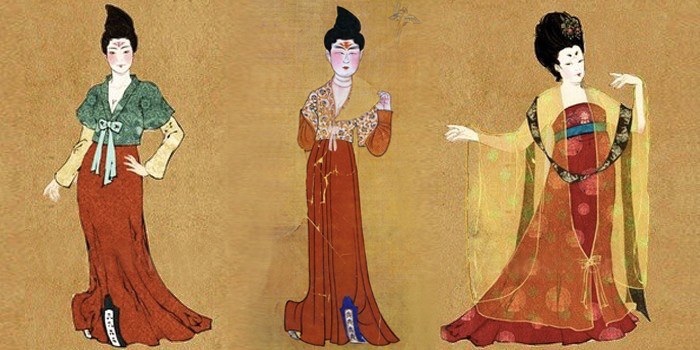
Opening and closing the gates of heaven,
Can you play the role of woman?

Something I’ve learned to appreciate over the years is the mental challenge of empathizing with a text that occasionally transgresses our contemporary sensibilities: in other words, I read these words and recognize there is much here that “you can’t say anymore.”

Let’s say what is uncomfortably obvious – opening and closing the gates of heaven means two things, in this context: the act of childbirth and the act of sex. 

What does it mean to be directed toward these behaviors, these functions, and be challenged by a great sage in our ability to adopt this role, the uniquely female role?

It means: can you bring ideas into form. Can you materially contribute to the world? Can add to the sum of humanity? Can you usher in something precious and delicate, filled with energy and potential? Can you make the world a more beautiful place? 

The gates of heaven swing both ways: mortals are lifted up to it, and the material world descends from it. Women are here identified as facilitating that process symbolically but also in a very literal way. There is more or less nothing more pleasurable than sex and there is nothing more awe inspiring than the birth of a child. Life comes into this world through women, and women do a great deal to make life what it is. Therefore anyone who reads “can you play the role of woman” and recoils in offense is nothing but a churlish prude: Lao Tzu has quite literally recognized women as having divine purpose.

Also, remember that it was not uncommon for women to die in childbirth. Can you, therefore, summon the fortitude to sacrifice yourself for the sake of the future? For the sake of our collective continuity? Can you conceive of something more important than you, meant to outlast you, meant to literally replace you, and commit everything you have to its development? Can you pay the ultimate price for the sake of what will die without our continued care and attention?

The “role of woman” is here defined by answering the terror of our own mortality with the sacrificial act, in both big and small ways, of creating the future.
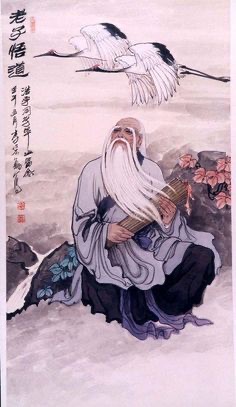
Understanding and being open to all things,
Are you able to do nothing?

Doing nothing becomes an option to the person who has achieved understanding. Without openness and understanding, there is only discomfort with what is not understood. There is only the threat of what you don’t understand and cannot control, and the countless ways people flail about in their frustrated confusion.

Much of this activity doesn’t look frustrated or confused on the surface – often enough, it looks and many ways is perfectly orderly and elegant. A job, a career, a relationship, a family, even a healthy, active, scholarly or meditative way of life – these are all constructive and worthwhile things that are nonetheless likely to be used as distractions from the deeper mysteries we feel unfit to face.

We busy ourselves being industrious, or leisurely, or artistic, or sociable, to some degree, because we are not truly at peace just as we are. I have to insist that this is not meant to, nor does it diminish the value and the benefits of living in these ways – but all I have to do is ask you, do you understand and accept the world?, and just about anyone is short-circuited by this.

To be fair, it’s a highly unfair question! A person isn’t meant to go asking this of others, and no acceptable answer or explanation could possibly be given! Nor is do nothing meant to be taken for the Sage’s prescription to the aspirant! What you are meant to do is ask yourself. 

Calmly and quietly, search for the still reservoir of calm and quiet inside yourself. Look for the understanding already present within yourself, give yourself permission to acknowledge it. But, rather than jump up to act on it, thereby spoiling it, simply accept that you know whatever it is that you know. Don’t tell others, don’t write it down, don’t try to change your life. Simply admit to yourself that you understand. Accept your own knowledge, and do nothing but accept it.

Once you have learned how to want to understand rather than want to change something, your day to day thoughts, words, and actions will change. They will change in the sense that they will gradually adjust and reflect your growing understanding, just as they currently reflect the understanding you have now. 

There is a lag time between the new understanding and it’s reflection in your actions, because you have to learn how to behave in accordance with new knowledge. The lag time is enhanced by the fact that if you are truly seeking understanding, from a place of complete openness, you are certainly not preoccupied with yourself. You’re not thinking of how you look, how you sound, or how to impress or convince others. What you’re thinking about is the object of your understanding – whatever it is in your life that you have truly begun to investigate and care about. You are earnest, sincere, and diligent, and will not be rushed or dissuaded by anything or anyone: this is the path of understanding, as contrasted with the path of preoccupation and performance.

Preoccupation? Performance? By this I mean that many of us can do the right things well enough, but the motive is not totally right – we perform our morality because we are preoccupied with our own standing in our social milieu, or preoccupied with our own discomfort in the face of what life presents to us, and so we act out the prescribed behaviors to make the discomfort go away.

You can live your entire life this way, to the point where the discomfort in the face of what is not truly understood is buried beneath all conscious recognition. No one is castigating anyone for this, but Lao Tzu simply asks, “are you able to do nothing?” Can you be still and resist the compulsion to manage things into their cubbyholes, can you be still and mentally investigate the meaning of the events unfolding around you? Can you welcome reality in a gentle and benevolent way, seeking to see beneath the surface and to truly get to know your world?
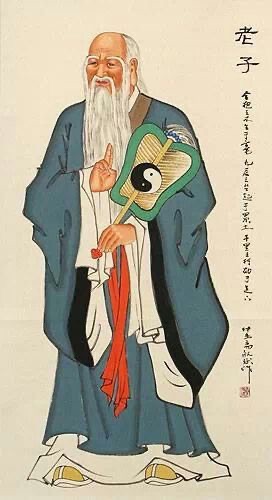
Giving birth and nourishing,
Bearing yet not possessing,
Working yet not taking credit,
Leading yet not dominating,
This is the Primal Virtue.

Lao Tzu asks his six penetrating questions, setting a high bar both conceptually and ethically, and concludes by distilling the essence of them into a simple injunction: pour yourself into whatever you do, and put yourself aside.

Shoulder the weight, but don’t claim ownership of what you carry. Carry it because it needs carrying.

Bring life into the world and care for it.

Perform the tasks before you because they are incomplete, and incomplete work cannot stand. That you did the work does not make you special – failing to do it does.

When you know what needs to be done, how to do it, and why, you have a responsibility to guide those who don’t. This does not make you superior to them, nor them subordinate to you.

In short, nothing you do can give you some claim to special status or treatment: a duty is a duty because of the harm that befalls the community when it is abdicated. “Status” is nothing but a position of greater responsibility, greater and more consequential duties. We are not here to barter with life – not here to set up deals and collect on whatever we can get for ourselves. 

The best way for us to enhance ourselves is by meeting life’s demands in the right way:

By learning to hold our in our minds our inner beings, bodies, and material and social environments all at once, continuously;

By giving complete attention to whatever we engage with and thereby staying fresh, flexible, and forever on the edge of discovery;

By cleaning our perceptions of the deposits of the past, and resisting the buildup that leads to cynicism and corruption;

By fully stepping into the role of a benevolent ruler, seeing to the needs of others and letting go of all “tricks of the trade;”

By using our minds and bodies as vessels for the future, bringing things from conception to material reality;

By having the insight and open-heartedness to resist compulsive, thoughtless actions – by having the capacity for stillness.

This is how we become virtuous, how we realize our potential, and find what we truly want out of life.

In short, what is needed for a remarkable and meaningful life is to be found in the completion of the various tasks life supplies to us without our asking. Therefore there is nothing to seek, only a life to be lived – it is nowhere else but before you now.

Thank you for reading. Talk to you soon.

Jas
The Tao of Diminishing Returns: a Sage knows when to stop

The Tao Te Ching is a manual for being yourself. A manual for living in the world without losing touch with what matters most: your own self, who senses, feels, thinks, imagines, reasons, judges, and decides. The subtle something that is there when you’re truly present, but whose absence renders everything subjectively meaningless.

I said it was a manual, but it is very unlike other manuals. Lao Tzu constructed the Tao Te Ching as a series of short, terse, and often opaque chapters that force you to think deeply. He says simplistic things right beside subtle things, to show you these two things aren’t that dissimilar after all. He describes the ways of a wise sage, and contrasts it with all the ways to live unwisely.

One of more prominent themes of the book, and a necessity on the road to wisdom, is the cultivation of unforced restraint.

While other teachings speak the language of right and wrong, good and evil, heaven and hell, today we are speaking the language of enough and too much. 

And, what is too much? The point at which you lose yourself. Avoiding this error is the subject of our talk today.

It is not about the process

When you are in control of yourself, aware of what you are doing, for whom, and why, you know when to stop: the sufficient quantity, quality, scope, and character of the end result, whatever form it takes, is kept in view until it is reached.

In every moment, however, there is a tug of war taking place: the zoomed out maturity of perspective on the one side and the up-close pull of mindless activity on the other.

Every action offers you the opportunity to lose yourself in its performance. The opportunity to take your mind off the results and to become utterly absorbed in the action itself.

Normally, when you hear people talk about ignoring results for the sake of enjoying the process, this is presented as desirable, therapeutic, and wise.

Not so fast.

Doing things correctly means producing correct results. Losing yourself in a positive way only means finding the appropriate level of difficulty that allows you to become absorbed in the execution, rather than bored (too easy) or self conscious (too difficult). 

The quality of what you produce is always paramount. How could it be otherwise?

Losing yourself, in a positive way, really means forgetting about what you’re receiving as compensation, and thinking only of the quality and quantity of effort that you are giving. It means thinking only of the needs of whatever or whoever is demanding your attention.

When you behave this way, results are never secondary: your process conforms willingly and even gleefully to what is required in order to produce the necessary results.

Finally, inputs and outputs are inseparable from one another. Nothing happens by simply brooding over your desire for results, your impatience for them, your dissatisfaction with what you have, what you’re doing, or who you are now. Outputs only follow from inputs: competent people simply keep themselves occupied with supplying the necessary inputs, and monitoring the outputs as a form of quality control. This is the extent to which “favoring the process over results” has meaning.

Chapter 9 of the Tao Te Ching communicates all of this with the highest degree of economy:

Better to stop short than fill to the brim.

Oversharpen the blade and the edge will soon blunt.

Amass a store of gold and jade and no one can protect it.

Claim wealth and titles, and disaster will soon follow.

Retire when the work is done.

This is the way of heaven.

Four examples of excess, each subtler than the next. Each line a lesson in itself. It concludes with a simple injunction: stop when it is time to stop, and your life will reflect the highest virtue.

How do you know when to stop?

Here is what I am trying to understand: why do we keep going when we ought to stop? What puts us beyond the reach of the intervening hand called “enough?”

Is it pride? Is it tunnel vision? Is it immaturity? Is it impulsivity? Is it unconsciously projecting the past, or the “subconscious” onto the present reality? Is it an existential void that makes people seek wholeness in mere activity and possessions?

The cause of excess may be any of these at different times and for different people. If you want to be healthy and normal, your focus is on applying solutions, not contemplating the source of the problem. Lao Tzu explains the problem with the first four lines, and provides the solution in the last two: retire when the work is done. This is the way of heaven.

The first step in regulating yourself is to become transactional.

Bring your attention to the fact that what you’re doing is work. A task. And, because the completion of the task requires your presence every bit as much as it requires the resources you use, it follows that you too are a resource: whatever you do, everything you touch, is a project into which you are investing yourself.

To see yourself as a resource is to become conscious of expenditure. Would you keep handing money to the clerk after you’d already paid the full price? I hope not. A resource is finite, and is expended in exchange for something specific. Something that affords an advantage to the person making the expense.

To go too far is to be inattentive to the nature of the transaction at hand. As I said above, the reasons for inattention are legion. Ultimately, it is both impossible and unnecessary to know exactly why the approach is wrong, the attention is wrong, the results are wrong. 

At least, for the person trying to make improvements, this knowledge is not a prerequisite for the work to begin. Rather, the nature of the illness becomes clear as one advances on the road to health. The more you come to value yourself, to see your time and energy as the valuable thing being spent, the less you will blindly run after things, because you will see it as blindly buying things.

Once you begin to draw boundaries around your resources, you will gradually go from a sieve to a reservoir. You will become (and come to see yourself as) whole.

So, and this is the important part, what happens when you operate from a place of wholeness?

You are driven by interests, and the healthy signals of your needs and instincts. Not by a misplaced desire to complete yourself. A complete person is available and responsive from moment to moment, because his or her basic existential security is intact. Such a person can operate creatively, collaboratively, helpfully, and patiently.

The Law of Diminishing Returns

All activity has three phases: the productive phase, where every unit of input reliably produces the desired outputs; the phase of diminishing returns, where the outputs decrease in quantity and/or quality; and the phase of negative returns, where more inputs actually cause a depletion of outputs.

When you are caught up in an activity, possessed by it, and thereby blinded to its results, you misinterpret the signs as you move through these three stages. Thinking that more is always the answer, you will inevitably progress into the phase of diminishing returns and mistakenly respond with a redoubling of your efforts, which only pushes you toward the phase of negative returns.

This is where burnout happens.

This is where people quit, never to return.

This is where life stops making sense.

You throw the ball and it flies in the opposite direction.

You hit the nail with the hammer and it comes back out.

You run faster and the finish line only moves farther away, until it disappears.

This is what activity in the phase of negative returns feels like.

How do you stay in the phase of productive returns?

Lao Tzu, as usual, starts with an obvious example: filling a cup with liquid. If you keep pouring liquid into the cup, pretty soon it will overflow: pouring in has now become pouring out, even though the mechanics of the activity have remained constant.

Pouring water into a cup is an easy example, precisely because nobody pours for the sake of pouring. When you pour, you watch the cup, which is to say, you are only looking at the effects (the height of the liquid) as the means by which you moderate the cause (the mechanics of pouring).

Understanding the result you are looking for, the reason you are doing the activity, is the way you focus appropriately. It tells you how, how much, in what way, for how long, and when and how to stop. 

I’m writing this article right now – I have clear criteria for completion. My goal is to wake you up to the urgently important nature of everything you are so sure you already understand. To bring your attention to what is foundational and unremarkable, and activate a sense of discovery and adventure – that is my work. I have no knowledge and no presumptions about what you might like to build on your own foundation, but I do presume that your foundation could be stronger.

What limited me was precisely this: a weak and incomplete foundation. I had to learn how to stop, how to move on from something once it had served its purpose. I had to learn how to live purposefully, and to reject temptations and invitations to activities that had no clear or beneficial purpose.

I had to learn how to work, and to retire upon completion of the work. I discovered that retirement, the conscious act of finishing something and putting it aside, is both edifying and reifying.

What do I mean by that?

Edifying because I separate myself from the task by pronouncing it complete. Not perfect, but sufficient, and concluded. I regain the part of myself that was tied up in the work, and it returns to me accomplished, efficacious, dignified. 

Reifying because my work now has a beginning and an end. Whatever I have done, it now lives as a  discreet fact of existence, real, concrete, specific, and eternal. It is eternal because is is now part of the unalterable record of the past.

By saying, “I have now completed this,” both my person and my deeds have acquired more reality and more solidity in the world. One accomplishment at a time, I become more accomplished. If the deeds were worth doing, then the world, too, has become a better place by the same increment.

Every time I do this, I become more conscious of limits. I can see the lip of the cup in all things, because I know what activity, completion, and cessation feel like when done correctly.

Better to stop short than fill to the brim.

Oversharpen the blade and the edge will soon blunt.

Amass a store of gold and jade and no one can defend it.

Claim wealth and titles, and disaster will soon follow.

Retire when the work is done.

This is the way of heaven.

Thank you for reading. Talk to you soon.

-Jas

Only The Ruthless Can See Clearly Enough To Be Helpful: Chapter 5 of the Tao Te Ching

One ring to rule them all.

That’s the famous line from The Lord Of The Rings. The ONE ring, the one source of power that controls all the rest.

There were other rings, many others in fact, that were given to numerous people in various positions of power, but, secretly, one ring controlled them all.

In the books and the film adaptations, these rings were all created by the arch nemesis, Sauron.

But is there an equivalent to The One Ring in real life, created by the good guys? Is there one thing, hidden away, that controls all the other levers that are visible publicly? One thing, that, if seized and taken control of, makes control of all the rest next to effortless?

For you and me, in other words for regular people trying to live good lives, The One Ring is wisdom. Good judgment. Right thinking. The proper use of whatever information we have.

If you think The Lord of the Rings is an old book, let’s look at a much older one: The Ramayana. The Ramayana is the tale of Rama, an avatar or incarnation of Vishnu, the Hindu God that sustains the universe (as opposed to Brahma, the creator, and Shiva, the destroyer).

Long story short, Rama and his allies undertake the arduous mission of dethroning and defeating the Demon King Ravana (not unlike Sauron in terms of his evil intent, but, rather unlike Sauron, still having a body. Ravana is, in fact, a serial rapist, murderer, and so on).

The good guys ultimately win, but in the immediate aftermath of their victory, something quite interesting happens. I say “interesting,” because, years after reading Ramesh Menon’s beautiful translation of the ancient epic, this is the one and only line from the book that I remember, verbatim, after only reading it once.

Here’s what happened.

The good guys win, and almighty Shiva himself appears before the victorious heroes to grant them any wish they choose. Literally anything. It’s worth taking a moment to contemplate what you might wish for.

Among them is Vibhishana, not insignificantly the younger brother of Ravana. When the Lord Shiva asked him which boon to grant him, Vibhishana said, and let this be emblazoned across your mind forever,

“Let my first thought always be of dharma.”

And what is dharma? The Sanskrit root of the word means “to uphold.” So, that which holds this all together, what edifies and rightens the world, the principles-in-practice that lead us goodness and deliver us from wickedness – that is dharma.

Let my first thought always be of dharma. Let me always think wisely.

Vibhishana was wise enough to wish for wisdom. The story of the Ramayana, like Tolkien’s classic, is not just an accounting of our team beating the other team, but a parsing of right from wrong, wisdom from folly, in such a way that we might grow in understanding by reading and reflecting on it: we divide the world not into us and them but into right and wrong, good and evil, wisdom and folly.

Those lines will not obey the us/them distinction, as evidenced by the fact that Vibhishana is the brother of the villain, Ravana. In the Lord Of The Rings, Gandalf must defeat his own peer and former mentor, Saruman. The sentiment is the same: if the world is to be divided, let it be along lines of morality, ethics, and virtue. Let the good triumph over the wicked, even the wicked among us.

Let me take it a step further:

Let what is good, virtuous, and wise within you triumph over that which is wicked within you. Ravana and Vibhishana were brothers, born of the same parents, raised in the same household.

With that in mind, with this raised sense of urgency and consequence in mind, I wish to outline the meaning of chapter 5 of the Tao Te Ching, the Book of the Way. My invocation of the Tao is quite close to Vibhishana’s invocation of Dharma: that which upholds.

Come with me on this journey into the obscure and esoteric: what we are looking for, what we are actually hammering into its shape with each discussion, is The One Ring of wisdom, of Dharma, of Tao.

I’ll begin by reprinting the chapter in full, and then exploring its meaning one idea at a time. Let’s get started.

FIVE

Heaven and earth are ruthless;
They see the ten thousand things as dummies.
The wise are ruthless;
They see the people as dummies.

The space between heaven and earth is like a bellows.
The shape changes but not the form;
The more it moves, the more it yields.
More words count less.
Hold fast to the center.

We essentially have two halves, one fairly straightforward, the second more subtle. As is often or even always the case with Lao Tzu, the simple is the solid foothold from which you step across the chasm to the deeper idea. He always gives you the means by which to do this. He always gives you the low rungs on the ladder to get you going.

Heaven and earth are ruthless;
They see the ten thousand things as dummies.
The wise are ruthless;
They see the people as dummies.

What are we to make of this word, “ruthless?” It means having no pity or compassion for others. It neither denotes nor connotes, however, ill intent or hostility. Rather, it highlights the coldness of an amoral universe.

The world is pitiless: unmoved by the suffering of its inhabitants. Not unaware: unmoved. Exceptions are not made in view of pain, loss, or even tragedy.

The world is the way that it is, and there is no operant power in it that will tilt the scales, look the other way, or otherwise grease the wheels if it can just be moved to sympathy. No. This sentiment also appears in Steven Mitchell’s translation of the Book of Job: behold, hope is a lie. More famously still, it is inscribed over the gates of Hell in canto 3 of Dante’s Inferno: lasciate ogne ‘speranza, voi ch’intrate (abandon all hope, ye who enter here): the rules shall not be bent for you, wretched creature.

As harsh as this is, it is a critical step toward wisdom. Heaven and Earth are ruthless, and the wise, too, are ruthless. Neither admit of exceptions. Neither traffic in sentimentality or sympathy.

Now hold on a moment. Usually,  when we think of wisdom we also think of benevolence, but these opening lines appear to shatter that completely.

We will have to repeatedly and often forcefully cleave apart pitilessness on the one hand and active malice on the other: the former is what we are dealing with, and it is, in fact, the only way by which the latter can be contended with.

What do I mean? Wisdom is what keeps you on the right path, by definition. This means there can be no room for fanciful nonsense, whimsical make believe, naive aspirations toward fairy tale endings. The wise are ruthless, and see the people “as dummies.”

In other words, as objects completely helpless in the face of the forces governing them.

If heaven and earth, which is to say the natural world, has no pity for the plight of its plants and animals, and those that make it make it and those that don’t don’t, then the wise sages have the resolve to admit that human affairs are no different. If food runs out, there is starvation. If shelter is not secured, the elements will take you out. If the cut is not cleaned, infection will set in.

This is ruthless simplicity: we are caught in the middle of countless cause and effect relationships, and they are all as unalterable as the laws of physics and other biological realities.

“Tell me lies, tell me sweet little lies” is not the refrain of the sage. A sage faces reality, and whether in the form of direct instruction or simply an instructive example, shows you how to do the same.

So far, I have been correct, but still incomplete. Benevolence must be addressed. Because, like I said before, a sage is benevolent. Wisdom is benevolence itself. How, may I ask, can benevolence be exercised in an uncaring world? And, how are people who are so often the authors of their own suffering, for reasons and in ways too numerous to enumerate, to be cared for? No honest person over a certain age can deny the frequency with which efforts to help others quickly dead-ends in frustration.

It is all too often because the naively well-meaning among us are rushing to the aide of the naively inept: help that is not truly helpful is being offered to those who are unable to receive. A stalemate, or a tragedy of errors, in the making.

In other words, a person who has not truly faced reality is seeking to remedy the reality of another

It is a hell of a statement to say that “the wise are ruthless.” Why? Because the council of a wise person is the best you could hope for. Or maybe you’d like to tell me what you’d rather have in a piece of advice or a bit of help than wisdom. Let us just say it then: the most helpful possible person is also someone characterized by ruthlessness.

Or did you already know that?

If error, if avoidable suffering, is caused by illusions, help worthy of the name can only come from someone with none, and such a person will seem downright ruthless to the deluded.

The space between heaven and earth is like a bellows.
The shape changes but not the form;
The more it moves, the more it yields.

This is the truly esoteric idea at the core of the chapter. Once we understand its meaning on its own, we can look at how its meaning is extended by the lines that come before and after.

Let’s start by rewording this strange phrase as “the world moves, but it doesn’t change.” I will come back to this, but I have to tease out or demystify it a bit more first.

Something else the metaphor of the bellows implies is that what “it yields” is just the movement of air. The air it draws into itself when it opens is the same air it expels when it closes: the more it moves, the more it yields.

In other words, look at “the ten thousand things,” which is to say, the contents of the world, less as many individual objects and more like a singular expression of a convulsing world.

Its shape is changing in the sense that it is moving, but the form doesn’t change. Meaning, the movements are built into the way it is structured: the form can remain static even as the shape moves, and moves much air in the process.

What, finally, does this mean? What if I answer with another question (forgive me): what if all you’re seeing before you, day after day, year after year, is movement, not change?

From one person to the next, one situation to the next, one relationship to the next, one environment with its set of dynamics, personalities, and politics to the next – it’s all just “the world.” All of this, all of it, is nothing but the world.

Are you seeing it? Not reducible to a unit smaller than “the world!”

This is why the idea of change is taken off the table, and replaced with the more limited concept of movement (this is what is meant by drawing a distinction between “shape” and “form”).

What this means is that there is not nor could there be, for someone seeing the world in this way, such a thing as novelty. Or anonymity. Or running away and starting over. When you were born, you entered into an exclusive relationship with something called The World. Every distinct person, every distinct circumstance, is still just you and the world taking a long walk together. It is all the same, ever the same, inescapably the same.

This means that everything you say or do, you say or do to the world itself. No slate is wiped clean by the revolving door of faces, situations, and circumstances.

This is intrinsically related to the ruthlessness of both heaven and earth and the wise: if there is never change, only movement, then there is no running away from the consequences of your actions, no dodging, no concealing, no procrastinating.

If there is nowhere to go, because the world is a single indivisible mass and does not break down into any, and I mean any constituent parts, then whatever is broken or incomplete in your understanding of and relationship to the world may as well be faced down and resolved right here, right now.

More words count less.
Hold fast to the center.

The missing piece in our lives is not, I promise you, more words. You don’t need more theories, explanations, ideas, and dreams, but a firmer and less-frequently-interrupted grip on reality. You need to feel the center, to make it central, and to stay right there, right with it.

Thoughtless and self indulgent speech takes you away from the center. Words make conceptual maps of the world. More words can make you think the world itself has expanded. Uncovering a new idea – surely there are objective natural phenomena that correspond to these word-pictures? Maybe not. You can use words as if to fashion a brand new key. You now assume there is a special door somewhere waiting to be opened by it.

But the world we construct out of words, the world of abstractions, of which political or religious rhetoric is filled to the brim, is like the incomprehensibly large keyring of a janitor in a high rise building –

Except that none of those keys correspond to actual doors. They are just there, jingling at the jostling of your hips, like the ringing of a bell that heralds the presence of the man of knowledge, the sophisticated person.

There was only ever the world, the one and only true world, and because it is the one and only, there isn’t even a door, isn’t even a key, and there never was.

Wisdom is the ruthlessness that strips all this make believe away, sees the one and only real shape standing in the room full of mirrors, holding fast to the center all the while.

Thank you for reading. Talk to you soon.

-Jas

Looking for more?
My recent interview with Atlantic Bridge Podcast
Follow me on X
Take my FREE 5 Day Self Development Primer

I Read The Tragedy of Faust: Here’s What I Learned

Welcome back.

Earlier yesterday morning I finished reading one of the crowning achievements of western literature, The Tragedy of Faust, written by the German polymath Johan Wolfgang von Goethe between 1730 and 1790.

In today’s article, I’m going to give a brief overview of Goethe as a literary and cultural figure, provide a very general outline of the plot, summarize what the play has to say about the nature of good, evil, and redemption, and conclude with some reflections of my own.

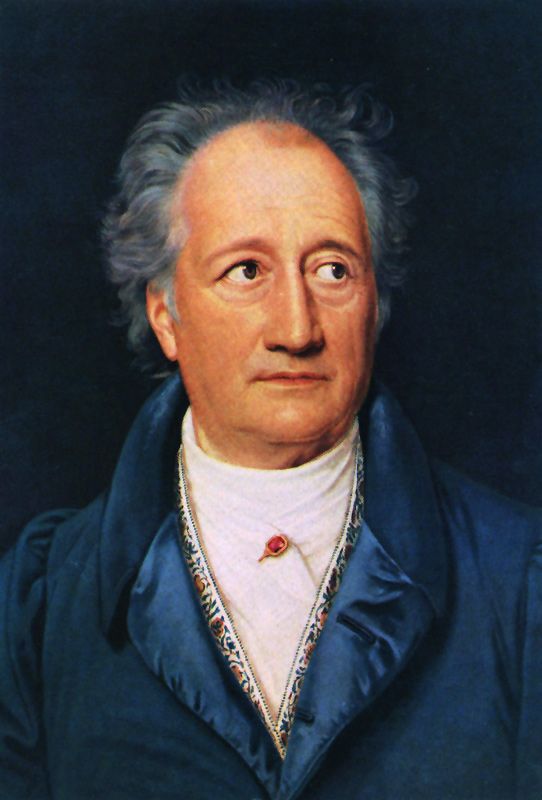
Goethe (pronounced, more or less, Gur-ta) was German novelist, playwright, poet, scientist, critic, statesman, and even theater director.

His career is, therefore, beyond synopsis and not reducible to a single work, or even a single genre of writing. In every area of intellectual life Goethe touched, he is considered a master, and, in some cases, unsurpassed.

His influence on the German language and on the trajectory of the western literary world is hard for an anglophone reader to comprehend or relate to.

Perhaps, if Shakespeare, Charles Darwin, and Mark Twain were combined into one person, this might approximate the stature of Johann Wolfgang von Goethe.

For these reasons, his tragic play Faust holds special significance. It is a life-spanning work, begun early in his life and concluded near its end.

Johann Wolfgang von Goethe

The protagonist, Heinrich Faust, is clearly a representation of Goethe in many ways: a doctor and a scholar, whose studies and achievements have led him to the pinnacle of the European model of enlightenment, has nothing left to conquer.

Alone in his study, his quest for knowledge has alienated him from the world: not only has he not found happiness, fulfillment, or love, but he can think of nowhere else to look. He is experiencing, in the words of the poet Wallace Stevens, “the barrenness of the fertile thing that can achieve no more.”

He has followed the enterprise of truth seeking, as he understands it, to a dead end.

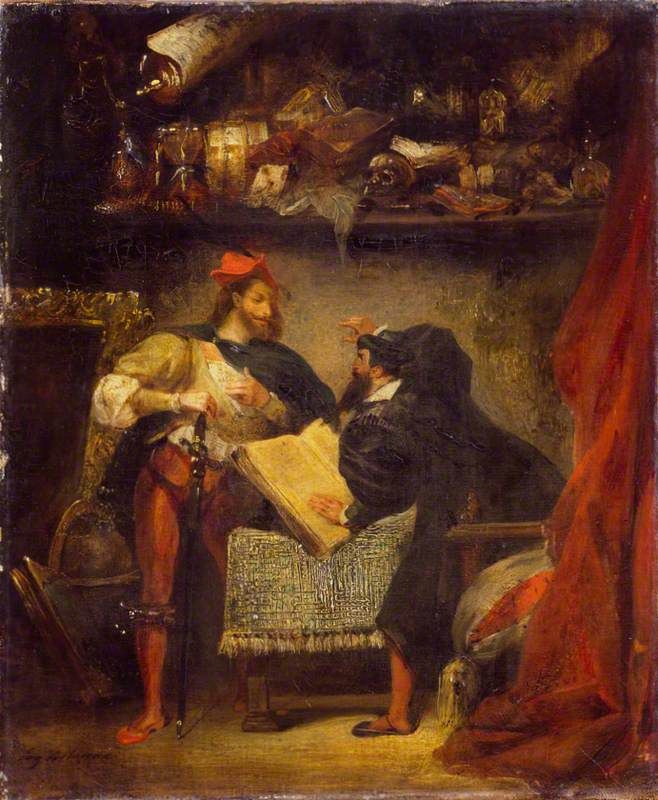
Late into the night, he thinks to turn to occultism. He opens a book of runes and symbols, eventually deciding to summon the Earth Spirit.

Faust may be an impressive scholar, even an authority, but he is out of his depth when the Earth Spirit materializes: he jumps with fright and cowers from it, embarrassing himself and drawing the ire of the apparition who is taken aback and disappointed by Faust’s temerity. He departs, leaving the would-be wizard dejected.

This is Faust’s lowest point: he is in fact contemplating suicide, seeing that he can no more be satisfied with academic knowledge than he can stomach the path of occult knowledge. He has nothing left.

At the last moment, however, he is interrupted by his servant, Wagner. They briefly converse, and his despair is not so much assuaged as it is dissipated. They decide to take a stroll through the town, now that the sun has risen.

It is here that the real plot of the play begins: a black dog approaches them, follows them home, back to Faust’s study, and then reveals his true identity: Mephistopheles, the devil. Or, as he describes himself, “the spirit that negates.”

After some back and forth, the world-weary and disaffected Faust sees in Mephistopheles an opportunity, and strikes a bargain with him: grant my every desire, always at my beck and call, until the moment I say “abide moment, thou art so fair.”

Faust is going to exploit the supernatural powers of Mephistopheles in one final attempt to find that which has eluded him all this time: that magical something that will finally quell his desire for more. If Mephistopheles can satisfy Faust, Faust’s soul belongs to Mephistopheles for eternity: the archetypal Faustian bargain.

The adventures that follow are humorous, grotesque, macabre, and also heartbreaking. He encounters a simple but virtuous peasant woman, Gretchen, with whom he becomes infatuated. Enlisting the dark powers of Mephistopheles, he eventually creates the necessary conditions to seduce her, and they have sex.

Because Faust is searching for the be all and end all of experience itself, however, he is not and cannot be satisfied with this, and abandons her to pursue other strange and dark phenomena with his enabling companion.

When he misses Gretchen and decides to visit her again, however, he finds that she has gone mad, and is awaiting execution. We learn that her encounter with Faust has irreparably destroyed her family, her sanity, and her life.

The sleeping potion that Faust gave to Gretchen’s mother to ensure that she wouldn’t wake up while they were having sex proved fatal.

The man that learned of their illicit rendezvous and died in a duel with Faust in an attempt to defend her honor was her own brother, Valentine.

Gretchen became pregnant with Faust’s baby and, both abandoned by him and left without any family on his account, drowned the baby and went mad. For the crime of infanticide, she is to be put to death.

While Faust is overcome with grief by what has happened to Gretchen, he does not truly love her, and is not prepared to sacrifice anything for her. He cannot save her conscience, but he tries to get her to escape the jail with him (made possible by the help of Mephistopheles). But for Gretchen, it is all over: she cannot live with what has happened, what she has done, and with the total loss of her own innocence and virtue. She stays, and dies. Faust leaves, to continue his quest.

This concludes part 1 of the tragedy. Part 2, heavily abridged in the Walter Kaufmann translation I read, concerns Faust and Mephistopheles traveling through time and to distant regions of the world, interacting with mythological and historical figures.

The play concludes with Faust, now a very old man, with the tragedy of Gretchen far behind him, now engaged in an ambitious project of land development, essentially taking on the work of civilization itself: conquering nature for the sake of human flourishing.

One elderly couple stands in his way, refusing to give up their estate to make room for his designs. He enlists Mephistopheles’ help, but his demonic companion goes too far and burns down their vineyard, killing the old couple.

For the first time, Faust expresses remorse, and is soon thereafter visited by the spirits of Want, Care, Guilt, and Distress. Care alone can reach him, and she immediately takes his eyesight from him.

It is here that Faust undergoes a sudden change: unable to see the results of his actions, he begins to direct the actions of others, not to the fulfillment of his desires, but towards what he intuitively knows to be “right” in a higher sense.

Essentially, he directs the men at his disposal to work at the limits of their ability, even the limits of their safety, in the service of work that is both beneficial and never ending. In the knowledge that men would undertake this task, at his behest, he says at last, verweile doch, du bist so schön! Abide, thou art so fair.

Faust then dies, and, before he can be taken away to hell, the sky opens and the angels remove him to heaven, where his spirit is reunited with the heavenly spirit of Gretchen.

Faust dies a reformed, enlightened man who has attained the true meaning of human life, and has exercised his accumulated power to pass it along. In so doing, his soul is redeemed, and the devil is cheated of his due.

And so the play is concluded.

Analysis

What does Faust get wrong? How does his path lead him from error to enlightenment? In what way does his ultimate realization excuse or redeem his previous errors?

Let’s start with the first glaring error: Faust is mistaken about both the nature of truth seeking and meaning.

Faust sees truth as a thing you can acquire. A commodity or currency that he stockpiles through taking on and mastering various fields of study. This is an incorrect path to truth, and I will now explain why.

The idea of seeking truth, as we understand it, could be said to begin with Socrates. There were pre-Socratic philosophers in ancient Greece, but they did not give us methods, only specific ideas – some of them still inspire us today, most are antiquated, but none of them can be called a system of thinking.

What Socrates gave us was a method by which we could inoculate ourselves against falsehood. A method of probing into facile statements that served a kind of scalpel of logic: whatever is unclear, shallow, or contradictory is cut away by the process of inquiry.

For Socrates, truth is whatever remains after untruth has been carved away by inquiry: resistant to paraphrase, summary, or sloganeering, the truth is subtle and dignified. It is not a possession.

The purpose of pursuing truth, from a Socratic standpoint, is to purge oneself of falsehoods, to say and do nothing that you know, deep down, to be flimsy, expedient, or manipulative.

This is not what Faust has done. Faust has lived his life like a kind of academic imperialist – going from one field of study to another in the hope that his lust for conquest will one day be sated.

In other words, what he is really seeking is technical mastery. Expertise. It is fundamentally acquisitive: something is missing in his life, and he believes that once he reaches a certain threshold, or perhaps unlocks one specific secret, that he will finally be at peace.

Why is this the correct understanding of Faust? Because of the terms of his agreement with Mephistopheles. He is willing to pay the ultimate price, the eternal fate of his soul, in exchange for the one experience that will make him say “abide! Thou art so fair!”

It should be said that Faust is intellectually arrogant. He believes himself to be above his fellow man, and believes the world to be incapable of offering him anything up to his standards.

Mephistopheles frequently mocks him for this, and we see that away that the promise of instant and total wish fulfillment is instantly and totally corrupting for Faust: he becomes so infatuated with Gretchen that he begins bossing around Mephistopheles in a way that almost elicits sympathy from the reader.

This poor little devil, made to do the bidding of this petulant and impetuous man, who has lost all sense of proportion of over the prospect of, pardon me, getting laid, and who senselessly lavishes a modest peasant girl with entire treasure chests of gold and jewelry, on a scale that brings her more embarrassment, suspicion, and social alienation than delight.

And, why is Faust so obsessed with Gretchen to begin with? Because Gretchen is good, simple, and pure. She has substance, but is not learned or sophisticated. She has a simple way of life, working with her hands and caring for immediate family.

She has what he lacks: dutiful, honest work and human connection based on love and mutual interdependence. She has a real life and real relationships.

An already enlightened Faust would have met Gretchen recognized this. Would have committed himself to her and gone through the necessary steps of winning her over, and winning the approval of her family.

But Faust wants to have her, not commit himself to her. This is the entirety of the difference between Faust and Gretchen: she has commitments, he has conquests.

If we are to learn anything from what happens to Gretchen, from her sorrow and madness at having been reduced to a vehicle for sexual experience while being left to deal with the real consequences of that – her brother dying in an attempt to vindicate her honor, her mother dying from a sleeping potion, her pregnancy and subsequent act of infanticide, and all of this happening without Faust by her side – it is that the promise of effortless wish fulfillment leads to tragedy and disaster.

What is it that ultimately redeems Faust?

Let’s hear it in his own words:

This is the highest wisdom that I own,
The best that mankind ever knew:
Freedom and life are earned by those alone
Who conquer them each day anew.
Surrounded by such danger, each one thrives,
Childhood, manhood, and age lead active lives.
At such a throng I would fain stare,
With free men on free ground their freedom share.
Then, to the moment I might say:
Abide, you are so fair!
The traces of my earthly day
No aeons can impair.
As I presage a happiness so high,
I now enjoy the highest moment.

Let’s break down what this isn’t. He doesn’t find faith. He doesn’t commit himself to a woman. He doesn’t find meaning, necessarily, in charity or “selfless service” either.

What he finds is a categorical change in where meaning is sought, rather than in what. There is no longer any what at all, but a how. Not in acquisition, not in knowledge, not in experiences, not even in the nature of the rewards or consequences.

Redemption is found in the process of giving the moment one’s all, one’s total effort, with nothing held back. “Surrounded by such danger, each one thrives.” Real activity, with real stakes. Work that must be renewed daily. The opposite of accumulation, and, actually, the opposite of achievement in the way we think of it.

Faust comes to understand that no single experience or achievement or acquisition relieves the need for daily exertion toward worthy ends: his error, all along, was the belief that there is such a thing as satisfaction, cessation, or arrest.

Oddly enough, his final understanding is an echo of one of his musings early in the play:

It says: “In the beginning was the Word.”
Already I am stopped. It seems absurd.
The Word does not deserve the highest prize,
I must translate it otherwise
If I am well inspired and not blind.
It says: In the beginning was the Mind.
Ponder that first line, wait and see,
Lest you should write too hastily.
Is mind the all-creating source?
It ought to say: In the beginning there was Force.
Yet something warns me as I grasp the pen,
That my translation must be changed again.
The spirit helps me. Now it is exact.
I write: In the beginning was the Act.

Faust speaks these lines moments before the black dog reveals itself to be Mephistopheles, reinforcing the blasphemous nature of the statement. What Faust’s final speech makes clear is that his emphasis on action was right all along, but not the spirit in which it was undertaken.

The deluded Faust of this early monologue dreams of the power to hold dominion over his world, but the enlightened Faust sees that only in the performance of the action is redemption to be found.

This realization stands outside of any commentary on what one should do, and toward what ends. It leaves the question of ends off the table altogether. And, it must be so: Faust has gone to the ends of the earth, backwards and forwards through time, in search of what, and has found nothing. Nothing real, nothing final.

What he finds is not quite the act, in the sense of cause and effect, in the sense of agency and mastery, but action itself: primal, atemporal, total, immersive, vigorous.

It can be said that this understanding is redemptive because it leaves no room for the corruption of one’s motives, because there is no motive. There is no reward. The total immersion in the action itself is the reward:

Freedom and life are earned by those alone
Who conquer them each day anew.

Thank you for reading, talk to you soon.

-Jas


PS – I explore ideas like this because it brings my life into alignment with my ideals. My inner picture of who I am and how I want to live in the world.

I share my thoughts publicly because I want to encourage others to do the same: to make the necessary changes that will bring the outer into harmony with the inner. This is happiness, self respect, and purpose.

To that end, I also create short form content on X/Twitter dealing with psychology of self development, and I’ve recently created a free 5 day educational email course on the same topic, “Self Development Cheat Codes.”

It goes over the 5 biggest mistakes people make when they decide they want to get their lives together, and I provide 15 specific frameworks to guide people along their journey. If you’d like to have more of a concrete method at your disposal, get the free materials here.

Thanks again.

The Weak Have Desires, The Strong Have Purpose

Welcome back.

Today, we start with a quote from anthropologist Ralph Linton, taken from his text The Study of Man. I’ll reproduce the quote first and provide analysis after:

This tendency toward the unnecessary and in some cases even injurious elaboration of culture is one of the most significant phenomena of human life. It proves that the development of culture has become an end in itself. Man may be a rational being, but he is certainly not a utilitarian one. The constant revision and expansion of his social heredity is a result of some inner drive, not of necessity. …it seems possible that the human capacity for being bored, rather than man’s social or cultural needs lies at the root of man’s cultural advance. (p.184-5, Ralph Linton, The Study of Man)

Read the first sentence again: this tendency toward the unnecessary and in some cases even injurious elaboration of culture is one of the most significant phenomena of human life.

“Injurious elaboration of culture.”

Let me paraphrase: the same way that a moth is hardwired to use a light source to orient itself in flight, and cannot distinguish between the moon and a candle, and thus cannot avoid burning itself…

…it seems possible that humans are hardwired to revise and expand upon their inherited social systems, and cannot distinguish between what works just fine and what could be better. Thus, we can’t quite steer clear from “injurious elaborations of culture.

To paraphrase again: boredom leads people to do things that are unwise, on both a personal and societal scale.

What is wisdom? The capacity to differentiate between what is truly beneficial and what is merely tempting. What is necessary and edifying and what is unnecessary and injurious.

Philosophy (the love of wisdom) is the enterprise of installing better software in our malleable minds – updates that can tell the moon from a candle, an opportunity from a trap, selfishness from self respect.

And this is why I focus as much as I do on the Tao Te Ching: it seems dead set on communicating the necessity of knowing when to stop. How to become someone who instinctively knows where the limits are before they are exceeded.

It immerses you in the attitude of a wise person, and, if you stay in it long enough, internalizing and practicing it diligently, you become wise too. Doing less of what is unnecessary, the requisite attention, energy, and will to do what is necessary is available more often and in greater supply.

Today, I want to dissect chapter 3. You’ll see why in a moment. It contains some truly puzzling phrases that demand interpretation but yield correspondingly deep insights.

Chapter 3

Not exalting the gifted prevents quarreling.
Not collecting treasures prevents stealing.
Not seeing desirable things prevents confusion of the heart.

The wise therefore rule by emptying hearts and stuffing bellies,
By weakening ambitions and strengthening bones.
If people lack knowledge and desire,
Then intellectuals will not try to interfere.
If nothing is done, then all will be well.

When I was engaged in the work of memorizing the text, I began to take a special liking to the stanzas that seemed almost intentionally objectionable in the way they were worded.

People should lack knowledge? That is a good thing? We should do nothing? We should ignore the problems of the world? We should give up on our hopes and dreams and just eat to our hearts’ content?

It sure sounds like that’s what’s being said.

I can assure you, however, that Lao Tzu went to the appropriate lengths to divert shallow, reactive minds. These seemingly ridiculous statements that occasionally surface in the text are here, I believe, to attract those who are sincerely curious and willing to do the necessary heavy lifting, so to speak, to get at the truth, while putting off those unwilling to exercise their minds.

So, let’s begin. Let’s actually think, and grow from the labor of doing so, rather than simply consume the same trite drivel in new verbiage over and over again, atrophying from the lack of effort.

Not exalting the gifted prevents quarreling.

Let’s make sense of this by going back to the absolute basics. What do we want a society to be? Harmoniously integrated. We grant without question that there is a distribution of virtue: some are obviously better than others. Some are taller, stronger, faster, healthier, smarter, and even nobler than others: only the worst people deny this. What, then, is the best thing to do with the best of us?

If the goal is cohesion, integration, a society functioning as one organism, assigning the appropriate duties and resources to each component part, then exaltation does nothing to achieve this goal.

Exaltation actually separates the gifted from the rest, and puts a spotlight not on their achievements but on them. To exalt means to lift above the others. Why? So it can be seen and admired by all. Does that sound healthy and appropriate to you? To encourage people to think of some as above them, and themselves as necessarily inferior?

Is it socially responsible to encourage some people to feel superior and others inferior?  Is it socially responsible to turn attention and praise into a currency with value, to be sought, traded, and expended for personal benefit?

Obviously not. We’re invited to consider how this path leads to division (quarreling), rather than cohesion.

What do I think we should do instead? Fair question, and I will answer it later, but not now. Now, we get clear about what does not and cannot possibly work. That’s always step 1.

Not collecting treasures prevents stealing.

It might not be obvious that exalting the gifted causes quarreling, but it should be obvious that stockpiling resources attracts desperate and unscrupulous people seeking resources.

What’s less obvious, though? That having to have (collecting treasures) isn’t that different from having to praise (exalting the gifted). If the best thing to do with the gifted is not to exalt them, then the best thing to do with treasures is not to collect them, and for the same reason.

Not seeing desirable things prevents confusion of the heart.

One more negation before we get into solutions, prescriptions made in the affirmative.

Where does confusion of the heart come from? From gazing upon something lovely and longing for it. Imagining you need it, feeling pained by your lack of it. Feeling that whatever you do have must not be good enough, if you feel this desire and longing in the face of what you do not possess.

This is confusion: not knowing where to go, being unsure of where you are, unsure of what you perceive. Possessed by fantasy, imagining yourself enhanced by the acquisition of more, and being increasingly lured into an imagined world. It should go without saying that living in imagination, in longing, in fantasy, does not make for coherent and sensible actions in the real world.

The wise therefore rule by emptying hearts and stuffing bellies,
By weakening ambitions and strengthening bones.

Paraphrase: the wise rule by putting energy into what is real, and ignoring what is not real.

What is wise is to invest your energy in what you have (stuffing bellies and strengthening bones), rather than chasing after and longing for what you don’t.

Before you entertain ideas of what’s missing in your life, experience what it feels like to be truly well nourished and strong. Learn to combine a rigorous exercise regimen with an appropriately robust diet. Learn how to sleep properly. How to drink water diligently and consistently, how to maintain mobility and flexibility and balance.

Instead of becoming enamored with the value in others and in objects, see value in yourself. Not in an egotistical way, which is actually seeking the approval of others and therefore valuing their opinions over your own, but in a responsible way. Extract all the gold from your own mine before envying another’s.

Said as directly as possible: draw all the strength, stability, health, capacity, confidence, and even beauty out of the resource that is your own body before you give a single thought to what you would demand of the world.

If people lack knowledge and desire,
Then intellectuals will not try to interfere.
If nothing is done, then all will be well.

People always have a hard time with these three lines, and it’s not hard to see why.

As is always the case with Lao Tzu, use the part that does make sense to decide the part that doesn’t: this never fails.

Let’s agree that interference is bad. In this context, it almost certainly means misguided, unhelpful, and possibly harmful and exploitative input from people who don’t really understand the subtleties of how to promote human flourishing.

And who are these people who are interfering? Intellectuals. People who understand things at the level of theory, policy, scripture, or even research, but by definition lack the grit that comes with a lifetime of practical application.

People animated by intellectual arrogance are inserting themselves into the affairs of others, both because they think they know better and because they wish to interfere, resulting in negative outcomes.

How are the people making themselves targets for meddling know-it-alls? With their own lack of self sufficiency, their own deluded ideas of utopia. A whole and healthy person has a purpose, a duty. A broken or halfway-there person has desires.

Grow sufficiently solid and strong, and you will simply see the unfolding of events before your eyes and respond to them as necessary: you have both the capacity and the availability to act, because your own needs have been fulfilled.

If you are incomplete, and unable to complete yourself, however, you will invariably be seeking the missing pieces outside of yourself. You know something’s missing, and you want it. This is what is meant by knowledge and desire.

Now, we can make sense of the last lines:

When people lack knowledge and desire,
Then intellectuals won’t try to interfere.

We can now paraphrase this, confidently:

If you properly care for yourself, you will not become a target for parasitic con artists who live off a society’s resources but only contribute theories that lead people in circles and ultimately to ruin.

If nothing is done, then all will be well.

If you’re walking up a staircase, with the landing at the top clearly in view, you know where you are going, and your body automatically responds to the command “climb the stairs.” If I were to ask you, what are you doing, you would probably answer in terms of why you were going where you appear to be going. What I doubt is that you would answer in terms of your knees, ankles, calves, quadriceps, hamstrings and gluteal muscles. I would assume you are consumed with ideas of purpose, rather than mechanics.

I’m not being pedantic: this is the meaning of non action, of saying “if nothing is done, all will be well.” If you are at a state where, once you understand what must be done, you simply do it, with the how relegated below the threshold of conscious awareness, too unremarkable to notice, then you yourself are well: you are a capable person. Nothing is done, but all is well. Actions are automatic, and only purpose is under consideration.

This level is only available to the person who has total command over the instruments of action, and this is why the wise rule by emptying hearts and stuffing bellies, by weakening ambitions and strengthening bones.

Without this bedrock of self sufficiency, we exalt the gifted, we collect treasures, and we see whatever we don’t possess as desirable.

When we are strong, we leave the gifted to their work. We appreciate art and all forms of finery, but do not feel the need to possess or stockpile it, because nothing in us is seeking enhancement by proxy. We don’t imagine another’s life to be better, or alternative circumstances to be more conducive to our happiness.

With a full belly and strong bones, we know that happiness comes from the knowledge and sensation of one’s ability to stand up to life, not from luxuriously hiding from it.

For this reason, those who have nothing to offer the world but false promises of utopia know that we are simply not in the market, and they keep moving.

This is how one steers clear of unnecessary and even injurious elaborations of culture: life honors the perfectly sane limits of the body, rather than the inexhaustible caprices of the mind.

Said another way, a person who truly works hard every day never encounters boredom, but only well deserved repose.

Thank you for reading. Talk to you soon.

-Jas

Fulfill Roles, Not Desires: why emotions are irrelevant to situations

Welcome back.

Today, I want to make a case for the reluctant hero. The person who doesn’t seek glory, but is nonetheless dragged into a conflict by circumstance. This is someone who wasn’t looking to get involved, but whose conscience will not permit him or her to walk away. 

In other words, a person motivated by principle, by a sense of duty, rather than their passions.

I’d like to clarify exactly what I mean by this by first making a distinction:

This is not exactly the same thing Kant meant by saying an action has to go against inclination for it to have moral worth.

That statement, found in his Groundwork for the Metaphysics of Morals, meant that moral worth requires conscience triumph over instincts to the contrary, in the same way that bravery requires, by definition, the overcoming of fear. 

When you overcome your prejudices to give someone your full attention and a fair shot,

When you hold yourself back from temptation, knowing you’d likely get away with it,

When you stay up late or get up early to take care of something important, fighting the urge to blow it off all the while –

These are examples of conscience winning over inclination: acts of moral worth.

And what I’m going to advocate for today is something five degrees off from that:

Doing something despite having a lack of interest in the outcome.

Maybe a better term for what I’m talking about isn’t actually “the reluctant hero” but the disinterested hero.

If you’re wondering why I didn’t just say that in the beginning, some ideas are discussed so rarely that you need to explain what you don’t mean before you can say what you do mean.

The concept of the disinterested hero is summarized perfectly in chapter 68 of the Tao Te Ching, the foundational text of Taoism, a school of Chinese philosophy that started roughly 2500 years ago.

I’ll reprint Gia-Fu Feng’s iconic 1972 translation below, and then proceed to expound upon it –

You could very well just take the 55 words of this chapter and meditate upon them daily or hourly for a year or so, and I’m sure you would come up with all kinds of deep insights. I’m sure because that’s what I did, and I want to tell you what came to mind for me, and how I applied it to my life. 

SIXTY-EIGHT

A good soldier is not violent.
A good fighter is not angry.
A good winner is not vengeful.
A good employer is humble.
This is known as the Virtue of not striving.
This is known as the ability to deal with people.
This since ancient times has been known
as the ultimate unity with heaven.

“The virtue of not striving.”

That sums it up, and yet I know it only raises more questions than it answers. As a first step in answering those obvious questions, read it again, and see how quickly your mind starts to clear up like a stuffy room once the windows are open.

What do these repetitive stanzas reduce to?

A good person is unemotional.

The skills of warfare do not require or benefit from the anger of the soldier.

The fighter is not better at fighting because he is angry with his opponent.

The person who triumphs is not enhanced by feelings of antipathy toward the person who lost.

The person who is in charge does not become a better boss by gloating over his or her authority.

Striving, then, is equated with the extra emotions: angry, violent, vengeful, proud or arrogant.

Lao Tzu says there is a virtue in not striving, a virtue in lacking the animating force of intense emotions.

In the very next line, he says something that sheds some light on exactly what he means by all this:

This is known as the ability to deal with people.

Again, his answers are puzzling, but they are answers.

In the absence of striving, in the absence of strong emotions that take us over, we have the ability to deal with people.

Well, I have to say I find that very interesting. What is implied here is that emotions make us forget that we are dealing with other humans. Emotions blind us by making us unthinking, lacking in sympathy, and myopic.

Let’s keep paraphrasing the lines until they become even less cryptic:

A good soldier/fighter/winner/landlord has the ability to deal with people.

Are you shocked yet? Because this is nothing short of shocking if you have truly grasped it.

Being good is less about having to be better than other people, and more about being good with people. With them! This can only mean that these sorts of strong emotions actually disconnect you from others, and turn you into someone trying to get something from others.

The angry soldier needs to kill the enemy, the violent fighter is trying to do as much damage to the other as he can, and the vengeful winner doesn’t want to win as much as he wants the other to lose, and the arrogant employer loves that his employees are dependent on him for their livelihoods.

All of these asymmetrical dynamics are actually quite unfortunate: wars, fights, stressful contests of skill, and the mutual interdependence of the fortunate and the unfortunate.

But for people animated by these violent emotions, they relish in the destruction, denigration, and subordination of the lesser, the loser, the weaker, the poorer of the two parties.

This is not virtue, because this is not how you deal with people.

The implication here is that, yes, life drags us into conflicts all the time, but something is wrong with you if you are happy about that. You have your duty to produce results, and that very fact stratifies the world into winners and losers, masters and slaves, those who eat and those who are eaten.

But are we required to be sad about it? Nothing to that effect is said here. It is enough to emphasize the fact that an enthusiasm for life’s inevitable moments of destruction is pathological and by definition antisocial, and that something of profound importance is lost when you are so excitable by the prospect of gain at another’s expense.

The ultimate unity with heaven is what comes to those who do what must be done, to the best of their ability, because anything that must be done must be done as well as possible, if it truly must be done at all. Unity with heaven is what you get when you understand that the best you can do is not the most you can do, the farthest you can go.

To do the best you can also means you must not do any more than is necessary: this is known as the virtue of not striving. It goes without saying that an angry, violent, vengeful person does not know when to stop, and this requires no elaboration on my part at all.

How did I apply this to my life?

To put it simply, the 68th chapter of Tao Te Ching taught me to focus on the person I’m dealing with, instead of trying to be true to the emotions aroused in me by the situation at hand.

I never questioned the emotions, and I never thought seriously about what it was I was trying to accomplish: I would capitulate to my feelings, thinking that this was “authenticity,” and that there was something noble in refusing to betray my feelings for the sake of superficial social conventions.

What I gradually came to understand is that my intense emotions were born of immaturity, even petulance, not “authenticity.” I saw that I was dramatizing my own emotions because I lacked the ability to deal with people. The moment I began to focus on creating the best possible outcome between myself and the other party, and therefore began to cultivate the skill of dealing with people, the emotions began to disappear altogether.

I still have emotions, of course, but they are speaking in their inside voices, so to speak – they are not shouting, feigning urgency, and attempting to hijack the conversation. They inform, rather than insist, because I no longer believe that emotions excuse anything, and because I now understand that emotions can function as a smokescreen that conceal the inability or simply the refusal to analyze.

Does that make me, as I implied before, disinterested?

I think that when you start to see your life as an aggregate of relationships, there is both so much more to be done and almost nothing to react to: you are action itself, and nothing is happening to you as much as you are the activity that is happening, the conduit through which moments of contact and exchange occur.

I think the examples of soldiers, fighters, winners, and employers are used to make the point clearly: often enough, we are called upon to enter into dynamics where not everyone can come out feeling like the winner, and there needn’t be any emotion involved at all.

In that moment, there is something that needs to be done. Our purpose, yours and mine, is to be calm and clear enough to perceive it, participate in it, and fulfill it.

The virtue of not striving means the virtue of not being on a crusade – some goal above and beyond the actual humans you share your life with. There simply is no life without others, in the most basic sense.

For this reason, nothing that comes between you and the continuity of your relationships with others can be called virtue: the only way forward is together, and this must inform and temper the moments when, yes, we must fight and militate against and dominate each other.

I cannot stress enough that these asymmetrical dynamics cannot be avoided, and, when I say that a communitarian ethos should temper our behaviors, I mean they should cleanse us of stupid, unthinking brutishness.

In no way am I saying, as a general principle, to become a pushover, without a spine and without boundaries. I am actually saying something quite opposite: become perfectly capable of delivering on what is demanded by life, unclouded by trite ideas of both pacifism and heroism.

What is there to strive for? Life has placed an entire life, an entire world, right in front of you: simply fulfill the roles you have been granted. This, since ancient times, is known as the ultimate unity with heaven.

Thank you for reading, talk to you soon.

-Jas

The 3 Distinctions That Lead To Greater Self Confidence

Welcome back. Today, I’m going to discuss the not-so-secret secret sauce that everybody needs, but very few can explain how to get:

Self confidence.

It opens doors.
It makes you respectable and attractive.
It picks you back up when you hit the ground.
It gives you a forcefield against negative emotions.

I can remember when I didn’t have it, and all the ways I tried to compensate for that (they didn’t work).

I can remember what had to change before I could truly acquire it,

And I can see and appreciate all the ways in which I now live in a different world, living a different life, on account of finally having it.

The reason the confident and the unconfident person live in different worlds is because each sees the world differently:

Different perspectives cause different observations,
Different observations cause different conclusions,
Different conclusions cause different actions,
And different actions cause different results.

This is why I’m here to lay out the 3 distinctions that separate confident people from unconfident people:

It really is mental. Well, it begins that way. When you start enacting the new understanding I’m about to lay out, you’ll soon find everything changes, not just your thoughts.

Distinction One: preparation, not faith

Oxford Languages defines “confidence” as “the feeling of belief that one can rely on someone or something; firm trust.”

To be self confident, then, is to be convinced of oneself.

If you were going to make a significant purchase, what would convince you of your ability to do so, checking your account balance and reviewing other upcoming expenses, or quietly affirming to yourself “I am abundant, prosperous, and wealthy?”

The numbers adding up is what convinces you. This is why companies have finance and accounting departments: confidence comes from evidence, not faith.

When I lacked confidence, I would try to pantomime the behaviors of a more confident person. Sooner or later, however, I always self sabotaged. I self sabotaged because, deep down, I knew that I didn’t know what I was doing.

I was unprepared!

How did I remedy this?

There’s no shortcut for this, and that’s why it separates the committed from the merely wishful: I started putting in the time.

Let me give you some examples:

With respect to my musicianship, I began actually practicing my guitar to a metronome for a minimum of 30 minutes every day. I began reading through the sheet of music of, say, Mozart’s piano sonatas and John Coltrane’s saxophone solos.

In other words, I began to systematically learn new musical ideas, practice them to an unforgiving click that would reveal, rather than flatter, my technique, and, as a result, I began walking into my rehearsals feeling excited and intentional about getting into the material and applying what I was learning.

I wasn’t afraid to make mistakes, because I had clear targets for what I was trying to implement, and I was willing to make as many mistakes as it took before I could demonstrate a command of the material.

As a result, I take more risks, try things that push my limits, and feel pretty uninhibited about floating ideas about how my band might realize a particular song or evolve in general terms.

I don’t just have faith in myself: I have repeatedly gone through the process of introducing, developing, and mastering new ideas. Some of them work, some don’t, and I know how much practice it takes before you can really tell the difference.

I have the confidence to assert my ideas, even in an inchoate form, because I have the evidence of my previous successes and failures to lean on: I know I can do this.

It is the same with writing. Once I found templates and guidelines from credible sources, I just began implementing them, publishing short form content to X every day, and, eventually, newsletters like this one every week. Every time I hit “publish,” I’ve created more evidence that I can do this. This thing I’m doing now is a thing I have done before, and with each successive word that I write, each new word that I have to write becomes smaller and smaller in comparison to the total lifetime volume.

In the beginning, it was hard. But one article is evidence I can do it. Twenty articles is proof that I am doing it.

The same applies to weightlifting, or discussing a sensitive topic with my girlfriend: I’ve done this before, and the evidence of my past efforts both gives me the confidence to try now and the experience to avoid error. I have faith, yes, but it is faith informed by evidence.

How to generalize this and apply to your life:

Take some quiet time for yourself and write down in a doc or in a notebook about the areas where you don’t feel solid. There might be a couple, there might be several. Just pick one for now.

Write down all the “wins” you can think of for this topic. Let’s say you want to get your finances together, or feel together about them. Create a checklist of everything someone who feels confident about money would be able to say.

For example: how often do you check your balances? Do you have a place where all your recurring expenses are written down? Do you track your one-off spending? Are you saving money? Do you have a notice or a spreadsheet that’s set aside for this? Do you have a time set aside once a week for this?

When you are happy to answer all those questions, and this holds for six months, you have established some evidence that you have your finances together, and what you get in exchange for this is confidence. What you lose is anxiety.

Distinction Two: rules, not exceptions

Confidence is all about feeling solid, and that includes solid boundaries. Yes means yes, and no means no.

Do things you know you shouldn’t do,
Say things you know you don’t mean,
Get involved in situations you feel uneasy about,
And stifle the impulse to say or do something,

And you have only confused yourself.

On the one hand, it’s your life.
On the other, it doesn’t seem like you realize that.

Owning your life, really taking charge of things, is about defining the rules and sticking by them. Enforcing them.

Have you really quit, or just cut back?
Have you cut back, or are you just saying that?
Did you break up, but keep answering late night texts?
Did you say you wouldn’t eat that, and yet you are?
Are you uncomfortable with how much you’re on social media, but don’t really make changes?

All these situations undermine your sense of self confidence for two reasons:

You’re shutting out your intuitions.
You’re not abiding by your decisions.

Your intuitions should be the source of your rules.
Your decisions enforce them.

When I say that I live by my own rules, and I do, I don’t mean I break the rules of society, or that I care less about the consequences of my actions than others –

I mean what Socrates meant when he said he has an inner dæmon that calls bullshit when he says or does or is about to say or do something that he knows to be not quite correct and forthright but merely expedient. When you don’t know better, then you don’t know. You can’t act consistently with knowledge you don’t have. But if you do know, and here I’ll sound a bit authoritarian, you must obey. Not because someone else said so, but because you said so!

I cannot overstate how much self-confidence has followed as a result of knowing myself to be free from as many contradictions as possible. When I know I’m wrong, I admit it and correct course. When I think I might be right, I dare to speak up,  find out, and abide by the results with dignity. When I know I’ve said or done something I find morally offensive, I apologize. Even more importantly, I do not apologize simply because someone else is offended: perhaps they are unreasonable, or have incomplete information. Sometimes, an explanation is needed, even if an apology is what is expected.

When I know I’ve done nothing wrong, I offer only information, courteously, but never an apology. One person’s indignance does not inspire my contrition, but my sense of right and wrong does.

This is called having some respect for yourself, having some boundaries, and having an internal locus of self worth.

I know right from wrong.
I know I have impulses that fly in the face of my moral judgments, and I know that I am the best person to police my impulses in the name of my moral judgments.

Kant said that only that action that runs contrary to inclination has moral worth, and this is what he meant: an adult is a responsible parent to the eternal child within. You do not capitulate to children, but you do negotiate with them: you set clear expectations and boundaries, and you make proper behavior as appealing and richly rewarded as possible. You overcome destructive impulses with sustained corrective pressure. You do this as an investment in the realization of their potential. This is love.

And, when you do this, you are a person with moral worth, and a deep wellspring of self confidence. A child without boundaries is anxious, not comfortable, not confident.

How to adapt this to your own life:

Make a list of the promises you keep breaking for yourself. Come up with concrete strategies for finally keeping them.

If you promised yourself less screen time, buy an exciting book, and set down the phone in another room until the next day.

Buy an actual alarm clock, instead of using your phone.

Purchase your next book when you’re within 100 pages of finishing the book you’re in now.

Treat the promises you make to yourself like contracts that would incur steep fines and reputational damage were they to be broken.

Distinction Three: inner, not outer.

Confident people are confident because they address underlying issues, rather than cover them up. Let me make one caveat here, worded as an additional distinction: not necessarily permanently resolved, but resolved into a plan. Resolved into a system where the problem is managed.

Some things can be overcome with a little planning and effort: go and overcome them (this is what distinction two is all about: “I solve all the problems I possibly can” is a rule everyone should follow).

Some things, however, need ongoing management. You can manage them from one of two places: the inside or the outside.

Eating right, drinking plenty of water, and getting plenty of rest and vigorous exercise would be managing your appearance from the inside. You look good because you are healthy. The exterior is an expression of the interior.

Managing it from the outside means covering up imperfections. Outer presentation is necessary and important, but you know exactly what I mean: can you say you show care and respect to your body and its needs?

Finances are the same way: are you working to increase your productive capacity, finding ways to offer more valuable skills to the marketplace, becoming more efficient and reliable, and adventurously expanding your horizons,

Or is your courageous plan to settle for second best so you can afford to retire?

You resolve money issues by inwardly transforming your capacity to generate it. For example, I write, and invest in every opportunity to become a better writer, so that writing can one day replace my day job. That’s an example of managing it from the inside. As a result, I don’t quite feel so self conscious about where I am in those terms, and I don’t unfavorably compare myself to others: I have a plan, a goal, and a system for getting me there. It will take time, but, here I am, putting in the time.

That’s inner work. And, here’s how it’s distinct from our first distinction (evidence, not faith):

Yes, all work creates persuasive evidence, but the confidence that comes from working to resolve rather than working to conceal comes from reducing the number of loose ends, rather than adding to a pile of wins.

You don’t win the game of fitness, or career, or relationships, or creative, artistic pursuits. You don’t win the game of learning. What you do is stay in the game. And you stay in the game by accounting for and managing the entropic forces that could eventually take you out of the game:

Hubris, apathy, futility, atrophy, boredom, cowardice.

Essentially, you stop trying, and one day you realize you’re no longer in the game of life. You’re replaying it in your head. Activity lives in memory.

The answer to this is to envelope whatever cannot be truly defeated into a system that can be run in perpetuity.

Some examples you can use?

Date night every week is a system.
Reading books and studying new things is a system.
Staying physically active is a system.
Calling and texting to check up on people is a system.
Having ongoing projects, the more difficult the better, is a system.
Always having something in your life that you’re taking to the next level is a system.
A newsletter every week, a handful of pithy tweets a day, is also a system.

I was born a mass of weakness, ignorance, incompetence, and selfishness: converting as much of that coal as possible into the diamonds of strength, knowledge, skill, and caring with the time I have available to me

Is a system.

And what confidence does that give me? The confidence that this will not be a wasted life.

Thank you for reading, talk to you soon.

Jas

Accept The One And Reject The Other: being good means choosing better

Welcome back. I write a lot, here and on X, about being good. What “good” means in an absolute sense, and what getting better means in a relative sense.

You need both. If all you have is relatively better or worse, you can do objectively bad things while telling yourself those acts are better than a hypothetical alternative – these are lite cigarettes, diet sodas, not the really hard drugs, and I don’t drink as much as these other people.

“Better,” as an idea, might hold you over for a time – but “good” is the only way you can truly hold your head high.

Similarly, if all you have is a kind of Platonic “good” floating out there in the ether, painted on a ceiling somewhere in Italy (oh, Italy), it never quite connects to the decisions and actions and plans that you make today.

“I want to be good, and I make that happen by choosing better.” That, right there, is the relationship between the two: “better” is the filter applied to decisions, and “good” is the overall sense you get when you make decisions correctly more often than not for long enough.

The road to goodness, therefore, is walked one decision at a time, and this is the tricky part:

Getting better means understanding more than you used to, literally from one decision the next, one day to the next.

What that means, of course, is that the picture of what it means to be good is always evolving over time – or, rather, it is evolving for the person who is getting better.

This why it’s so difficult to continue improving: you always have to give up some idea of what “good” means to you. The immature idea has to be surrendered when the more mature idea is presented.

And that is what “better” actually means: the more fully matured understanding and application of “good” between the two or however many options you have.

To get better from there is to repeat that process, and this, by definition, always requires a willingness to add on to or replace what may have worked just fine at a prior juncture.

This requires flexibility. It also requires humility, which is actually indistinguishable from flexibility: move according to what is truly necessary, rather than in the limited ways that best please you.

A failure of flexibility, for example, would be to reach a certain degree of goodness and say, “ok, this is good enough for me.” If you’re looking for the day when you give up this tedious business of getting better, and finally pat yourself on the back for being good, you’ll find it, but it will be your invention.

I should know. This was my main preoccupation for some time. I liked feeling confident that I was good, and I liked hearing it from others. Unfortunately, I was neglecting those daily decisions, those daily acts of choosing better than before.

That requires scrutiny. It requires a clear image or vision of a goal, and sustained attention on it. You have to be looking for the opportunities to continually fork off in a different direction in order to continually make progress.

It is impossible to muster that potent panacea called “sustained intention” for something you don’t truly want. You have to want it, like a teenager wants sex, or else there’s just no way.

Why say all this? Because most people want to be seen and regarded as good, by themselves and others, far more than they actually want to get better. Getting better is work!  Nothing but work! Needing to feel good is, and here I’ll say something embarrassingly obvious, often at odds with the will to work hard.

I believe my lengthy preamble has led me to a declaration of intent for the remainder of the essay:

Let’s really make the important distinctions surrounding this topic, this business of betterment in the pursuit of the good, perhaps not once and for all, but certainly with due rigor. Certainly, we can and should advance the conversation to the point where we can say a seed has been planted, and an irrevocable step in the right direction taken.

To accomplish this, I turn once again to my old friend Lao Tzu, who lays this out with perfect clarity in chapter 38 of the Tao Te Ching. Close to halfway through the eighty one chapters, we are handed a subtle but thorough accounting of the distinctions I’ve just begun to discuss. Here we go:

A truly good man is not aware of his goodness,
And is therefore good.
A foolish man tries to be good,
And is therefore not good.

A truly good man does nothing,
Yet leaves nothing undone.
A foolish man is always doing,
Yet much remains to be done.

When a truly kind man does something, he leaves nothing undone.
When a just man does something, he leaves a great deal to be done.
When a disciplinarian does something and no one responds,
He rolls up his sleeves in an attempt to enforce order.

Therefore when Tao is lost, there is goodness.
When goodness is lost, there is kindness.
When kindness is lost, there is justice.
When justice is lost, there is ritual.
Now ritual is the husk of faith and loyalty, the beginning of confusion.
Knowledge of the future is only a flowery trapping of Tao.
It is the beginning of folly.

Therefore the truly great man dwells on what is real
and not what is on the surface,
On the fruit and not the flower.
Therefore accept the one and reject the other.

Let’s go through it one idea at a time, because we want to actually benefit, not merely appear sophisticated to an ignorant person.

A truly good man is not aware of his goodness,
And is therefore good.
A foolish man tries to be good,
And is therefore not good.

Trying is not doing. Becoming is not being. Even if the former may eventually lead to the latter, it is not a guarantee, and there is a fundamental, rock solid difference between enough and not enough.

In today’s world of lowering standards for the sake of sparing the feelings of mediocre performers, this could not be emphasized enough: trying to be good does not make you good. It makes you someone who is trying. Good on you for doing so, but keep it up, and expect no rewards until the goal is achieved.

A hunter cannot feed the village by advertising the fact that he is pursuing the bear or the boar, and there is no such thing as incremental progress to be celebrated: up and until the food is placed on the plates, nothing of value has been delivered.

A foolish man tries to be good,
And is therefore not good.

This doesn’t mean that trying to be good is foolish. It means that it is not the good man who must try to be good. The good man is not aware of his goodness, because he is aware of no delta, no change, between the state of folly and the state of goodness. He is profoundly established in goodness like, and I’m sure you saw this coming, a fish is established in water.

If you are contemplating your goodness, it can only mean that the memory of folly is still so fresh in your mind that you are surprised, relieved, perhaps and hopefully even overjoyed and grateful, that you have at last found goodness. Total goodness is marked by the cessation even of this.

A truly good man is unaware of his goodness, and is therefore good. To have goodness and to be unaware of it is to truly have it, to be truly good.

A truly good man does nothing,
Yet leaves nothing undone.
A foolish man is always doing,
Yet much remains to be done.

This idea is best understood as an extension of the previous idea: to “do nothing” does not mean inactivity, but, rather, activity that is so perfectly natural that it is utterly unremarkable in the eyes of the doer. Again, if you ask a fish what it was doing all day, I doubt it would say “swimming.” And yet, swimming took place.

At the highest levels of proficiency, actions become invisible even and especially to their doers. Actions done with the maximum skill “leave nothing undone.” They accomplish their objectives totally, as if a problem had never even emerged, let alone been solved. Like a dinner so completely consumed that you can look at the plate and wonder if there was ever food on it in the first place.

Contrast this with the foolish man who is always doing, yet much remains to be done.

The first thing to understand here is that this is not a denigration of the foolish man, but simply a delineation between foolish and good: the foolish person is the less skilled of the two.

The fool speaks words that create confusion, requiring further clarification or resulting bad instructions, misunderstandings, and offense.

The fool cannot do tasks as well, requiring supervision, or intervention, or correction, lest sub par word be admitted.

All of this looks like a lot of activity, because it is. It is so much more than would be necessary if a truly skilled, a truly good person were in the place of the fool.

The worst thing a fool can do, then, is give up. It takes time to get good, and much of that time is spent in tedium. Again, the objective has to matter to you very intensely: you have to want to do it right more than you want to feel good. You have to be willing to forgo superficial comfort long enough to taste the satisfaction of real accomplishment.

Eventually, you must forgo even that much: an actual fish receives no medals for swimming, and yet out swims everyone. If you are truly committed, this is where you are headed.

When a truly kind man does something, he leaves nothing undone.
When a just man does something, he leaves a great deal to be done.
When a disciplinarian does something and no one responds,
He rolls up his sleeves in an attempt to enforce order.

It is clear enough that the chapter creates a ladder of understanding that progresses as one line allows the next. The truly kind man is not exactly the same as the truly good man, because, while they both leave nothing undone, the truly good does nothing, while the truly kind does something.

The difference between truly good and truly kind is, then, in the sense of going out of one’s way. Making a special effort. Or, perhaps, in the necessity to do so. The truly good is presented as the highest form, with the truly kind coming in second.

What is the deeper significance of this, and why does it matter? Because, while the person making an effort in ways we can recognize might seem more praiseworthy, it only means that the person who is so advanced that the same task can be accomplished without effort is all the while going unnoticed.

This is meant to, perhaps, slightly or duly chasten those of us who like to congratulate our high achievers. To those high achievers, hear the subtle message being passed along here, implied by nothing more than the ordering of Lao Tzu’s observations: to become the very best you can possibly be, you must become good to a degree that will be unrecognizable to those who nurture and encourage you now.

It will mean a sacrifice, not merely on your part, but on theirs: they will feel as though they are losing something, even if this is not the case in reality.

Goodness is invisible, but kindness looks good. And, it is good.

When a just man does something, he leaves a great deal to be done.

What are we to make of this?

It’s one thing to distinguish between a good man and a kind man, which is already difficult enough, but it seems a lot to grant that a just man is not quite the same thing as a good man. In many circles, the good and the just are tautologies.

What can it mean, then, to say that a just man leaves a great deal to be done, and more than even a foolish man?

Because someone who goes about dividing the world into camps of innocent and guilty, with the innocent and guilty functioning as accounts receivable and accounts payable, respectively, is someone going about creating more work for everyone, work the judgmental “just” man has no intention of completing himself.

How can I say this? Because Lao Tzu has implied as much but the stratification of the good, the foolish, the kind, and the just.

The good is good,
The foolish tries to be good,
The kind can achieve goodness with effort,

And the just man is placed outside of all this. The just man is neither good, striving for goodness, nor occasionally achieving it. And yet we call him just. What then is the meaning of just, since it is not equal to good?

The one who assesses the relative goodness, kindness, and folly of others, in a way that creates problems, and does not necessarily solve any.

What happens at one step lower than this?

When a disciplinarian does something and no one responds,
He rolls up his sleeves in an attempt to enforce order.

Again, the relative placement tells you what you want to know. The nature of the disciplinarian better explains what is really meant by “a just man.”

If a disciplinarian is someone who doesn’t set an inspiring example, but simply tells others how to behave, and even employs intimidation tactics (he rolls up his sleeves in an attempt to enforce order), then the step preceding this would be, it seems, a preoccupation with the moral failings of others, rather than a focus on one’s own choices.

A just man, then, is a disciplinarian in the making: someone standing on the sidelines of life, critiquing the plays on the field but having no influence (no one responds).

And why do the words and actions of a disciplinarian fall flat? Why does no one respond, and why is that met with escalation, rather than reflection and adjustment?

The all too obvious answer is that no one likes or respects a disciplinarian very much, because, again, obviously, the strategy of a disciplinarian is off putting. People don’t like being told that what they’re doing is wrong. They don’t like being micromanaged and intimidated, and, if they comply, it is not truly voluntary.

Perhaps, and this is inference on my part, not elaboration based in the text, many a foolish person fails to become good because they fall victim to disciplinarians, rather than come under the tutelage of a truly good or kind person. They encounter too few exemplars of goodness, and too many meanspirited people who pick at their faults like vultures.

Let’s continue.

Therefore when Tao is lost, there is goodness.
When goodness is lost, there is kindness.
When kindness is lost, there is justice.
When justice is lost, there is ritual.

This both summarizes and advances the discussion, and with remarkable economy (writers, take note).

If “when Tao is lost, there is goodness” sounds like an indictment of goodness, it is and it isn’t. Let’s revisit my pedantic illustration: fish don’t hold swimming lessons, and even anthropomorphic fish wouldn’t have a word for “swimming.”

Goodness both emerges as a concept and becomes the stratum on which we settle when we lose the Tao. When we lose the way.

What exactly does that mean? That total integration is, to borrow a title, beyond good (and therefore, by necessity, beyond evil as well) – beyond a moralizing worldview, and therefore beyond a moralistic approach to behavioral prescriptions.

What is good if not that which redeems the bad, which stands above it, and orients, organizes, and stratifies us as a society?  Good only has a relative meaning: better than bad! As basic and obvious as this sounds, and is, we have to spell this out if we are to so much as point at the Tao as something beyond it.

To be above and beyond good and evil is to be amoral (not immoral). Almost nobody you will talk to has a working model for amorality that isn’t, actually, just immorality hiding inside a word salad. Amorality is not and cannot be nothing more than an attitude that fails to separate good from bad, and therefore fails to achieve what only good can – the mitigation of suffering.

A Taoist conception of amorality has to deliver something better than anything a dualistic concept of good possibly could, and that can only be the chiseling away of self congratulation and addictive clinging in response to the good on the one hand and self chastisement and compulsive aversion in response to the bad on the other.

It can only mean discernment purified of the clouding emotionalism of moral judgment. “Good” is what works, and “bad” is what doesn’t: in this way, the Tao overcomes the inevitable clash and competition between varying moral systems.

One need only observe the difference, and choose accordingly: feeling proud of good and ashamed of evil ends up being nothing more than an impediment to the free exercise of discernment and agency, because they burden the perceptions of both with excess conceptual baggage.

When goodness is lost, there is kindness.
When kindness is lost, there is justice.
When justice is lost, there is ritual.

We can afford a bit more brevity here in light of what has already been said: we now descend a ladder made up of more familiar steps:

Simply being nice can only be called the highest aim of someone who knows naught of real good, and this can only be because he has neither witnessed nor tasted of true evil. Good as such is, just as light and dark are born of one another, born of evil.

It is no great leader who can conceive of nothing higher than niceness as an answer to meanness.

By all means be nice – but it is no answer to evil, and I will not go into battle under the banner of “nice.” That is suicide. Why do I say that? Because good people have to be prepared to kill truly evil people, and that is not within the repertoire of a “truly kind man.”

When we lose kindness, after having already lost goodness, we harden into clerical judges. We don’t lead, but only administrate. We no longer nurture each other, but only indemnify.

This is the path to ritual, described here as the husk of faith and loyalty, the beginning of confusion. This is not unduly portentous. What do you have left when people can no longer identify and promote the truly good, can no longer persuade through kindness, and cannot even articulate the difference between right and wrong, cannot even properly outline systems of rewards and punishments?

You get ritual: we do what we do because it is what we do. In other words, an argument from tradition. A fallacy. Why is it like this? Because that’s how they did it back then. Senseless, empty parroting!

And, why is this the beginning of confusion? Because rituals are our way of acting out our values, acting out how we distinguish good from bad and enshrine the good. The rest all flows from there, from those values. Without goodness and the rest, you have the husk of faith and loyalty: halfhearted performances, mere appearances, and no underlying and pervading essence.

You have people doing things for no good reason, because the reasons are unknown to them. They therefore go through the motions without the intention of representing and advancing goodness – what is advanced, however, is conformity, the stock in trade of the disciplinarian.

An inner spark of faith in one’s own goodness begets loyalty to the path of goodness, the continual choosing of better over worse, day in and day out. It is self sustaining, self renewing. Enforcement wears people down, leading them to seek not redemption but escape, distraction, and oblivion. This, surely, is the meaning in saying that ritual is the beginning of confusion, rather than, say, the articulation of goodness.

Or, perhaps, this is what ritual becomes when it is all we have left. I shall return to this at the end.

Knowledge of the future is only a flowery trapping of Tao.
It is the beginning of folly.

What follows this last couplet is the summation of the chapter, and so this is the last truly new idea laid out to outline the edifice that is about to receive its finishing coating of sealant, so to speak.

Knowledge of the future… is the beginning of folly.

Not quite folly, but the start of it. One step in a foolish direction. What I find interesting is that Lao Tzu does not appear to negate the possibility of obtaining such knowledge, but implicitly grants it, and explicitly equates it with folly.

This implies something somewhat shocking: some knowledge is foolish. Bad. The information is not incorrect or unreliable, but both its pursuit and possession are nonetheless not to be counted as good, and, by implication, to be desisted from.

This anticipates the moral question hanging over today’s technologists like the Sword of Damocles: can we truly say that there are forms of knowledge, and therefore entire skill sets, that are better not to have at all?

Lao Tzu here says, unmistakably, yes. There is such a thing as a road better left unexplored.

Due to the positioning of this statement within the chapter, it is fair to infer that the sorts of people who seek destructive knowledge are those who have already been reduced to ritual, reduced to husks of their true selves. This seems entirely accurate.

Those who can no longer distinguish between good and evil, between kindness, politeness, fairness, and corrective scolding, who are simply held in their social roles by peer pressure, and who have been reduced to pantomiming rather than expressing society’s ideals – what is there for them to seek? Transgressive knowledge. Cleverness. Cunning. They seek their own advantage in a corrupted world.

When there is no absolute good to strive for, one can only strive to get ahead of one’s neighbor, and this leaves the door open for sorcery, for magic, for the knowledge and know-how of manipulation. This, you might say, is what becomes of better when it lingers on after the death of the good. It falls down a ladder from better to more to merely different. Novel. Stimulating. Extreme. We have all seen what happens to people who can only appreciate novelty.

Therefore the truly great man dwells on what is real
and not what is on the surface,
On the fruit and not the flower.
Therefore accept the one and reject the other.

This puts everything into perspective, and is the perfect summation of what has come before.

What is the relationship between ritual and the Tao, or true goodness? The relationship between what is real and what is superficial.

Therefore, the surface is not real, or at least of no real value. It may or may not correspond to an inner depth of virtue, but this presumption of correspondence is the basis of the allure we have for the surface.

This was later expressed by 18th century French novelist Stendhal: “beauty is the promise of happiness.”

Poignant, poetic, and all too familiar. Promises can be broken.

A truly great person knows the difference between hard assets, so to speak, and a promissory note. A great person can find happiness without being misled by mere beauty.

The final exhortation, therefore accept the one and reject the other, drives home yet another defining characteristic of a great person: he or she does choose. Does say yes to some things and no to others. It is neither a universalizing yes nor no to the world, but a selective acceptance of substance and a rejection of shallowness. One cannot have both, because it it were possible, a philosophy by which one might do this would have been given here.

We do have to look past the awkward words to hear someone’s true meaning and intent.

We do have to look past appearances to discern one’s character.

We do have to reject what is merely palatable for what is richly nourishing.

We do have to reject what is merely comforting for the sake of what is edifying, challenging, and rewarding.

We have to reject what is stimulating, seductive, charismatic, and charming, and accept what is truly worthy of respect, commitment, and trust.

The validity of this message lies in its straightforward acknowledgement of what all experience teaches us: that all is not one, that the world is indeed made up of diverse elements, and though all are equally real, they are in no way equally desirable, or of equal depth and value.

Substance is better than appearance.
Kindness and understanding is better than conformity born of fear.
Goodness is better than mere politeness.
Unostentatious virtue is better than a victory parade.

We have gharish, vacuous images on the one hand, and subtle inner essences on the other. They are never found together, and it is therefore unacceptable to avoid the decision between the two.

To reject the superficial for the sake of the real is what it means to choose what is better, and what it means to be good, even great.

Choose wisely.

Thank you for reading. Talk to you soon.

-Jas