Arthur Fletcher famously said, “a mind is a terrible thing to waste.” This sentiment was later echoed by then-Vice President Dan Quayle – “what a terrible thing to have lost one’s mind.”
Now that I’ve indulged in an esoteric dad joke, there is a lot to say about safeguarding, not wasting, the treasure that is your mind.
Your brain controls everything your body does, and is of course the seat of your entire perceptual and conceptual life: every thought you think, every observation you make, every moment that life pours in through your senses, begins and ends with the brain.
Let’s have a look at everything the brain actually does, according to biofeedback-neurofeedback-therapy.com:
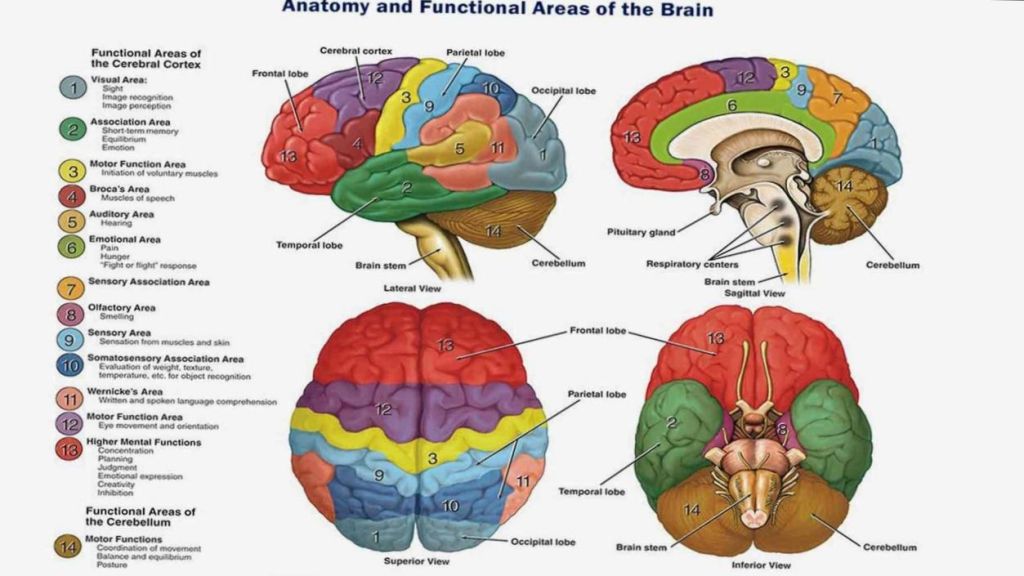
While I’m interested in the brain, and it’s a subject that is touched on in my newsletter about Episodic Future Thinking, I do not have a technical background in medicine, neuroscience, or neuroanatomy. Therefore, I do feel not unduly hesitant to continue “talking about the brain.” Googling does not an expert make.
What I do want to talk about, and what I feel perfectly qualified to talk about, is the journey to reclaiming my own mental power, and what I’ve learned along the way.
Like many people, at some point in my life I realized that I didn’t feel as mentally sharp as I used to. That my mind wasn’t filled with exciting thoughts. That I couldn’t remember the name of the last book I’d read, and that even reading silly articles shared to Facebook felt like a chore. I remember seeing large blocks of text and glazing over, just like some people must feel when they stand at the bottom of a long flight of stairs – I can’t do this.
I’m happy to say that I’ve remedied this. I took my mind back, so to speak, and I use it every day to enrich my life.
- Whether it’s reading challenging books,
- Researching, planning and writing newsletters,
- Reading sheet music and learning new music,
- Writing music,
- Improvising guitar solos with my band,
- Or listening to music analytically,
I put my mind to work every day. The more I do the sorts of things I listed above, the happier I am. Not just that, the sharper my mind becomes, and the greater the variety of ideas I consume and consider and digest, the more reasonable I become.
I listen better.
I speak more fluidly in conversation.
I consider opposing opinions and different sorts of people more easily.
I have a better attitude about work,
a better attitude about resolving disagreements or addressing complaints,
and I generally think that I’ve become a better person the more I’ve invested in my mental and intellectual fitness.
According to Britannica.com, intelligence is defined as “the mental quality that consists of the abilities to learn from experience, adapt to new situations, understand and handle abstract concepts, and use knowledge to control an environment.”
So, you don’t have to share my idiosyncrasies or niche interests to put a value on your brain power. I mostly listed off my own because I knew it would make you think of your own preferences in contrast or congruence to mine. Your preferences, your ways of thinking, are what I want you to be thinking about here: think of all the reasons you cherish the incredible gift that is your mind.
Because it is a terrible thing to waste, and, indeed, it is terrible to lose it, I want to share the practical Thou Shalts and Thou Shalt Nots of mental acuity.
What are the habits and lifestyle choices that keep your mind right beside you like a faithful servant? What are the things that degrade and vitiate it, that you really need to stop doing?
Let’s start with the helpers.
STEP ONE: THOU SHALT
DIET
A “Mediterranean Diet” is considered to be neuroprotective. Fruits, vegetables, nuts, olives, and fish.
I’ve gradually moved more toward this diet over time, although I eat more steak than fish. The foolproof rule to follow is to eat single ingredient foods.
Today, for example, I ate a salad with Swiss Chard, red butter lettuce, grated carrots, and a simple dressing of olive oil, apple cider vinegar, sea salt, and lemon juice. Then I had a burger seared in an air fryer. I’ll have an apple, an orange, and a banana after that, and then another protein dense meal (let’s be honest – it’ll be another burger, cooked “war crime rare”), and that’s it. That’s all the food I’ll eat today. Two meals, with some fruit in between. Zero snacking.
I also use things like ginger, turmeric, black pepper, ground cumin and coriander, all the chai spices (cardamom, cinnamon, nutmeg, clove), and raw honey as well.
I eat a lot of food every day. I get plenty of protein, fat, carbohydrates, and micronutrients. I never really feel hungry in an unpleasant way, but I never feel uncomfortably full either. I don’t feel bloated, sluggish, or, god forbid, brain fog. I feel clear headed after I eat. I’m writing this newsletter right after finishing a meal, and that’s because of what I eat and how I eat it.
If you tailor this to your specific tastes, you’ll feel wonderful. I do, all day long.
Quick caveat: I’m not even touching the domain of supplements, herbs, or nootropics in this article. It’s a standalone subject that requires its own newsletter. For the time being, it should suffice to say that eating clean, whole foods, plenty of animal proteins and fats, and good carbohydrates from fresh fruits and vegetables is a, pardon the pun, no brainer.
EXERCISE
Both cardiovascular exercise and strength training play an important role in your mental well-being.
Think of yourself as the thing you really are: an aggregate of various systems that ultimately make up an organism called a human.
A human is, at bottom, a primate that is tasked with surviving and thriving in its environment.
Physical activity tells your brain that your body is laboring to survive. Supply and demand, my friends: voluntary exercise levies demands, and your brain responds with the supply.
The supply of what? Of energy, alertness, and the availability of memory, vocabulary, and whatever other behavioral tools you will need. The law of the body is use it or lose it.
SLEEP
When you sleep properly on a nightly basis, you live in a heaven of your own making. I discuss the ideal nightly routine and how to optimize your sleep in a previous newsletter. Right now, I simply want to impress upon you the ways in which respecting your body’s need for sleep will reward your brain.
According to Kathleen Digre, MD, in a June 2023 article for The University of Utah, sleep helps with five distinct areas of brain health:
- Restoration and repair
- Memory consolidation
- Cognitive performance
- Brain development
- Emotional regulation
Read her whole article, which I’ve linked above, for a deeper understanding.
Now, whenever I talk about sleep, I invariably receive pushback in the form of I don’t have time. Let me address that with a bit of an aphorism:
You can have anything, but not everything.
Time is finite, but sacrificing sleep only sacrifices your quality of life, and should only be done out of real necessity. For most people, it happens because they don’t know how to end a day.
I can’t spend all evening writing, working out cool ideas on my guitar, reading about art history, catching up with a friend over the phone, watching a movie on Netflix, and tidying up at home.
I have to make choices.
I have to say yes to something and no, not to something else, but to everything else. For every one activity I’m doing at a time, I am abstaining from every other possible activity at that moment.
By the time I have died I will have done what I’ve done, and will have not done vastly more. I can’t read every book I want to read. I can’t write every song I want to write, I can only have so many conversations with the people I care about.
Life is about making room for YES by first saying NO. See the NO as a creative act, as the primer that goes on before the paint. The paint of YES.
ACTIVITIES
There are some hobbies that do wonders for your mind. Things like
- Chess
- Learning a musical instrument
- Dancing
- Puzzles
- Developing a new or existing skill
- Meditation and breathwork
- Eating unfamiliar foods
All aid in the development, and slow the aging of your brain. Other activities include brushing your teeth with your non-dominant hand, alternating between reading aloud and being read to (this requires a partner), adding up loose change in your pocket by feel alone, and rearranging or even inverting household objects. Read more about “neurobics” in this medically reviewed article by Laurence C Katz and Manning Rubin for thehealthy.com
BILINGUALISM
Lastly, speaking more than one language, or bilingualism, has been widely studied in the context of its positive effects on the brain.
According to a 2012 article for Trends Cogn Sci by Ellen Bialystok, Fergus I.M. Craik, and Gigi Luk, bilingualism aids brain development in children, and delays the onset of neurodegenerative illnesses like dementia in older people. Bilingual people perform better at both verbal and non verbal tasks, and studies suggest that the ability to suppress one language in the act of selecting another boosts their agility to discriminate between essential and nonessential information and stimuli. Read the whole article right here.
Simply put, start learning a foreign language. If you already know one, use it more often. Write, converse, journal, read, watch movies, and listen to music in another language. Is this easier said than done? Of course. But make it fun. You are sure to expand your horizons by doing this, which avails you of another brain-benefitting activity, forming new social connections.
PART TWO: THOU SHALT NOT
Now that I’ve given you a number of ways to be kind to your brain, here are some quick reminders for things to minimize or eliminate. I’ll keep this brief, as most of these are common sense.
AVOID PROCESSED FOODS
If your food has fine print, just say no. According to the Harvard School of Public Health, “people who eat diets high in ultra-processed foods, such as packaged cereals, frozen meals, and sweets, may have a higher chance of feeling depressed and anxious than those who eat fewer of these foods—and they may also have an increased risk of cognitive decline.”
The same goes for alcohol, drugs, and cigarettes. Usually I would mount more of an argument here, but I’ll keep it simple and say you know perfectly well that these things are bad for you. You know they make you feel bad, and think poorly, and that your life would be better without them. Why should I spend time convincing you of what you already know?
A perennial theme of writing, of my philosophy, is to obey your own conscience. The body of these articles is nothing more than elaborations on that sole commandment.
MINIMIZE SCREEN TIME.
I think we can agree that smartphones and social media are double edged swords. They’ve forever changed the way we learn, communicate, connect with others, and develop subcultures. They are also uniquely detrimental to emotional and psychological health. Social media use has been compared to gambling and drug use with respect to its effects on the brain (read the study here). Here is a chart from Michael Sandberg’s Data Visualization Blog
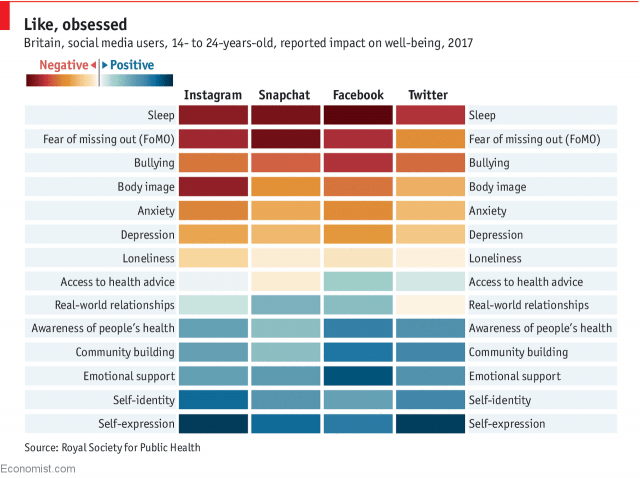
Social media makes you crazy.
In an interview with Michael Rich, MD, and director of the Center for Media and Child Health at Boston’s Children’s Hospital, Debra Bradley Ruder writes:
“The growing human brain is constantly building neural connections while pruning away less-used ones, and digital media use plays an active role in that process. Much of what happens on screen provides ‘impoverished’ stimulation of the developing brain compared to reality.”
The article goes on to discuss the effects of blue lights from screens on sleep quality, and the deteriorating effects of social media use on the reward centers in the brain and impulse control.
Author and associate professor of Computer Science at Georgetown University, Cal Newport, has said repeatedly in interviews and podcasts that, unless you use social media for your job, you should delete it altogether. And, if you use it for work, you should remove it from your phone. He speaks of social media on your phone the way most of us think about smoking cigarettes: an indefensibly bad habit. Listen to him discuss social media here.
IN CONCLUSION
The path to a lighter, stronger, happier mind is one laid with life affirming choices.
Say yes to eating well. To sleeping 7-8 hours a night, every night. Say yes to being active, to learning new things, doing familiar things in new ways, changing up your routines and your environments. Say yes to exploring another language, and the entire world that opens up to you. Essentially, say yes to a life of both exciting challenges and self care.
And also, say no. Say no to bad food. No to bad sleep. To smartphone and social media addiction. Use screens for learning, and for focused periods of entertainment, but not as a way to avoid boredom. Let your mind wander, and don’t feed it non-stop digital junk food.
The good news about the road to a healthier brain is that the journey is the destination, the same way that running itself confers the benefit, not the crossing of the finish line.
That’s all for now. Take care of yourselves.
Thanks for reading, talk to you soon.
-Jas
 Make Beautiful Choices