Welcome back.
Earlier yesterday morning I finished reading one of the crowning achievements of western literature, The Tragedy of Faust, written by the German polymath Johan Wolfgang von Goethe between 1730 and 1790.
In today’s article, I’m going to give a brief overview of Goethe as a literary and cultural figure, provide a very general outline of the plot, summarize what the play has to say about the nature of good, evil, and redemption, and conclude with some reflections of my own.
Goethe (pronounced, more or less, Gur-ta) was German novelist, playwright, poet, scientist, critic, statesman, and even theater director.
His career is, therefore, beyond synopsis and not reducible to a single work, or even a single genre of writing. In every area of intellectual life Goethe touched, he is considered a master, and, in some cases, unsurpassed.
His influence on the German language and on the trajectory of the western literary world is hard for an anglophone reader to comprehend or relate to.
Perhaps, if Shakespeare, Charles Darwin, and Mark Twain were combined into one person, this might approximate the stature of Johann Wolfgang von Goethe.
For these reasons, his tragic play Faust holds special significance. It is a life-spanning work, begun early in his life and concluded near its end.
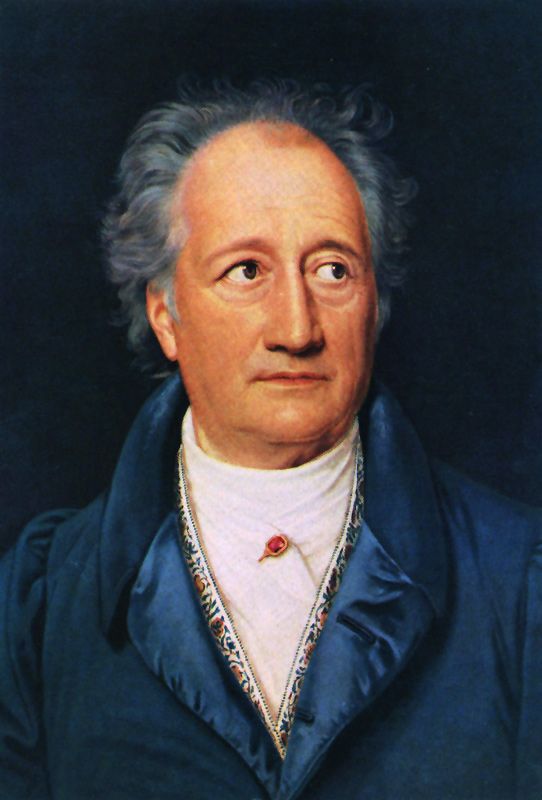
The protagonist, Heinrich Faust, is clearly a representation of Goethe in many ways: a doctor and a scholar, whose studies and achievements have led him to the pinnacle of the European model of enlightenment, has nothing left to conquer.
Alone in his study, his quest for knowledge has alienated him from the world: not only has he not found happiness, fulfillment, or love, but he can think of nowhere else to look. He is experiencing, in the words of the poet Wallace Stevens, “the barrenness of the fertile thing that can achieve no more.”
He has followed the enterprise of truth seeking, as he understands it, to a dead end.
Late into the night, he thinks to turn to occultism. He opens a book of runes and symbols, eventually deciding to summon the Earth Spirit.
Faust may be an impressive scholar, even an authority, but he is out of his depth when the Earth Spirit materializes: he jumps with fright and cowers from it, embarrassing himself and drawing the ire of the apparition who is taken aback and disappointed by Faust’s temerity. He departs, leaving the would-be wizard dejected.
This is Faust’s lowest point: he is in fact contemplating suicide, seeing that he can no more be satisfied with academic knowledge than he can stomach the path of occult knowledge. He has nothing left.
At the last moment, however, he is interrupted by his servant, Wagner. They briefly converse, and his despair is not so much assuaged as it is dissipated. They decide to take a stroll through the town, now that the sun has risen.
It is here that the real plot of the play begins: a black dog approaches them, follows them home, back to Faust’s study, and then reveals his true identity: Mephistopheles, the devil. Or, as he describes himself, “the spirit that negates.”
After some back and forth, the world-weary and disaffected Faust sees in Mephistopheles an opportunity, and strikes a bargain with him: grant my every desire, always at my beck and call, until the moment I say “abide moment, thou art so fair.”
Faust is going to exploit the supernatural powers of Mephistopheles in one final attempt to find that which has eluded him all this time: that magical something that will finally quell his desire for more. If Mephistopheles can satisfy Faust, Faust’s soul belongs to Mephistopheles for eternity: the archetypal Faustian bargain.
The adventures that follow are humorous, grotesque, macabre, and also heartbreaking. He encounters a simple but virtuous peasant woman, Gretchen, with whom he becomes infatuated. Enlisting the dark powers of Mephistopheles, he eventually creates the necessary conditions to seduce her, and they have sex.
Because Faust is searching for the be all and end all of experience itself, however, he is not and cannot be satisfied with this, and abandons her to pursue other strange and dark phenomena with his enabling companion.
When he misses Gretchen and decides to visit her again, however, he finds that she has gone mad, and is awaiting execution. We learn that her encounter with Faust has irreparably destroyed her family, her sanity, and her life.
The sleeping potion that Faust gave to Gretchen’s mother to ensure that she wouldn’t wake up while they were having sex proved fatal.
The man that learned of their illicit rendezvous and died in a duel with Faust in an attempt to defend her honor was her own brother, Valentine.
Gretchen became pregnant with Faust’s baby and, both abandoned by him and left without any family on his account, drowned the baby and went mad. For the crime of infanticide, she is to be put to death.
While Faust is overcome with grief by what has happened to Gretchen, he does not truly love her, and is not prepared to sacrifice anything for her. He cannot save her conscience, but he tries to get her to escape the jail with him (made possible by the help of Mephistopheles). But for Gretchen, it is all over: she cannot live with what has happened, what she has done, and with the total loss of her own innocence and virtue. She stays, and dies. Faust leaves, to continue his quest.
This concludes part 1 of the tragedy. Part 2, heavily abridged in the Walter Kaufmann translation I read, concerns Faust and Mephistopheles traveling through time and to distant regions of the world, interacting with mythological and historical figures.
The play concludes with Faust, now a very old man, with the tragedy of Gretchen far behind him, now engaged in an ambitious project of land development, essentially taking on the work of civilization itself: conquering nature for the sake of human flourishing.
One elderly couple stands in his way, refusing to give up their estate to make room for his designs. He enlists Mephistopheles’ help, but his demonic companion goes too far and burns down their vineyard, killing the old couple.
For the first time, Faust expresses remorse, and is soon thereafter visited by the spirits of Want, Care, Guilt, and Distress. Care alone can reach him, and she immediately takes his eyesight from him.
It is here that Faust undergoes a sudden change: unable to see the results of his actions, he begins to direct the actions of others, not to the fulfillment of his desires, but towards what he intuitively knows to be “right” in a higher sense.
Essentially, he directs the men at his disposal to work at the limits of their ability, even the limits of their safety, in the service of work that is both beneficial and never ending. In the knowledge that men would undertake this task, at his behest, he says at last, verweile doch, du bist so schön! Abide, thou art so fair.
Faust then dies, and, before he can be taken away to hell, the sky opens and the angels remove him to heaven, where his spirit is reunited with the heavenly spirit of Gretchen.
Faust dies a reformed, enlightened man who has attained the true meaning of human life, and has exercised his accumulated power to pass it along. In so doing, his soul is redeemed, and the devil is cheated of his due.
And so the play is concluded.

Analysis
What does Faust get wrong? How does his path lead him from error to enlightenment? In what way does his ultimate realization excuse or redeem his previous errors?
Let’s start with the first glaring error: Faust is mistaken about both the nature of truth seeking and meaning.
Faust sees truth as a thing you can acquire. A commodity or currency that he stockpiles through taking on and mastering various fields of study. This is an incorrect path to truth, and I will now explain why.
The idea of seeking truth, as we understand it, could be said to begin with Socrates. There were pre-Socratic philosophers in ancient Greece, but they did not give us methods, only specific ideas – some of them still inspire us today, most are antiquated, but none of them can be called a system of thinking.
What Socrates gave us was a method by which we could inoculate ourselves against falsehood. A method of probing into facile statements that served a kind of scalpel of logic: whatever is unclear, shallow, or contradictory is cut away by the process of inquiry.
For Socrates, truth is whatever remains after untruth has been carved away by inquiry: resistant to paraphrase, summary, or sloganeering, the truth is subtle and dignified. It is not a possession.
The purpose of pursuing truth, from a Socratic standpoint, is to purge oneself of falsehoods, to say and do nothing that you know, deep down, to be flimsy, expedient, or manipulative.
This is not what Faust has done. Faust has lived his life like a kind of academic imperialist – going from one field of study to another in the hope that his lust for conquest will one day be sated.
In other words, what he is really seeking is technical mastery. Expertise. It is fundamentally acquisitive: something is missing in his life, and he believes that once he reaches a certain threshold, or perhaps unlocks one specific secret, that he will finally be at peace.
Why is this the correct understanding of Faust? Because of the terms of his agreement with Mephistopheles. He is willing to pay the ultimate price, the eternal fate of his soul, in exchange for the one experience that will make him say “abide! Thou art so fair!”
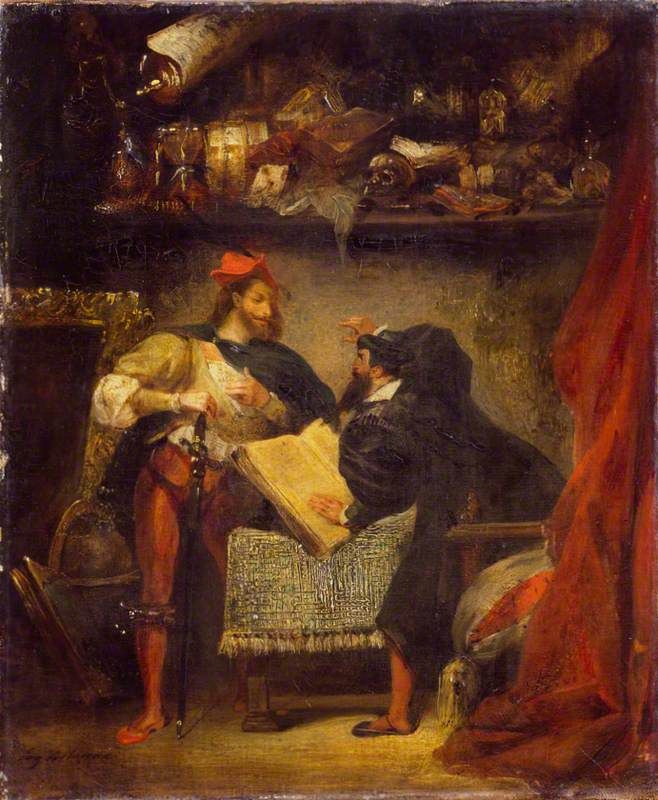
It should be said that Faust is intellectually arrogant. He believes himself to be above his fellow man, and believes the world to be incapable of offering him anything up to his standards.
Mephistopheles frequently mocks him for this, and we see that away that the promise of instant and total wish fulfillment is instantly and totally corrupting for Faust: he becomes so infatuated with Gretchen that he begins bossing around Mephistopheles in a way that almost elicits sympathy from the reader.
This poor little devil, made to do the bidding of this petulant and impetuous man, who has lost all sense of proportion of over the prospect of, pardon me, getting laid, and who senselessly lavishes a modest peasant girl with entire treasure chests of gold and jewelry, on a scale that brings her more embarrassment, suspicion, and social alienation than delight.
And, why is Faust so obsessed with Gretchen to begin with? Because Gretchen is good, simple, and pure. She has substance, but is not learned or sophisticated. She has a simple way of life, working with her hands and caring for immediate family.
She has what he lacks: dutiful, honest work and human connection based on love and mutual interdependence. She has a real life and real relationships.
An already enlightened Faust would have met Gretchen recognized this. Would have committed himself to her and gone through the necessary steps of winning her over, and winning the approval of her family.
But Faust wants to have her, not commit himself to her. This is the entirety of the difference between Faust and Gretchen: she has commitments, he has conquests.
If we are to learn anything from what happens to Gretchen, from her sorrow and madness at having been reduced to a vehicle for sexual experience while being left to deal with the real consequences of that – her brother dying in an attempt to vindicate her honor, her mother dying from a sleeping potion, her pregnancy and subsequent act of infanticide, and all of this happening without Faust by her side – it is that the promise of effortless wish fulfillment leads to tragedy and disaster.
What is it that ultimately redeems Faust?
Let’s hear it in his own words:
This is the highest wisdom that I own,
The best that mankind ever knew:
Freedom and life are earned by those alone
Who conquer them each day anew.
Surrounded by such danger, each one thrives,
Childhood, manhood, and age lead active lives.
At such a throng I would fain stare,
With free men on free ground their freedom share.
Then, to the moment I might say:
Abide, you are so fair!
The traces of my earthly day
No aeons can impair.
As I presage a happiness so high,
I now enjoy the highest moment.
Let’s break down what this isn’t. He doesn’t find faith. He doesn’t commit himself to a woman. He doesn’t find meaning, necessarily, in charity or “selfless service” either.
What he finds is a categorical change in where meaning is sought, rather than in what. There is no longer any what at all, but a how. Not in acquisition, not in knowledge, not in experiences, not even in the nature of the rewards or consequences.
Redemption is found in the process of giving the moment one’s all, one’s total effort, with nothing held back. “Surrounded by such danger, each one thrives.” Real activity, with real stakes. Work that must be renewed daily. The opposite of accumulation, and, actually, the opposite of achievement in the way we think of it.
Faust comes to understand that no single experience or achievement or acquisition relieves the need for daily exertion toward worthy ends: his error, all along, was the belief that there is such a thing as satisfaction, cessation, or arrest.
Oddly enough, his final understanding is an echo of one of his musings early in the play:
It says: “In the beginning was the Word.”
Already I am stopped. It seems absurd.
The Word does not deserve the highest prize,
I must translate it otherwise
If I am well inspired and not blind.
It says: In the beginning was the Mind.
Ponder that first line, wait and see,
Lest you should write too hastily.
Is mind the all-creating source?
It ought to say: In the beginning there was Force.
Yet something warns me as I grasp the pen,
That my translation must be changed again.
The spirit helps me. Now it is exact.
I write: In the beginning was the Act.
Faust speaks these lines moments before the black dog reveals itself to be Mephistopheles, reinforcing the blasphemous nature of the statement. What Faust’s final speech makes clear is that his emphasis on action was right all along, but not the spirit in which it was undertaken.
The deluded Faust of this early monologue dreams of the power to hold dominion over his world, but the enlightened Faust sees that only in the performance of the action is redemption to be found.
This realization stands outside of any commentary on what one should do, and toward what ends. It leaves the question of ends off the table altogether. And, it must be so: Faust has gone to the ends of the earth, backwards and forwards through time, in search of what, and has found nothing. Nothing real, nothing final.
What he finds is not quite the act, in the sense of cause and effect, in the sense of agency and mastery, but action itself: primal, atemporal, total, immersive, vigorous.
It can be said that this understanding is redemptive because it leaves no room for the corruption of one’s motives, because there is no motive. There is no reward. The total immersion in the action itself is the reward:
Freedom and life are earned by those alone
Who conquer them each day anew.
Thank you for reading, talk to you soon.
-Jas
PS – I explore ideas like this because it brings my life into alignment with my ideals. My inner picture of who I am and how I want to live in the world.
I share my thoughts publicly because I want to encourage others to do the same: to make the necessary changes that will bring the outer into harmony with the inner. This is happiness, self respect, and purpose.
To that end, I also create short form content on X/Twitter dealing with psychology of self development, and I’ve recently created a free 5 day educational email course on the same topic, “Self Development Cheat Codes.”
It goes over the 5 biggest mistakes people make when they decide they want to get their lives together, and I provide 15 specific frameworks to guide people along their journey. If you’d like to have more of a concrete method at your disposal, get the free materials here.
Thanks again.


 Make Beautiful Choices