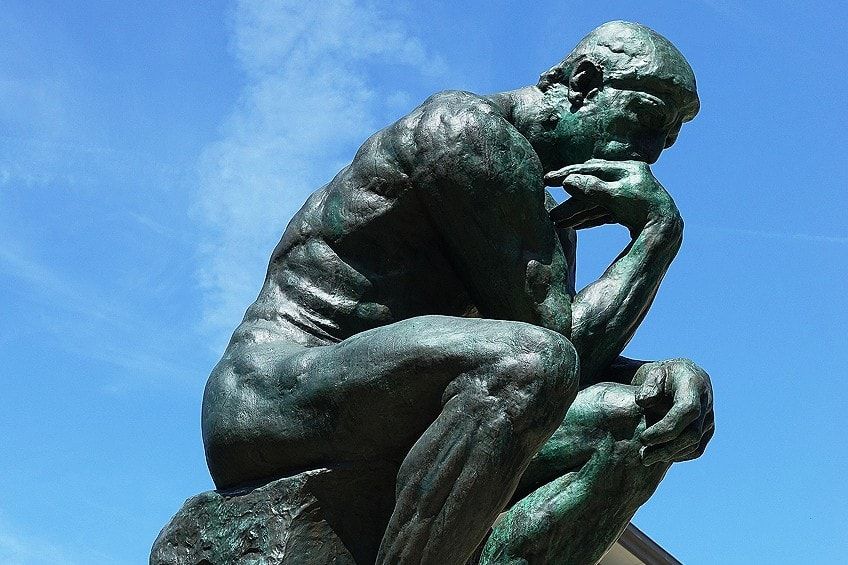
Today I’d like to start by expanding on a theme that came up in last week’s discussion of Faust: you don’t possess capital T truth as much as you divest yourself of expedient lies.
For context, Socrates used to refer to a little voice within himself (dæmon in Greek) that would object when he was about to say something dishonest, facile, or otherwise playing to emotion but lacking in rational substance. We call Socrates wise, and he was, because he obeyed this voice consistently.
What always struck me as the most notable quality of Socrates is the lack of an intuitive sense of rightness: the best he got was an absence of wrongness. No green lights, but either red lights or no lights at all, so to speak.
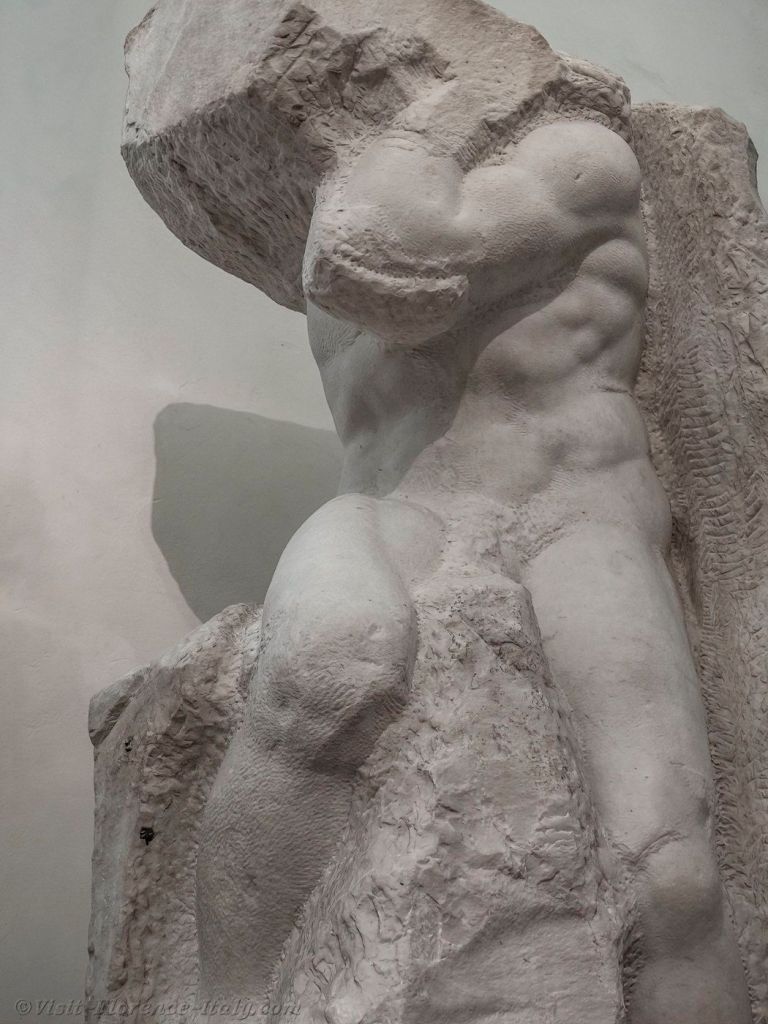
There is a parallel to this in Michelangelo’s statement that he removed everything that was not David, or Thomas Edison saying that he didn’t fail 10,000 times but rather found 10,000 ways that didn’t work.
The right way is there, and no matter how much marble you remove or methods you have to discard along the way, the one right way just happens to be the one that doesn’t feel wrong.
What you don’t do is invent it. You don’t invent it because you can’t invent its rightness, its efficacy, or its perfect proportionality: that feeling of yes, this is it (the actual lightbulb turning on) is discovered, not created. If it were created, you could have created a “wrong way” that worked, because you would have created a thing that also possessed the feature of “working.”
We all know this is not what happens: why else would it take Edison 10,000 iterations, or Socrates a few moments of reflection, or Michelangelo however many blows of the chisel: we cannot make untrue things true.
What I’ve just done is laid the groundwork to discuss the first chapter of the Tao Te Ching. The book of the way.
I look at the Tao Te Ching as the most effective means by which people can disabuse themselves of wrongheaded ideas, and, specifically, inoculate themselves against ideology. To stop reducing the world and everything in it to dogmas, doctrines, memes, avatars, slogans, and statistics, and start actually seeing the world as the world.
The world is already here, but unlike Michelangelo’s David, it is not latently present in rock and awaiting its liberation by our hands.
Unlike Edison’s lightbulb, we don’t need to go through 10,000 ways that don’t work before we can find the one real world.
It is actually something closer to Socrates: he didn’t say things he knew to be untrue, and we must stop believing in things that we know to be make believe.
The world is what you have left, what you always already have, when you stop ignoring it in favor of make believe.
This will all make a lot more sense after we’ve gone through the entirety of chapter 1 one idea at a time, which starts now.
The Tao that can be told is not the eternal Tao.
The name that can be named is not the eternal name.
The nameless is the beginning of heaven and Earth.
The named is the mother of the ten thousand things.
Ever desireless, one can see the mystery.
Ever desiring, one sees the manifestations.
These two spring from the same source but differ in name; this appears as darkness.
Darkness within darkness.
The gate to all mystery.
Analysis:
The Tao that can be told is not the eternal Tao.
The name that can be named is not the eternal name.
To just say the tired cliche once so we can move on: the Tao is beyond words.
What does it mean, then, to start a book with that statement?
There is already an invitation to think, and I can promise you that it goes farther than thinking about the ineffability of some great profound truth. That by itself, while it might feel grandiose or inspiring depending on your temperament, does nothing for you in practice.
What it asks you to consider is that what you are about to read is a book about the Tao. The book itself is not the Tao, the same way a book about apples isn’t an apple and can’t be eaten or planted or used to make pastries.
A book about apples, to someone who has eaten, or farmed, or baked with apples, however, would be quite interesting and valuable in its own way.
Words are words, and things are things. For words to really make sense, and not lead us astray, they must refer back to real things. They must illuminate them in some way, either through analysis, parable, or even something more poetic and abstract.
What words do not do is alter reality. Words are the map, but the world is the real unalterable thing we are trying to map with our words.
The nameless is the beginning of heaven and earth.
The named is the mother of the ten thousand things.
Here are two “terms of art” used throughout the text: “heaven and earth” refers to the greater backdrop of nature itself (mountains, the sky, oceans, the elements in general, the world in an inert sense), and “the ten thousand things” refers to the humdrum of activity, the bustling and coming and going of life, human society, the dynamic and demanding perpetual motion of the world.
The above lines are more here for clarification of terms and establishing, pardon me, a proprietary lexicon, rather than make a specific point.
If something is being said here, it is simply that language exists to help us navigate our world, and would be irrelevant and non-existent were we to be without the need to live and move about in it.
Again, words are not real in an absolute sense, but are perspectival in nature.
Ever desireless, one can see the mystery.
Ever desiring, one sees the manifestations.
To continue with the theme of perspectivalism, the world looks the way it looks because of the things you want from it. When you’re in the mall and you’re trying to find Zara the other signs only have the meaning of “not Zara.” When you need to find the bathroom the blue and white rectangular sign with the slacks or the dress is the only symbol you see – the rest vanishes.
If our perceptions reflect our motivations, our physiology, our abilities, our societies, our threats and fears, how much does our language reflect those perceptions?
Language describes reality in a way that advances a particular agenda: it is a function of the desires we are actively working to fulfill.
If our desires were as simple as someone trying to find Zara or the bathroom, our language would be that simple (and when that’s truly all that’s at stake, our language is indeed simple).
Consider that people’s agendas are often quite a bit more complex than this, however.
People conceal things from themselves and others, and advance a specific version of themselves through social conditioning,
manners,
self image,
aspirations,
regrets,
the intent to appear
sexually available or unavailable,
interested or uninterested,
in agreement or disagreement,
confused or comprehending,
cooperative or hostile.
What people see in front of their faces has every bit as much to do with what they have or haven’t learned from the past and where they believe they’ll be in the future. What people see before them and what they do and don’t want from it is conditioned by time constraints, mood, social standing, relative familiarity with whatever is around them, and the history of their relationships with whatever they’re interacting with.
This is but the quickest and crudest of hints at what people have going on beneath the surface.
A person is like Omega Centauri: a globular cluster of thousands upon thousands of stars that looks like a single, unified star to the naked eye.
If the appearance of the world varies based on our varying desires, then there are as many worlds as there are people in it.
Well, not as many worlds, but as many maps of the world. Maps tell you how to get from one place to another, but the world itself doesn’t tell you anything.
Change your desires, and the manifestations change. The map of the world changes.
Am I saying that there is such a thing as living entirely in the world, without any reference to the abstraction of a map (a picture of the world made of concepts)?
There may or may not be, but I can tell you that every description of such a life, every church or workshop or online course or YouTube channel or tweet or cult leader or infographic or alien artifact telling you how to achieve it and why would be nothing more than another map.
The Tao that can be told is not the eternal Tao. Whatever it is you’re saying, it is about the Tao, but does not in itself constitute the Tao.
These two spring from the same source but differ in name; this appears as darkness.
Darkness within darkness.
The gate to all mystery.
Lao Tzu is saying, to stick with my verbal device, that both the map and the terrain “come from the same source, but differ in name.” He then goes on to say that such a thing is confusing and mysterious. Well, I’ll say.
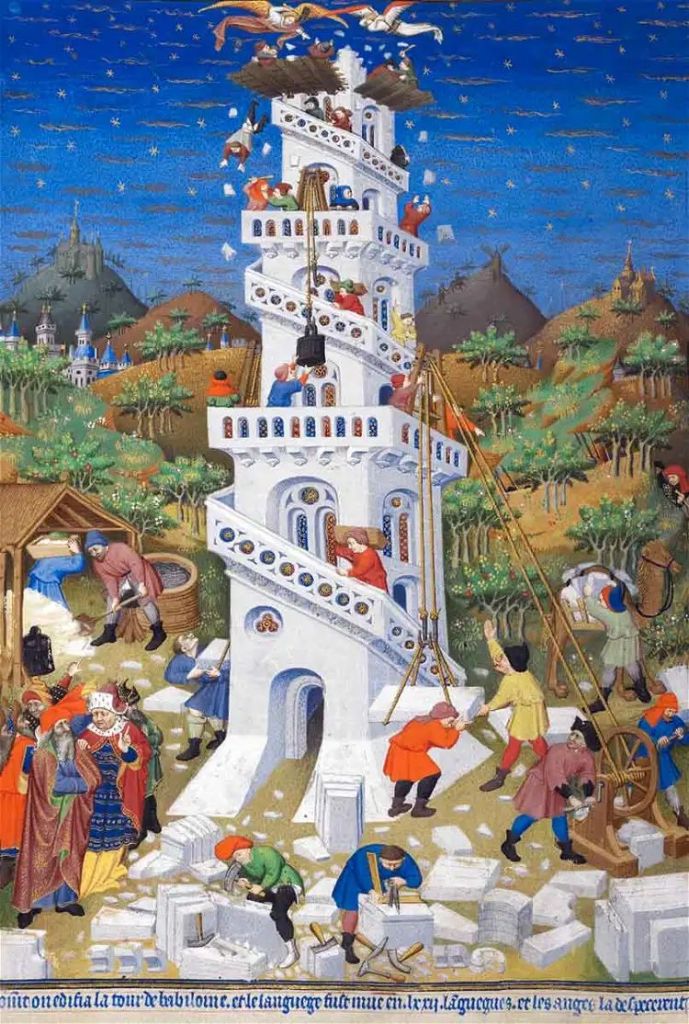
But we can neither claim a full understanding nor be content with our incomprehension: we must strain to grasp the just out of reach knowledge, and not “revel in ignorance as a maggot revels in pus” (thank you, Swami Venkatesananda, for that blinding gem of invective).
The terrain includes you, with your private map. It is a fact that you imagine the world as you do. Your imaginings may be illusions, but there is also the concrete fact that you operate under their sway. That you believe them is a concrete fact, that you act within the framework they create is a fact, and the consequences of those actions are also facts. How could it be otherwise? And so, the dream comes to life. The sleep walking man, whatever he sees in the dream, walks over to a real toilet or refrigerator or staircase or whatever.
And in this way, illusions are real. Both true and untrue, both ephemeral and concrete.
Unless you are willing to say that all illusions,
all delusions,
all forms of make believe,
all beliefs,
some noble and some nihilistic,
murderous and saintly,
are interchangeable solely because they share the quality of perspectival relativism,
then you must admit, at least provisionally,
that they have an unconditional reality to them in one respect: they are specific perspectives.
The line between the two, between mystery and manifestation, conditional and unconditional reality, objective and subjective, is therefore, at some level, not as distinct as we would have it.
These two spring from the same source, but differ in name: truth and illusion differ in name only.
He says it: this is the gate to all mystery, darkness within darkness. If you say you get it, you are lying. If you say you have no idea what he means, you aren’t even trying.
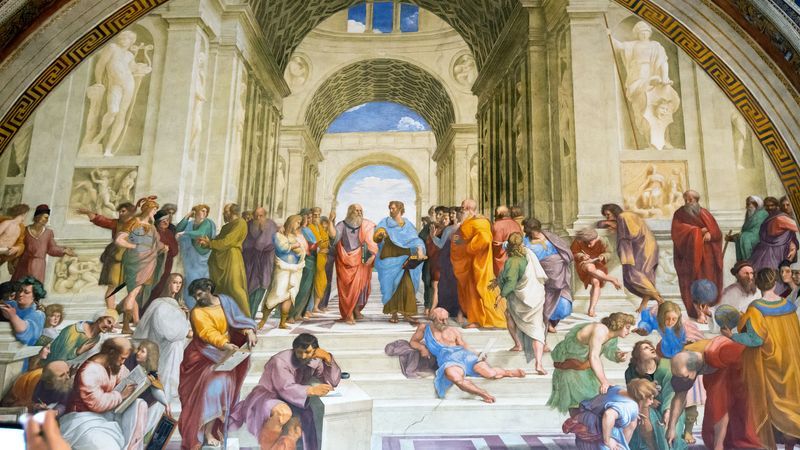
In conclusion, what do we do with the ideas we have just been occupying ourselves with? What is their value? I contend to you that their value is Socratic: they make the inner voice a bit louder and clearer when it seeks to stop us from capitulating to expedient falsehoods. We can temper our inescapable participation in perspectival relativism, in private illusions. In recognizing that illusion is the one universal currency we all traffic in, we can become a bit less bewitched by our own and a bit more interested in another’s.
Not for the sake of being persuaded, co-opted, intimidated or seduced, but for the sake of sanity. For the sake of avoiding a war between competing illusions, and for aiming at what is real and shared rather than what is private and illusory.
Society, civilization, culture – these are shared maps. Shared ways of organizing the world that factor in the realities we can’t escape and the illusions that comfort us in ways the bare terrain simply doesn’t (if you doubt this, show me one group of people who doesn’t participate in invented meaning).
The ever present danger that people pose to one another is the co-opting of public tools by private agendas.
We create something held together by abstractions, which is culture, so our personal impulses can be restrained and sublimated toward an idea of the greater good.
But because those abstractions are just that, abstractions, individuals can put pressure on them in all kinds of ways so that they change into a reflection of their own desires – not inherently a bad thing, but the devil’s in the details: we want more culture, more advancements in quality of life, higher standards of literacy, fitness, purposeful industriousness, research, and so on. What we don’t want, what no decent person wants, is for these collective word games to devolve into ideology.
Ideology is the brutish half wit cousin of culture, of thought. Culture makes life livable, makes life’s mysteries approachable from countless directions and thereby provides outlets and purpose to all temperaments and talents – ideology shrinks life into trite slogans and shuts off the noble impulse toward knowledge and self actualization that defines culture at its best.
Ideology shuts off thinking and drives base instincts toward exploitative ends, all while invoking principles, compassion, empathy, and tolerance. It only unites one group so that they might be mobilized against another.
It speaks the language of guilt, justice, resistance, restoration, oppression, victimhood – never of challenge, achievement, discipline, sacrifice, individual cultivation, skill, or wisdom. It parasitizes culture while animating us with the spirit of barbarism.
It can only be practiced collectively, never privately. Culture, in the sense that it is the opposite of ideology, is a system that creates personal enrichment through collective cooperation.
From one human to another: always be mindful of this difference.
The enduring value, for me, in my life, of remembering that the Tao that can be told is not the eternal Tao, and that mystery and manifestation spring from the same source, is humility. Humility. Stupid, doltish, boorish ideology is what awaits every slob who believes he is gorging himself on the truth, like a pig burying its face in a trough of slop.
Believing that you know, that you own the real and are here to spread it, to lease it at a premium, to bestow it upon the great unwashed masses, is the path over the edge of the cliff, admiring your elegant map all the way down.
A sage bows before reality, no matter how dimly or partially he sees it. And in so doing, saves himself and others from harm. From all the harm that could have been prevented with just a bit more wisdom and a bit less falsehood.
Thank you for reading, talk to you soon
Jas

 Make Beautiful Choices